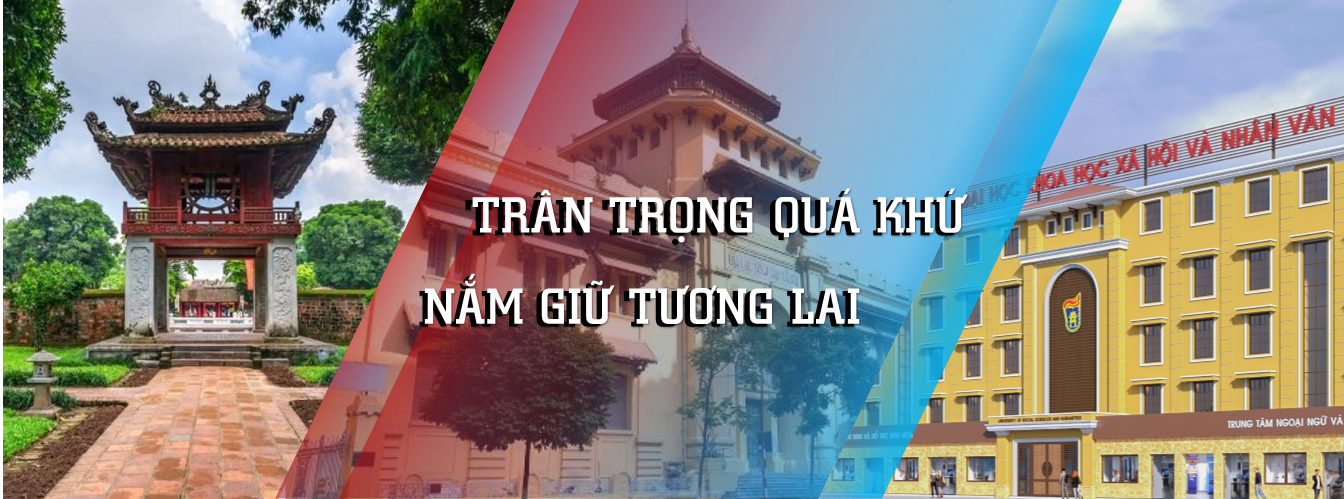
The University of Social Sciences and Humanities (USSH), Vietnam National University, Hanoi (VNU), holds the mission of leading the training of high-quality, highly skilled human resources; researching, creating, and disseminating knowledge in the social sciences and humanities to serve national construction, defense, and international integration.
Pioneering – Innovative – High Quality – High Proficiency
Leveraging its strengths as a university specializing in basic sciences, USSH aims to develop into a multidisciplinary and interdisciplinary research university with a team of leading experts. The University will develop pioneering training programs that play a core role in the country's basic science training and research, reaching regional and international standards, and ranking among the top 100 universities in Asia and the top 500 globally.
To develop the University of Social Sciences and Humanities into a research-oriented university, affirming its leading position in social sciences and humanities research and training in Vietnam. The University strives to rank among the top 150 universities in Asia by 2025, the top 100 in Asia by 2035, and to be on par with advanced universities worldwide (top 500).
A. Training high-quality, highly skilled human resources to serve industrialization, modernization, and international integration.
Create favorable conditions to unleash creative potential, critical thinking, and entrepreneurial spirit; build an open, friendly, and cohesive academic environment so that intellectuals, learners, and society can participate in the University's development and contribute to building a learning society[1].
Each academic year, faculties, departments, centers, and research institutes shall invite at least one expert from a prestigious foreign university to teach and exchange scientific knowledge, with the number of invited international experts increasing in subsequent years.
Implement and refine training programs approved by VNU, enhancing interdisciplinary connections; expand high-quality programs aligned with societal needs; propose new advanced interdisciplinary programs; and expand international training partnerships with prestigious regional and global universities.
Focus on high-quality training at all three levels: Bachelor's, Master's, and Doctoral. Increase the proportion of postgraduate training, especially doctoral training. By 2025, ensure that postgraduate students account for 20% of the regular student body.
The training scale is expected to reach 7,800 full-time undergraduate students and 300 gifted high school students by 2025. International students will comprise 2% of the full-time undergraduate population.
By 2025, approximately 10% of graduates in fields such as Oriental Studies, International Studies, Journalism, Public Relations, and Tourism will possess the professional skills and foreign language proficiency to successfully participate in the ASEAN Economic Community labor market.
The University considers maintaining and continuously improving training quality, and developing a team of highly qualified, autonomous, and creative scientific staff, as a central task and a "strategic solution"[2]in the long-term development plan.
B. High-quality scientific research serving national construction, development, and defense.
Identify priority research directions leveraging the University's strengths, closely linked to Vietnam's historical, cultural, and social traditions, its unique development path, and its position in international relations. Focus on national sovereignty and security, particularly regarding borders, maritime territories, and territorial processes.
Establish and develop at least two key laboratories/research centers at the VNU level, specifically the Institute of Policy and Management and the Laboratory for Social Assessment, to serve research on ethics, lifestyles, and social issues.
Plan and build a team of leading experts, ensuring that each key research area has at least one strong research group and/or a potential research group at the VNU level.
- Further promote international publications to ensure that the total number of international publications of VNU reaches 10%.
C. Developing resources and implementing a culture of quality.
Implement the motto: "People are the center of the development strategy and are also the subjects of development"[3]The University adopts strong mechanisms to train staff, especially leading experts and scientists in its key fields.
Optimize the personnel structure to ensure sufficient resources for task implementation and to meet the requirements of expanding the training scale and organizational structure.
Prioritize investment to improve faculty quality, meeting training and research requirements in the context of deep integration and the orientation of an autonomous, innovative, connected, and entrepreneurial research university.
Faculty and staff shall be highly capable, creative thinkers in teaching and research, possessing a firm grasp of advanced methods and perspectives. Lecturers must be not only professionally competent but also proficient in foreign languages to participate in international programs, academic exchanges, collaborative research, and scientific dialogue.
Establish mechanisms to attract highly qualified experts; leverage resources and cooperation projects to invite international experts and scientists for guest lectures, conference presentations, and research collaboration.
Continue to develop financial resources, effectively utilizing State allocations while diversifying revenue streams by attracting funding from training programs, research cooperation, and development projects with domestic and international partners.
Strengthen a culture of quality, prioritizing efficiency in all University operations; professionalize management, training, and research; and build a community spirit of shared responsibility. Align quality with strategic objectives, moving towards AUN-QA accreditation; ensure 100% of undergraduate programs and 30% of master's programs are accredited according to domestic and international standards.
1]Resolution No. 29 of the 8th Plenum of the Central Committee of the Communist Party of Vietnam, 11th term, on fundamental and comprehensive reform of education and training to meet the requirements of industrialization and modernization in the context of a socialist-oriented market economy and international integration.
[2]The Party's 2011 platform considers the rapid development of human resources, especially high-quality human resources, as one of Vietnam's three breakthrough solutions during the transition period to socialism.
[3]Communist Party of Vietnam, Platform for Building the Country during the Transition Period to Socialism, in: Documents of the 11th National Congress of Delegates, op. cit., p. 76.
Author:Quynh Vu Hanh, USSH Media

