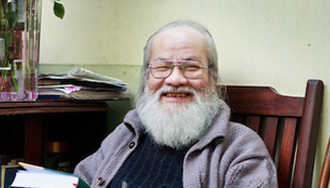
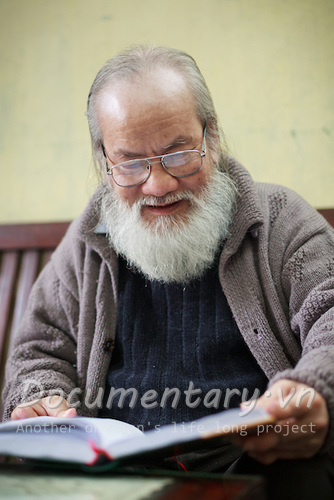
Associate Professor, Doctor, Distinguished Teacher Nguyen Thua Hy was the Deputy Head of the Department of Ancient and Medieval Vietnamese History, Faculty of History (1995-2000)/Photo: Thanh Long
Among the 12 Ho Chi Minh Prizes and 20 State Prizes for science and technology in 2011, the Faculty of History, University of Social Sciences and Humanities - Vietnam National University, Hanoi, received two: one Ho Chi Minh Prize awarded to a series of works on Vietnamese culture by the late Professor Tran Quoc Vuong, and one State Prize awarded to a work...Thang Long - Hanoi in the 17th, 18th, and 19th centuriesThis award is given by Associate Professor, Doctor, Meritorious Teacher Nguyen Thua Hy. This is the fifth Ho Chi Minh Prize and the fourth State Prize that the staff of the History Department has been honored to receive from the State.
Associate Professor, Doctor, and Meritorious Teacher Nguyen Thua Hy was born in 1937 in the "core space" of "Hanoi of a thousand years ago" (Hang Cot Street, Ba Dinh District). His ancestral home was in Ha Dinh village (now in Thanh Xuan District), and his mother was from La Phu village (formerly Ha Tay province). After graduating from one of the three most prestigious high schools in Hanoi at the time (Nguyen Trai High School, along with Chu Van An and Truong Vuong High Schools), he became a student in the first cohort of the History Department at Hanoi University, in the same class as later famous figures in the field of history, such as Professor and People's Teacher Phan Dai Doan, Professor and People's Teacher Vu Duong Ninh, Associate Professor and People's Teacher Le Mau Han, and Associate Professor and Meritorious Teacher Pham Thi Tam… It is said that in this first cohort of the History Department, he was one of the best students. But unlike many of his peers, after graduation he was assigned to teach history at the high school level. After thirty years of teaching and working in the Departments/Offices of Education in Ha Nam and then Hanoi, it wasn't until 1990, at the age of 53, that he returned to work as a lecturer at the Department of Ancient and Medieval Vietnamese History, Faculty of History, at the invitation of Professor Phan Huy Le, who was then the Head of the Department.
One might think that being a high school teacher meant simply teaching and not needing to do research. But he didn't settle for mediocrity. With his passion for science, the knowledge he had accumulated—especially from books written in English and French—and his innate ability to absorb information, he quietly wrote, not excessively, but profoundly.
Then, from the early 1980s, he decided to pursue postgraduate studies (in Vietnam). At that time, postgraduate students, in general and in history in particular, were rare. He chose Hanoi – the land where he was born and raised, witnessing many changes – as his research subject. This was certainly not a coincidence. In early 1984, his dissertation was completed.Thang Long - Hanoi in the 17th, 18th, and 19th centuries (the socio-economics of a medieval Vietnamese city)His thesis was defended, among the first doctoral dissertations (then called associate doctorates) of the History Department. His defense (at 19 Le Thanh Tong Street) was attended by a large crowd, including many prominent figures in the field of history. Later, in 1993, this work was published as a book and immediately garnered attention from researchers both domestically and internationally. Now, more than two decades later, it has become an indispensable book, one that cannot be omitted, mentioned, or cited in studies of Thang Long - Hanoi, especially during the 17th, 18th, and 19th centuries.
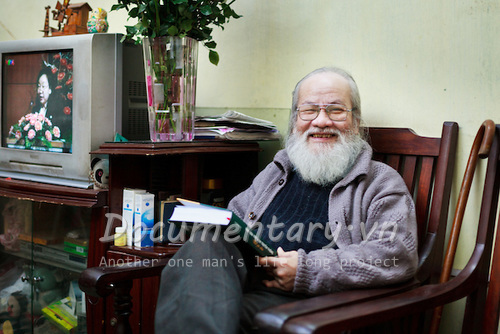
He was awarded the State Prize for Science and Technology in 2010 for his work "Thang Long - Hanoi in the 17th, 18th, and 19th Centuries".
By exploiting diverse sources of information, especially those written in Western languages (English, French), and processing them carefully, methodically, and effectively, this work has depicted the appearance of Thang Long - Hanoi through various periods, particularly the 17th, 18th, and 19th centuries. It highlights the socio-economic structure and economic activities of Thang Long - Hanoi during these centuries, as well as the policies of the Vietnamese feudal states regarding this issue, using the case of Thang Long - Hanoi as an example. The insightful analyses of the economic structure, social structure, class system, and class interaction are particularly noteworthy. The generalizations about the factors of urban development and prosperity, the urban-rural relationship, the duality of state and people in urban areas, and the forms of urban development and transformation have become important and widely influential topics in research circles both domestically and internationally, among undergraduate and graduate students, and doctoral candidates when approaching the socio-history of medieval Vietnam. This work has become a representative study on Thang Long - Hanoi, frequently cited by researchers both domestically and internationally when studying Vietnamese history in general and the history of Thang Long - Hanoi in particular. This work is also a valuable monograph, effectively serving the training work of the Faculty of History, University of Social Sciences and Humanities, Vietnam National University, Hanoi (bachelor's, master's, and doctoral degrees in Ancient and Medieval Vietnamese History, Vietnamese Cultural History, and other related fields).
The work has been translated into English (published by The World Publishing House in 2002), gaining recognition from scholars and readers in many countries, contributing to the promotion of Vietnamese history and culture in general, and the history and culture of Thang Long - Hanoi in particular, to international friends. Recently, the work was added and published in the "Thang Long Thousand Years of Culture Book Series" on the occasion of the 1000th anniversary of Thang Long - Hanoi, and continues to be highly appreciated by researchers and readers.
In another sense, this work has made a significant contribution to promoting the development of Hanoi studies. As an outstanding study of Thang Long - Hanoi, it can be considered a model monograph on the history of Thang Long - Hanoi as a city playing a central political and administrative role in the country. Although the work focuses mainly on the period from the 17th to the 19th centuries, most issues related to the socio-economic life of Thang Long - Hanoi are summarized within the entire historical process, creating a relatively comprehensive picture of the socio-economic structure of this city. Among hundreds of monographs on Thang Long - Hanoi to date, this work can be considered one of the most outstanding studies, marking a step forward in Hanoi research.
Reading Nguyen Thua Hy's work, one clearly sees his profound knowledge and literary elegance, especially in his writings on the history and culture of Thang Long - Hanoi. Perhaps this is a combination and assimilation of the ancient Thang Long culture with the sophisticated modern Hanoi urban culture. At nearly 80 years old, with weak hands and feet, he remains remarkably sharp-minded. Even while staying home, he regularly browses the internet, using both landline and mobile phones, and is aware of world affairs, national events, school matters, faculty affairs, and personnel matters of all sizes (sometimes even knowing them in advance). And remarkably, he continues to write, from research papers to books. During the Thang Long - Hanoi Millennium celebration, he served as the chief editor of a book.Documents on the cultural heritage of Thang Long - Hanoi: a collection of Western documents.It was a thousand pages thick, highly acclaimed, and then in 2011, he published it.Traditional Vietnamese culture - a perspective, over half a thousand pages. He translated and edited famous works by foreign scholars about Vietnam.
Meeting him always brings joy and a love for life. He works wholeheartedly, seriously, responsibly, and efficiently. He hardly ever worries about gains and losses in life. Because of this, he is very "leisurely." And perhaps because of this "leisure," he is very "profound."
|
Associate Professor, Doctor, Distinguished Teacher Nguyen Thua Hy
+ Workplace: Department of Ancient and Medieval Vietnamese History, Faculty of History. + Management position: Deputy Head of the Department of Ancient and Medieval Vietnamese History (1995-2000).
Learn about Indian culture., Culture Publishing House, Hanoi, 1986. Thang Long - Hanoi in the 17th, 18th, and 19th centuriesPublished by the Vietnam Historical Association, Hanoi, 1993. Socio-economic conditions of Thang Long - Hanoi in the 17th, 18th, and 19th centuries., Hanoi Publishing House, Hanoi, 2010. Documents on the cultural heritage of Thang Long - Hanoi: A collection of Western documents, Hanoi Publishing House, Hanoi, 2010. Traditional Vietnamese culture, a perspective, Information and Communications Publishing House, Hanoi, 2011.
+ State Award for Science and Technology in 2010 for the workThang Long - Hanoi in the 17th, 18th, and 19th centuries. |
Author:Assoc. Prof. Dr. Vu Van Quan
Newer news
Older news

