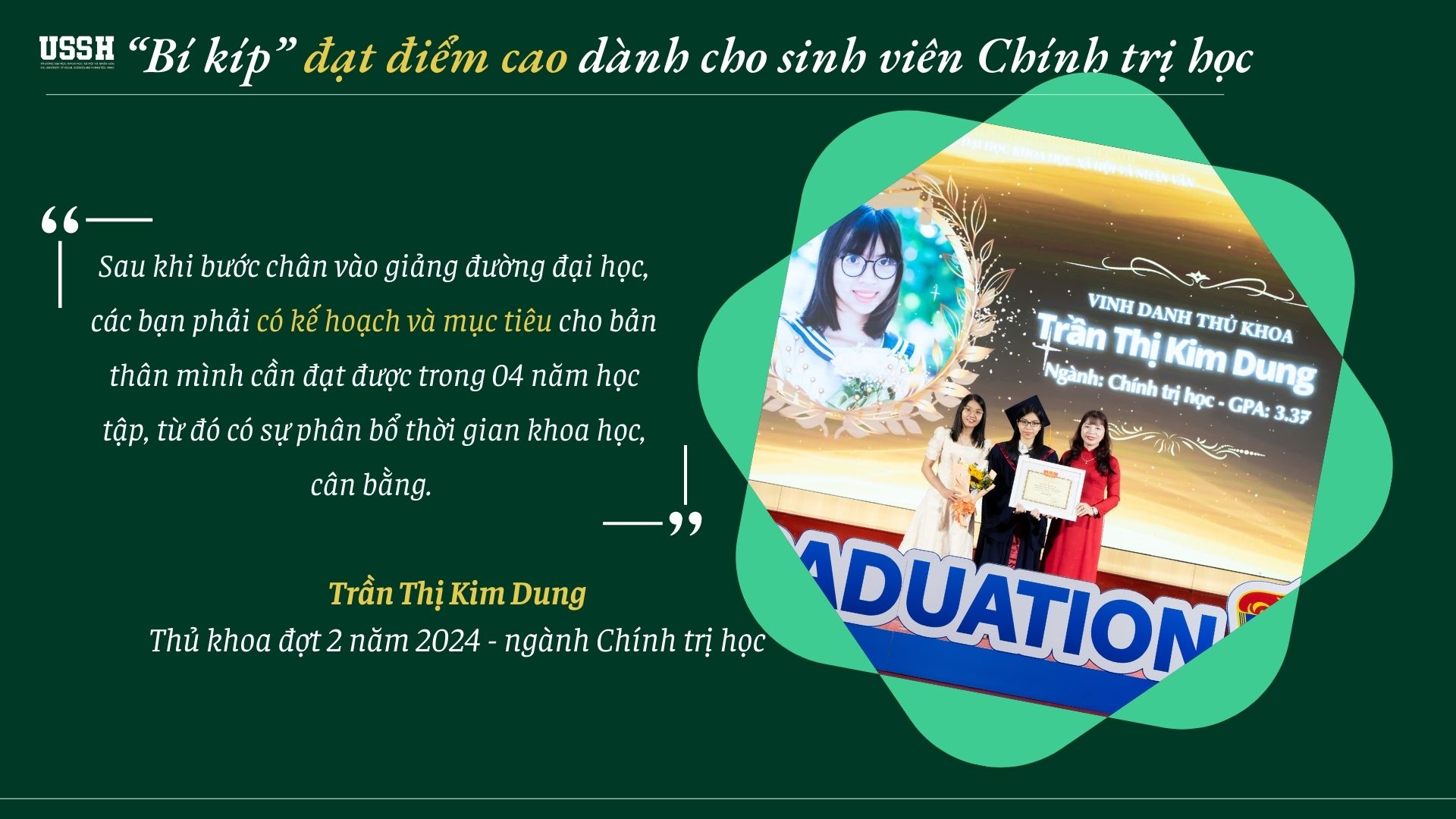
When asked about her feelings regarding the field of study that Kim Dung had chosen and "lived, breathed, and pondered" throughout her four years of university, the valedictorian shared:
When it comes to Political Science, most people think of it as a dry, stressful field of study that demands many qualities. However, in practice, thanks to the dedicated and thorough guidance from experienced and highly qualified professors in the Department of Political Science,Political ScienceFor young people like me, it becomes both appealing and practical.".
Political science trains students to be knowledgeable about political realities, possessing skills in critical thinking, gathering and processing political information and situations, and developing skills in research, writing, and presenting on various issues. In addition, Political Science helps students accumulate teamwork skills, management skills, and communication skills, both in the workplace and in social interactions.
"These are essential skills that students need to excel in their studies and seize job opportunities."- Kim Dung emphasized.
Kim Dung also stated:
The course "Politics and Policy" is the specialized course that has given me the most satisfaction in my field of Political Science.Through this course, students are provided with a fundamental understanding of policy, the relationship between politics and policy; they grasp the constituent elements of policy, the forms of policy expression, the criteria of good policy, the policy planning process, and the organization of policy implementation. From this, students are able to identify and analyze policies from a political perspective, participate in policy planning, and present the feasibility of policies.
According to
Three Public Disclosure Reports for the 2023-2024 School YearAccording to a survey of graduates from the University of Social Sciences and Humanities, the employment rate of Political Science students within one year of graduation (based on a survey of 2022 graduates) is 85.42%.
After graduation, Political Science students have participated in advisory and consultative work in agencies that formulate the Party and State's guidelines and policies; and have worked as consultants and advisors in agencies and organizations within the political system, as well as socio-economic organizations.
Many former students are currently working as researchers in political theory institutions or as reporters, editors, and commentators on current affairs and politics at central and local newspapers and television stations.
In addition, after obtaining a degree in Political Science, students can work in research and teaching of Political Science in Party schools, universities, colleges, and vocational high schools.
Kim Dung said that after graduating from university, she participated in youth work in her local area and continued her studies by enrolling in a Master's program in Political Science at the University of Social Sciences and Humanities, Vietnam National University, Hanoi.
With a Bachelor's degree in Political Science, students can continue their studies at the postgraduate level (Master's and PhD) in Political Science and Ho Chi Minh Studies (and several other political science specializations will be developed: International Political Relations and Communication, etc.); they can also pursue a second undergraduate degree in related fields such as Policy Science, Journalism and Communication, International Relations, etc., at the University of Social Sciences and Humanities.

During their studies, Kim Dung and her classmates participated in numerous field trips and internships organized by the Faculty of Political Science, such as visiting the National Assembly and undertaking practical training in three provinces: Nam Dinh, Thai Binh, and Ninh Binh. There, students received presentations on the socio-economic situation of Nam Dinh province at the Truong Chinh Political School (Nam Dinh province), observed the new rural development model in Hai Ly commune (Hai Hau district, Nam Dinh province), learned about the new rural development work of the Fatherland Front in Thai Binh province, and visited historical sites and natural landscapes in the three provinces.
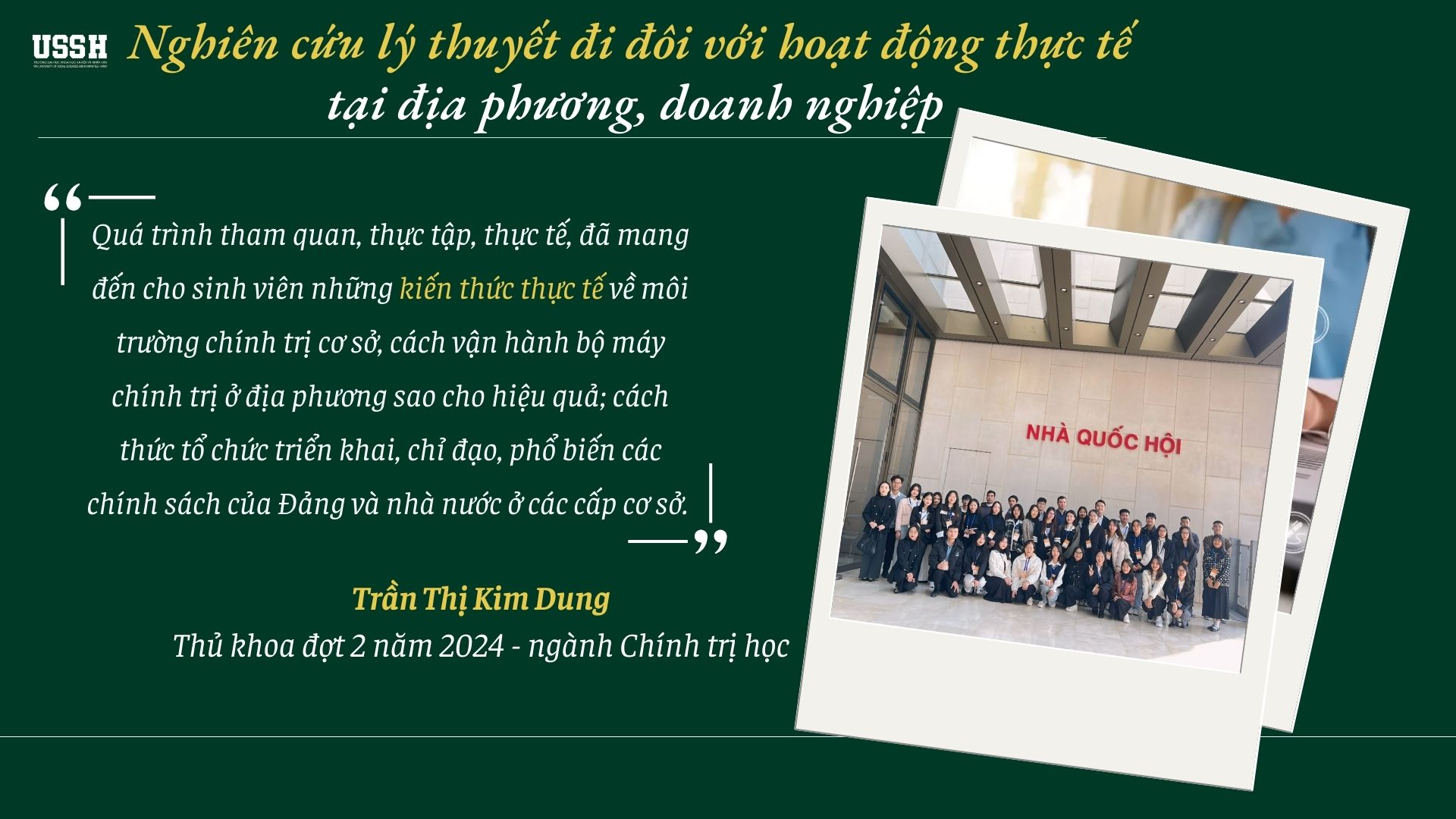
Kim Dung shared that the process of visiting, interning, and gaining practical experience provided her with real-world knowledge about the grassroots political environment, how to work and operate the political apparatus at the local level effectively, and how to organize, implement, direct, and disseminate the policies of the Party and the State at the grassroots level.
"These are also valuable experiences that I and my classmates need to acquire before working in government agencies after graduation."- Kim Dung said.
The top student in Political Science shared the following with fellow students:
"After entering university, you must have a plan and goals for yourself that you want to achieve during your four years of study, so that you can allocate your time scientifically and in a balanced way."
During the first two years, you shouldn't have the mindset of "now that I've passed, I can relax," because this is the time to study general subjects, which form the foundation for specialized knowledge.
For specialized subjects, please pay close attention to lectures, research additional materials related to your major, and engage in academic discussions with classmates or lecturers."
Kim Dung also shared that students should actively participate in school and class activities, join clubs, and conduct scientific research to broaden their communication and create opportunities for learning and collaboration. In particular, the top student in Political Science advised:
"You should strive to improve your foreign language skills, because this is not only a tool for communicating with international friends but also creates more job opportunities after graduation."Once again, congratulations to the top student, Tran Thi Kim Dung, and best wishes for continued success in her future endeavors!
Related articles:
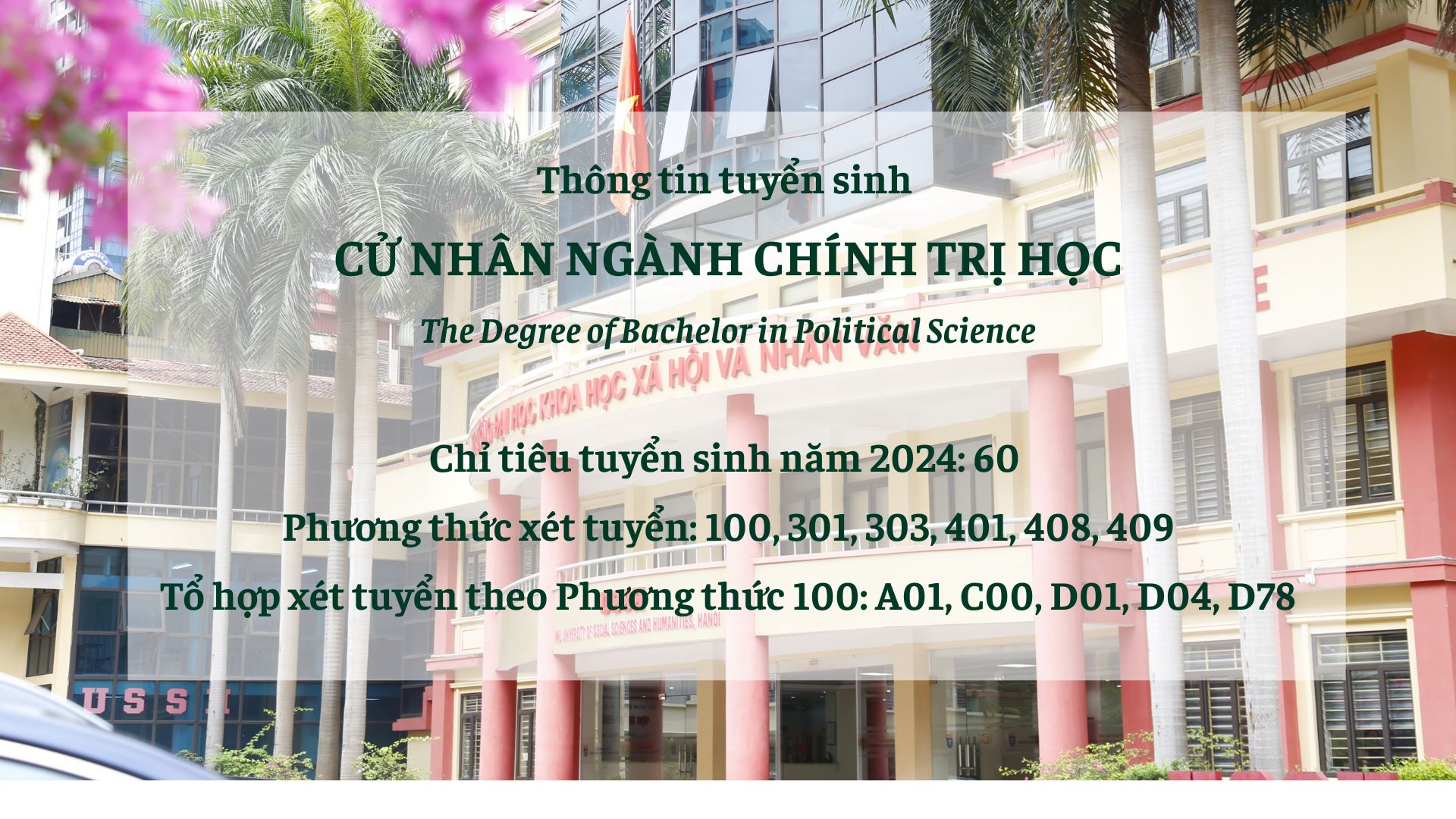
Announcement of University Admissions for the year 2024