My teacher, Mr. Giàu, was a treasure trove of legends among artists and writers. One day, a writer told me: "Anecdotes about artists and writers are 'saturated.' It's a pity there aren't any anecdotes about scientists!" I laughed and said: "There are plenty!" And I recounted a whole bunch of anecdotes about "Mr." Giàu, about "Mr." Mai (Đặng Thai), about "Mr." Thảo (Trần Đức), about "Mr." Đào (Duy Anh), about "Mr." Tường (Nguyễn Mạnh), about "Mr." Huy (Cao Xuân)... All of them were great figures who directly taught me at university. Professor Tô was so delighted to hear them that he told me: "Write them down, I'll take responsibility for publishing them, don't worry!" (Professor Tô was the General Secretary and Party Secretary of the Vietnam Folk Arts Association, so he had the power, the money, and wasn't afraid of "losing his principles" like I was). I knew quite a lot, but I only "published them orally"...
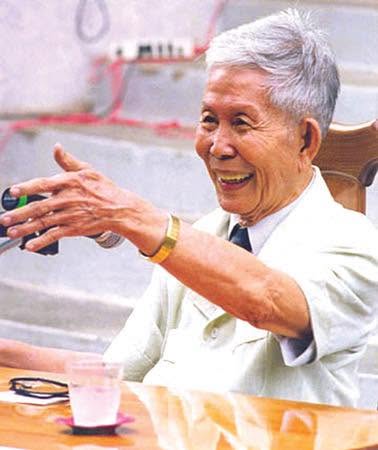
Professor Tran Van Giau
But this year (2001), the 90th anniversary of my teacher Giàu's birth, also marks the 45th anniversary of the founding of the History Department, of which my teacher was one of the founders. So I'm trying to write these few lines as a way of "repaying my teacher's kindness in every way." I wasn't his most devoted student. That person must be Professor Đinh Xuân Lâm, and possibly later, Mr. Nguyễn Đức Sự and Mr. Đặng Huy Vận, who co-authored many books on modern and contemporary Vietnamese history with him, which were once used as university textbooks in the History Department of Hanoi University.
I have some rudimentary knowledge of astrology and intended to discreetly inquire about the Master's birth date and time to create a prediction about his "ups and downs" in life (Who with real talent doesn't experience the ups and downs of the "anxious and turbulent" times of Vietnam and the world in the 20th century?). Since the early 1990s, Mr. Thanh Hoang Khe Le Xuan Hoa has "respectfully" gifted me a calligraphic painting quoting a line of poetry by Tam Nguyen Vi Xuyen Tran Bich San, which I greatly admire and always keep framed in glass in front of my desk:
A person who doesn't face hardship and adversity will never become wealthy.
(Rough translation: How can someone who hasn't experienced hardship and adversity possess true talent?)
But, being naturally optimistic and playful, I also hung in my office a calligraphic painting by Phan Cam Thuong, which contained a poem by President Ho Chi Minh that I also greatly enjoyed:
The story unfolds calmly, like the sun and moon.
(Rough translation: Working leisurely for five long months)
Perhaps that's just how my teacher, Mr. Giau, is: having weathered all the storms of life, he still goes about his work calmly.
Even now, at his advanced age, Professor Giàu still wants to write a comprehensive book summarizing the ups and downs of Vietnam's anti-colonial struggle. The revolutionary Marxist spirit—which I sometimes consider "excessive"—seems to have become ingrained in his very being.
In 2000, the History Department of the University of Social Sciences and Humanities (formerly the University of Hanoi) was awarded the title of Heroic Unit. We would like to invite Professor Giau from Saigon to Hanoi to attend the ceremony to receive that glorious title. We also heard and were convinced that Professor Giau had also been awarded the title of Hero of Labor by the state, just like the veteran Professor Vu Khieu (who was a subordinate of our Professor Giau at the regional level during the resistance against French colonial aggression).
Professor Giàu was frail. His wife – whom we respected and who was always kind and welcoming when we occasionally visited them at the greenhouse – was even more ill. Yet she still came to Hanoi, to the History department, to share our joy.
Unable to contain my emotions, I shouted three times: "HURRY PROFESSOR TRAN VAN GIAU!" And the entire hall of thousands of people joined me in a resounding cheer.

After the celebration, Professor Giàu invited some of his older students to a large hotel in the capital the next day for a treat. I reluctantly objected, "It's already a great honor for you to come and see us. Tomorrow, please allow us to treat you." Professor Giàu insisted, "Tomorrow I'll treat you all!" And he quickly pulled a wad of green bills from his suit pocket, emphatically saying, "I have money here, quite a lot!" Dr. Phan Xuân Biên nudged my side with his elbow, giving me a look that seemed to say, "You must follow the Professor's wishes!" I immediately changed my tone, "Oh! Professor Giàu is still rich. We are very happy to be treated to food and drinks by you!" And Professor Giàu softened his tone, his face relaxed, and he smiled happily, "I'm not rich, but I'm quite well-off." (In the South, there was a man named Trần Văn Khá, and another man – not sharing the same ideals as my Professor – named Trần Văn Lắm. But that name is very "Southern Vietnamese").
The next morning, at exactly 9 o'clock as agreed, several dozen of us arrived at the ASEAN Hotel. We chatted while waiting for Professor Giau. His car didn't arrive for a long time. About an hour later, Dr. Phan Xuan Bien and Nguyen Van Lich (also my former students – in our History Department, we have more than five generations of teachers) helped Professor Giau arrive. We took pictures non-stop.
Then we listened in silence as Mr. Giau spoke:
- This trip to Hanoi is probably my last (I thought to myself: not yet, Professor!). I came here for two reasons: Yesterday, I celebrated the heroic history department and congratulated the professors and professors on becoming mature adults. Today, I went to pay my respects to President Ho Chi Minh. He choked up, his eyes welling up with tears. I and many of my fellow students and colleagues bowed our heads, tears streaming down our faces. Since childhood, I've been the youngest child in a family prone to tears. When one of my doctoral students at the Institute of History defended her dissertation with excellent marks, her mother, the widow of a former member of the Central Committee of the Communist Party, came up crying and said: "This is the first time our family has a PhD, and I regret that her father is no longer here to know about this day..." I'm not a Party member, but tears streamed down my face.
Continuing on about Professor Giàu, he said that since the mausoleum of President Ho Chi Minh was closed today, he knelt outside to pay his respects... In my life, I've only had two true teachers: one famous one, President Ho Chi Minh, and one anonymous one, History. As for me and the professors here, like that guy Vượng over there for example (this was the first time Professor Giàu called me "that guy," three or four times, in an affectionate and intimate way), I heard he teaches well and is highly praised by his students, but we are just lecturers, not teachers (capitalized).
I and a few of my older, more daring students responded to Mr. Giàu:
- What you said is one thing, and we greatly appreciate your unique ideas, but we would like to respectfully address you as "Teacher" (capitalized).
Actually, completely independently of Mr. Giau, he was in Saigon, I was in Hanoi, and we didn't exchange any opinions. In an article I wrote on the eve of the two-millennium celebration, I said that in this world, I only unconditionally respect two people:
- THE PEOPLE
- PRESIDENT HO CHI MINH
And I am extremely grateful to the People's Army Newspaper for daring to print out on paper that idea of mine, a former student of Teacher Giau, "like father, like son," "like pot, like lid," as the common saying goes.
My teacher and I calmed down and became cheerful again (a celebratory feast should be cheerful, shouldn't it? Crying and being overly serious all the time?). I was curious about the fortune teller's way of "digging up dirt" on the teacher.
- Sir, you were born in the year of Tan Hoi (1911), the same year as Mr. Le Duc Tho?
Yes, I think he's about the same age as Vo Nguyen Giap...
- No, I'm absolutely certain that General Giap's birth date, as well as that of "Mr." Pham Van Dong, is not as recorded in the Central Organizing Committee's biographical documents! So, what is your birth date, Professor?
It was only then, after more than forty years of knowing and being close to each other, that Teacher Giau finally "revealed":
I didn't know! And my name (Giau) wasn't even given to me by my parents. I'm from Long An, my father was a village headman, from a wealthy family. Shortly after I was born, one day my father met a village headman on the street. After exchanging greetings, my father said:
- Hey, my wife just had a baby boy, you record it in the register, okay?
After saying that, he left. Mr. Huong Bo went back and checked the register, noting that day as my birthday, and as for the name, he thought I came from a wealthy family, so he arbitrarily wrote Tran Van Giau in the register.
Everyone was surprised and laughed heartily...
I think it's quite interesting that in 2001, both honorary presidents of the Vietnam Historical Association - Vo Nguyen Giap and Tran Van Giau - were celebrated on their 90th birthdays by many associations, friends, and students.
That's just social "convention" and "feeling"!
I heard about Mr. Tran Van Giau after the August Revolution of 1945, when I was a "pioneer youth," and he was then the chairman of the Southern Resistance Committee. I heard that he studied at the University of the East in Moscow in the same "leadership training" class as Mr. B. Tito (Yugoslavia) and Mr. M. Thorez (leader of the French Communist Party), and that he even excelled more than them...
In 1950, at my house we had a lithographed book by Mr. Tran Van Giau titled "The Communist Party, the Party of Intellect, of Determination, of Honor of Vietnam" (probably brought home by my father, who was then a member of the Indochinese Communist Party), with a preface by the editor-in-chief of the Cuu Quoc newspaper in Zone Three - I think his name was Nguyen Tuan - and the opening sentence: "Throughout Southeast Asia, everyone knows Mr. Tran Van Giau and is aware that he is a Communist..." The book was later criticized because the Indochinese Communist Party was then going underground, although in November 1945, Mr. Tran Huy Lieu – whom I later became very close to and always called "Teacher" – on behalf of the Indochinese Communist Party, announced at the Hanoi Grand Theatre that the Indochinese Communist Party was dissolving itself to join the National Unity bloc (probably a clever tactic of President Ho Chi Minh and the Central Committee of the Party, but there was still a "Association of Marxist Researchers in Vietnam" chaired by Mr. Truong Chinh. I was a member of that association from 1950 when I was just 16 years old. My older siblings had joined the association before me and later all became Communists).
It was in 1951 that I first saw the face – from a distance – of the orator Tran Van Giau when he was invited to speak at the famous Lam Son High School (formerly Dao Duy Tu High School) in Thanh Hoa. At that time, it seems he had resigned from his position as Director General of the National Information Agency (to make way for To Huu) and was assigned to Thanh Hoa to do some kind of intellectual mobilization work (I was still a student at Lam Son High School in the 8th grade at the time, so how would I know? You should ask Mr. Vu Xuan Ba, who was then the Party Secretary of Lam Son High School). My classmates and I listened intently, and the Headmaster, Mr. Doan Nong (father of Professor Doan Quynh, a mathematics professor and close friend of mine), was the one who, during the "seasonal break" (in the resistance against the French, there was no summer break, but two seasonal breaks when the rice ripened in the fields), would gather the "unemployed" students (we were people from Hanoi and Hue who had evacuated to Thanh Hoa, attending Thanh Hoa school, not being the children of farmers who could help their parents with the harvest) at a small outpost at the beginning of Thanh Tin village (Tho Xuan, Thanh Hoa) to teach us French. As for mathematics, we had Mr. Dang Phuc Thong, the Deputy Minister of Transport and Public Works and the father of Professor Dang Xuan Hoai, also a classmate of ours, to teach us.
(At this time, from the 1950-51 school year, Vietnamese education had shifted to the Soviet model of "9-year, 3-level general education," and the Ministry had ordered the abolition of French and English, which I had studied from childhood until mid-1950). Many of our English and French teachers were unemployed at that time, and most of them had "defected" (moved to the temporarily occupied zones or went abroad).
For some reason, Principal Doan, who was also a non-Party member like me, was very fond of the communist Mr. Tran Van Giau and invited him frequently to come and talk to us and teach us. Mr. Tran happily accepted, but something kept holding him back. He was busy compiling and printing several issues of the magazine "Intellectuals of the Resistance" printed in Thanh Hoa, which my "Brother Ba" often had. I lived in the same house, like a foster brother to Brother Ba, and ate and lived with his siblings. He was busy with teaching and Party work, so he was often away from the boarding house (people from Thanh Hoa at that time didn't charge rent; they usually gave up their houses for us to eat, study, and teach in).
At that time, there was no market economy, and everyone obeyed President Ho Chi Minh's orders: "All for the front lines - All for victory," "Culturalization of the resistance - Culturalization of the resistance!" (What beautiful slogans, and the only fear was that "they would never return"!).
Presumably after some preparation, Professor... Tran Van Giau launched a Preparatory University in Thanh Hoa province, followed by a "Advanced Teacher Training" with a five-person board of directors, all renowned figures: Dang Thai Mai (before that, Professor Dang and Professor Cao Xuan Huy had opened a Literature University class for about a year in 1949 with several dozen students such as Ton Gia Ngan, Nguyen Tai Can, Vu Xuan Ba, Nguyen Duc Nam, Dang Thi Hanh, Hoang Nhu Hoa... (My memory is dull, I only remember this much, please forgive those whose names I've forgotten), Nguyen Thuc Hao, Nguyen Manh Tuong, Tran Van Giau (also the Party Committee Secretary) (and another person whose name I've forgotten, I think it was a member of the Zone Three Party Committee, Dang Xuan Thieu, who came to Thanh Hoa for medical treatment and whom Professor Giau introduced to us students as the school's "political commissar"). There were also quite a few well-known professors, from the Literature Faculty: Cao Xuan Huy, Dao Duy Anh, Truong Tuu... from the Natural Sciences Faculty: Ho Dac Lien, Pho Duc To...
Although it's called a five-person board of directors, the person who practically organizes and makes all the decisions is Mr. Giàu.
After the "supplementary 9th grade" classes that the Ministry forced us to attend and study on our own, I would often sneak off on foot five or seven kilometers to Cau Ke and Dan Tai communal house to "audit" at night (nighttime study during the resistance with dim lights like fireflies). There was also a teacher - I think it was Mr. Truong Tuu - who, while giving a lecture on Tran Huu Thung's "Visiting the Rice Fields" (the first prize winner for the poem "World Peace"), discovered a "stranger" eavesdropping when I was sitting huddled between Ms. Dang Thanh Le and Mr. Nguyen Dinh Chu, Mr. Le Duc Nam... who were my "senior" students. But the teacher only brushed it off when I "shamefully" bowed my head. After all, back in the day, when Mr. Tu Lo was just a young student tending pigs, he used to sneak in and listen to lectures, so how could I be!
But in 1953, when Professor Giau decided to open the second preparatory university course, I enrolled in the Mathematics and Physics department. (Actually, with the French math textbook my father sent from the temporarily occupied zone of Hanoi – along with my very "cool" eyeglasses – I, along with Dang Xuan Hoai, Doan Quynh... and with the help of teachers/brothers Doan Chau Long, Trinh Ngoc Thai, after engineer Dang Phuc Thong passed away from pulmonary tuberculosis (At that time, there was an instruction for us to only address the young teachers as "brother." How strange!), we had almost completed the General Mathematics curriculum. Professor Nguyen Trac (later Professor Nguyen Trac of Hanoi Pedagogical University) told me: "Vuong is good at Literature and History, but studying Literature and History is difficult and requires a 'talent,' while anyone can study Math and Physics. You should reconsider." But I – although I loved Professor Trac – he taught Literature and lectured on Literature very well – did not change my mind. But then... "I reflected that everything is in the hands of Heaven.")
Whether it's fate or the "leader's 'uplifting'," it's all the same.
Back then, there was a custom that high-ranking officials had the right to send one child to study abroad.
My father was then a high-ranking official at the Inter-Regional level, having received political training at the Central level and been taught by President Ho Chi Minh. I was an excellent student at Lam Son High School, quite prominent, and also active in the Student Union and the National Salvation Youth movement. I received many certificates and awards, although I was often ridiculed for my arrogance, stubbornness, and romantic nature (like "schoolboy" romances, boys and girls holding hands, nothing more than the "this and that" kind of things that would happen later). I sent all my certificates to my parents in Zone Three.
From Zone Three, my father (I called my parents "uncle and aunt" - a colonial urban style) telephoned me in Zone Four: "Go immediately to kilometer 12 in Nho Quan, to the Pham Le Bong plantation to meet your uncle and then go to study abroad" (meaning to study overseas).
Some of my friends (like Phan Kế Hoành, who passed away in 1922) also had those kinds of documents but kept them hidden because they preferred studying Literature with Professors Giàu, Huy, and Tường...
I, being a "stubborn fool," showed the telegram and said to my friends, "Why not send ME, personally, a good student and a good official, to study abroad instead of my father's son? I'm not going!" This matter reached the ears of Mr. Dao Van Nham, the political assistant to Mr. Giau.
One beautiful autumn morning in the year of the Snake, 1953, was a gloomy one for me. Mr. Nham entered my classroom, located in a five-room thatched house belonging to a relatively well-off middle-class farmer in Thanh Hoa province (later "demoted" to landlord during the Land Reform), which my teacher, Professor Nguyen Manh Tuong, with two doctorates, still solemnly called the Great Lecture Hall of the (resistance) University. Mr. Nham solemnly said: "After class, I request that 'comrade' (in those days, the word 'comrade' had a very sacred meaning) Tran Quoc Vuong come to meet with the Board of Directors!"
I don't know if young students nowadays are afraid of their Professors, Principals, and Directors, but back then, and even after that, despite living under a Democratic Republic, I was still very "afraid" of the Directors. My teacher, Professor Giàu, and Director Đặng Thai Mai were both very good, but they were also very authoritarian and patriarchal. Similarly, Professor Đào Duy Anh – my former superior – was also very good, but he was very patriarchal. He almost didn't want us to contradict them on anything!
After school, I walked three kilometers along the Chu River embankment to the Director's Office – a rather nice three-room thatched house on the bank of the irrigation canal next to the Kè Bridge.
Uncle Nguyen Khanh Dam - the (biological) older brother of writer Nguyen Tuan, who once opened a publishing house in Saigon during the French colonial era - solemnly but affectionately directed me to the Director's office. Only Mr. Giau was there.
I stood at attention—because the Teacher hadn't shown me a chair to sit on—and he always said:
- "You're quite something, aren't you? You don't want to rely on your father's influence, do you? Well, I'll transfer you to the Faculty of Literature, where you'll be in charge of the Student Union's executive committee and also responsible for all three subjects: Literature, History, and Geography. And if you still want to study Mathematics, then leave my school and go to China to study at the campus with Professor Le Van Thiem, for example. I don't want to compete with Professor Thiem or Professor Kom Tum at all..."
I didn't argue a word, went home, and walked a few kilometers along the dike, looking at the sky and the water, my stomach rumbling with hunger and my heart heavy. And my youthful "pride" flared up: - I don't care, I can finish whatever I study. And so I went to study Literature, became a Standing Committee member of the Student Union, in charge of general affairs and specifically in charge of arts and culture. The years of the Snake and Horse were turning points in my life.
I said goodbye to Math and Physics and gradually got used to Literature, History, and Geography, subjects I was quite good at back in high school!
The first "initiation" lesson for all students - Literature and Science - was led by Professor Tran Van Giau, the Director.
I vividly remember him wearing a worn-out brown silk áo bà ba (traditional Vietnamese shirt) that President Ho Chi Minh had given him around early 1947-1948. He continued wearing this increasingly tattered shirt for three years, 1952-1953, at the university, before the liberation of Hanoi on October 10, 1954. Occasionally, he would even sit on a desk to teach, not just on a chair.
Professor Giàu's inaugural lecture (known as Lecon inaugurale in the West) for about 100 of us students at Đình Ngò (Ngô Xá - Thiệu Hóa - Thanh Hóa) was simply this, written by the professor himself using white chalk on the blackboard:
UNIVERSITY = SELF-STUDY
I don't know what Cao Xuan Hao, Van Tam, Vu Dinh Cu, Phan Huy Le,... and my other classmates think. But I'm truly astonished...
Because I thought, after 10 years of high school, coming to this school as a university student instead of a high school student, I would have gained some more knowledge of "a few words of the SAGES" - now, of Marx and Lenin.
Who would have thought... Self-learning is something we've been familiar with for a long time.
Only later did I understand the profoundness of the teaching and learning methods at Tran Van Giau University. (He was a student at the University of Toulouse in France and then at the University of the East in Soviet Russia). And later, the directive at the beginning of the school year from the Minister of Higher Education and Vocational Training, Ta Quang Buu, was written more gently: "Transform the training process of teachers into a self-training process for students."
That strategic motto of the University was excellent and correct; it's just a pity that many teachers and students later failed to implement it. Now, many students are quite passive in the process of obtaining their bachelor's degree. And the foreign language proficiency of students is truly worrying. Most of them only use Vietnamese books and newspapers or translations into Vietnamese. In my generation, at eighteen or twenty years old, entering preparatory university and university required knowing at least two foreign languages. Not to mention that while studying at university, they had to learn Russian, Chinese, or some other language of the socialist bloc.
Professor Giàu and other leaders of the Faculty of Literature (Philosophy - Literature - History - Geography) even made us study classical Chinese and some general Natural Sciences topics to hone our logical and mathematical thinking skills...
At the preparatory university, Professor Giàu taught Marxist-Leninist philosophy. After writing each lesson, the students would print it in lithography and share it among themselves for study. Back in Hanoi in 1955, Professor Giàu revised it and had it printed by machine at the Construction Publishing House. Professor Chiêm Tế, the teaching assistant, lectured on "political economy." We already had F. Engels's *Anti-Dühring* in French, so we read each chapter and shared it in presentations. We asked Professor Giàu about anything we didn't understand.
At university, learning always goes hand in hand with questioning. And later, we even received the 4H principle that President Ho Chi Minh taught at the opening of the Nguyen Ai Quoc Advanced Party School in Viet Bac in 1948:
LEARN - ASK - UNDERSTAND - PRACTICE
(Later I learned that in the book *The Great Learning*, supposedly by Master Zeng Shen, there is a saying: "Be learned widely, ask many questions, think carefully, and act diligently.")
Teacher Giàu went to Việt Bắc for a meeting with the Central Committee and didn't return for a month. At home, Teacher Đào Duy Anh taught mainly about ancient Vietnamese history. At this time, Teacher Giàu was suffering from tuberculosis. Teacher Đào taught for only a few sessions; before leaving, Teacher Giàu discreetly called me up and said: "I've discussed it with Mr. Đào. Every week, you should make the effort to go to Mr. Đào's house (a few kilometers away), listen to his lectures, take notes, learn carefully, and then present the information to the others."
After 1956, I officially became an apprentice assistant to Professor Dao. As usual, the Professor suffered from sore throats, bronchiectasis, and was hospitalized while writing books. Every week I received Professor Dao's lesson plans and "taught" in his place (it should be clarified that I "presented according to Professor Dao's lesson plans," and the students at that time were all "adults," including Professor Dao's son, Dao The Hung, and Tu Chi...).
In the summer of 1956, all the professors of the Faculty of Literature went on a month-long visit to the Soviet Union and China. Professor Giàu called me and Đinh Xuân Lâm aside and told us just one thing:
While we're away, you guys can study on your own, whether you choose to study by yourselves or invite someone over to talk to you, it's up to you. But you mustn't skip class.
My brother and I discussed it and then invited revolutionaries (Tran Huy Lieu, Duong Bach Mai...) and military leaders (Tran Van Quang, Le Quang Dao, Song Hao...) to lecture on the history of the Revolution and the Resistance War in place of Mr. Giau.
Things were different back then. When we mentioned "teaching at the Faculty of Literature," those professors were very hesitant, and it was only after much persuasion and coaxing from us that they agreed to speak (some even wrote lesson plans, jotting down a few sentences, but most spoke extemporaneously). Mr. Duong Bach Mai, a close friend of Mr. Giau, was the most enthusiastic to accept and absolutely refused to travel by car. He walked from the headquarters of the Vietnam-Soviet Friendship Association on Trang Thi Street to the lecture hall at Vietnam University, 19 Le Thanh Tong Street, and spoke passionately about the revolutionary situation and the resistance in Southern Vietnam.
Looking back, I realize that our generation had many minor "misfortunes" and a great "fortune" in having had the opportunity to interact with and learn from the "great figures" of the Vietnamese Revolution and Resistance. Professor Giàu and Professor Liệu were truly leading figures of modern revolutionary Vietnamese historiography!
Related articles:
Professor Dao Duy Anh - A great historian and cultural figure.
Author:Faculty of History and Culture
Newer news
Older news

