
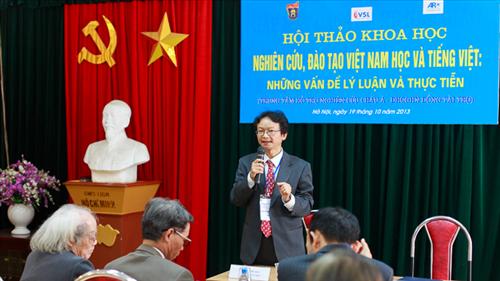

The scientific conference "Research and Training in Vietnamese Studies and the Vietnamese Language: Theoretical and Practical Issues" was organized by the Faculty of Vietnamese Studies and Vietnamese Language on October 19, 2013.
According to statistics, in the 2013-2014 academic year, 85 colleges and universities nationwide offered over 6,000 places in Vietnamese Studies, including 3,000 university places and 3,000 college places. The distribution of schools and places was evenly spread between the North and South, with 43 schools (3,000 places) and 42 schools (3,000 places) in the South. In terms of numbers, the school with the highest enrollment in the North was Hanoi University of Industry with 330 places, while the school with the highest enrollment in the South was Ho Chi Minh City University of Culture with 330 places. Of the remaining schools, about half had enrollment quotas of 80-150 students per year, and the other half had enrollment quotas of 30-60 students per year. The school with the lowest enrollment quota is Yen Bai College of Culture, Arts and Tourism, with 25 students per year.
Regarding the training history, the first university to offer Vietnamese Studies programs was Da Lat University, which has trained 19 cohorts from 1994 to the present, with thousands of graduates. Most recently, since 2009, the University of Social Sciences and Humanities (Vietnam National University, Hanoi) has begun offering Vietnamese Studies programs at the undergraduate level with two specializations: Specialization A for Vietnamese students and Specialization B for foreign students. This is also one of the few institutions currently offering Vietnamese Studies programs for both Vietnamese and international students.
However, current training in Vietnamese Studies faces several challenges, including: training institutions failing to correctly identify the research target and training requirements of Vietnamese Studies; a lack of strict quality control; training not truly stemming from the practical development needs of the field; many schools lacking clear training objectives; insufficient faculty resources; a lack of research supporting training; and limited international exchange opportunities.
According to Professor Dinh Van Duc (former Head of the Department of Vietnamese Language, now the Department of Vietnamese Studies and Vietnamese Language, Faculty of Social Sciences and Humanities, Vietnam National University, Hanoi), the opening of Vietnamese Studies programs in Vietnam began spontaneously and quite spontaneously, resulting in fragmented and difficult "domestic Vietnamese Studies" programs, often implemented in a haphazard manner, despite the Ministry of Education and Training's framework curriculum. Each training institution has independently defined its program based on its own subjective views, often with a strong emphasis on individual will. Regarding training objectives, most schools, while outwardly offering Vietnamese Studies programs, are in fact training students in specialized fields such as tour guiding, culture and tourism, tourism studies, and ethnic culture.
Sharing the same viewpoint, Associate Professor Dr. Le Quang Hung (Department of Vietnamese Studies, Hanoi Pedagogical University) argues that the Vietnamese Studies training programs at universities and colleges currently differ significantly. This is due to the very different starting points for developing this training program across institutions. Most Vietnamese Studies training institutions build their programs from a core discipline within their own field and rely on their existing professional staff. Furthermore, curriculum development is often based on job market demands, i.e., the "output" in each locality.
Professor Nguyen Quang Ngoc (former Director of the Institute of Vietnamese Studies and Development Science, Vietnam National University, Hanoi) emphasized that many training institutions do not conduct any research or training in social sciences and humanities, yet they still offer Vietnamese studies programs. He argued that the fact that more than 80 colleges and universities are currently offering Vietnamese studies programs is alarming, as it does not reflect the development of this field but rather the "distortion" of Vietnamese studies. Some institutions state on their diplomas that graduates are Bachelors of Vietnamese Studies, but in reality, they train people to work in tourism to serve local and social needs, as the field of Tourism Studies currently lacks an official training code from the Ministry of Education and Training.
According to Associate Professor Tran Le Bao (Department of Vietnamese Studies, Hanoi Pedagogical University), the above phenomenon stems from the rapid development of Vietnamese Studies, leading to an inaccurate understanding of this science. In practice, perceptions of Vietnamese Studies are diverse and complex. Subjectively, this includes differing perceptions and viewpoints among those who drafted the proposal to open a new Vietnamese Studies program at the Ministry of Education and Training. Furthermore, those who opened the program were not originally from Vietnamese Studies but often transitioned from other narrower disciplines, resulting in differing and limited understandings of Vietnamese Studies.
To address this situation, Professor Nguyen Quang Ngoc (former Director of the Institute of Vietnamese Studies for Development Science, Vietnam National University, Hanoi) argues that it is essential to begin with a correct understanding of the concept of Vietnamese studies and the development process of this scientific discipline itself in order to meet practical needs. In reality, all scientific disciplines that research the country, people, and culture of Vietnam to discover its distinctive values belong to the field of Vietnamese studies. Vietnamese studies, according to its developmental laws, begins with specific disciplines such as history, culture, language, economics, and sociology. The development of specialized sciences creates strengths in understanding but also reveals limitations, because when research is too in-depth and too detailed, the overall perspective weakens. Based on this foundation of specialized sciences, gradually, due to the need for a more complete and holistic understanding, these specialized sciences tend to link together. Comprehensive and interdisciplinary research has become an urgent need, thus Vietnamese studies is gradually shifting from specialized to interdisciplinary studies. Therefore, Vietnamese studies today must be considered an interdisciplinary science, based on the integration and linkage of specialized sciences to discover common cognitive values and shared characteristics of culture and society.
With a proper understanding of the concept, Vietnamese Studies will be able to correctly identify its subject matter and research methods. Universities will be able to set the right training goals for the field of study, taking into account the specific characteristics and identity of each institution. Based on this, the governing body, such as the Ministry of Education and Training, will be able to make necessary adjustments to eliminate institutions that lack the capacity to train students in this field.
Also emphasizing the "interdisciplinary" nature as a distinct characteristic of Vietnamese Studies, Associate Professor Dr. Le Quang Hung (Hanoi Pedagogical University) argues that interdisciplinary studies are not simply about teaching about many aspects of Vietnam and its people. The true essence of interdisciplinary studies lies in the fact that each specific issue needs to be analyzed, explained, and evaluated from multiple perspectives and using knowledge from various disciplines. To sustainably develop Vietnamese Studies, it is essential to establish a standardized curriculum for this field, clearly defining the training objective as producing Vietnamese Studies graduates with relatively comprehensive and systematic knowledge of Vietnam and its people, while also possessing the skills to work in specific areas of society.
Author:Thanh Ha
Newer news
Older news



