
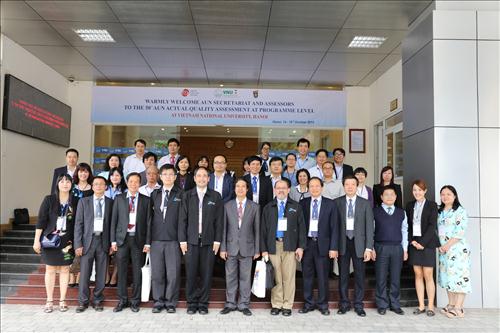
Attending the opening session were Choltis Dhirathiti, Deputy Executive Director of the ASEAN University Network (AUN), Ing-orn Jeerararuensak, representative of the AUN Secretariat, and accreditation experts Wan Ahmad Kamil Mahmood (team leader) and colleague Nakorn Srisukhumbowornchai.
Representing Vietnam National University, Hanoi (VNU) were Vice Director Nguyen Kim Son, leaders of functional departments, schools, faculties, and affiliated units of VNU, along with the Board of Directors, staff, lecturers, and representatives of the leadership of the Faculty of Oriental Studies of the University of Social Sciences and Humanities.
In his opening remarks, Vice Rector of Vietnam National University, Hanoi (VNU) Nguyen Kim Son stated that, to date, VNU has 15 accredited training programs that meet AUN standards. Quality accreditation not only brings positive results to the accredited programs but also has significance for other training programs at VNU. The continuously increasing number of accredited training programs is clear evidence of VNU's pioneering role in the innovation of higher education in Vietnam.
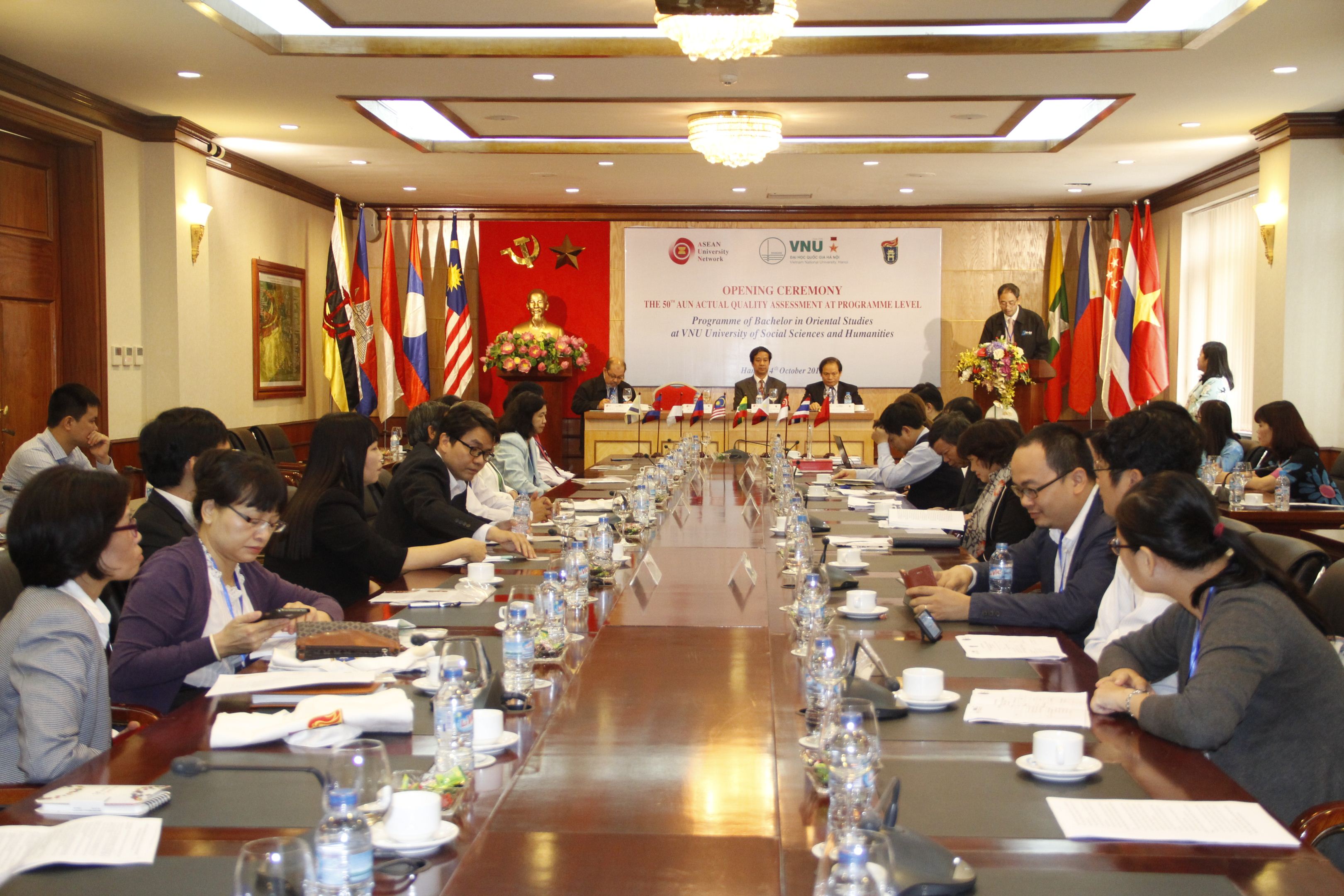
Overview of the session
The Vice Director stated that, in order to improve the quality of education and help students become globally competitive, quality assurance must be considered a central task. Therefore, VNU is constantly improving the quality of its training programs, striving to ensure that by 2020, 100% of its training programs meet AUN quality standards, with 35% of those meeting regional and global standards.
Mr. Choltis Dhirathiti stated that, with the aim of developing human resources through higher education in the ASEAN region, the ASEAN University Network (AUN) was established in 1995. To promote quality assurance within universities in the region, AUN launched an initiative to assess the quality of higher education according to common ASEAN quality assurance standards (ASEAN University Network - Quality Assurance, abbreviated as AUN-QA). By the end of this year, 161 training programs from 27 universities in 8 Southeast Asian countries will undergo quality accreditation.
Highly appreciating the proactive and positive approach of the University of Social Sciences and Humanities in particular, and VNU in general, in the evaluation activities according to AUN standards, Mr. Choltis Dhirathiti hoped that this evaluation would gradually contribute to promoting the recognition of academic achievements and training quality of VNU, as well as strengthening cooperative relations with universities in the Southeast Asian region.
According to Nguyen Van Khanh, Rector of the University of Social Sciences and Humanities, after 70 years of development, the University has always been considered one of the largest centers for training and research in social sciences and humanities in the country, with the mission of training high-quality, highly skilled human resources. Rector Nguyen Van Khanh expressed confidence that the assessment results from the working group will help to better identify the strengths of the training program to further develop them, while also uncovering areas for improvement, thereby enhancing the quality of education and training.
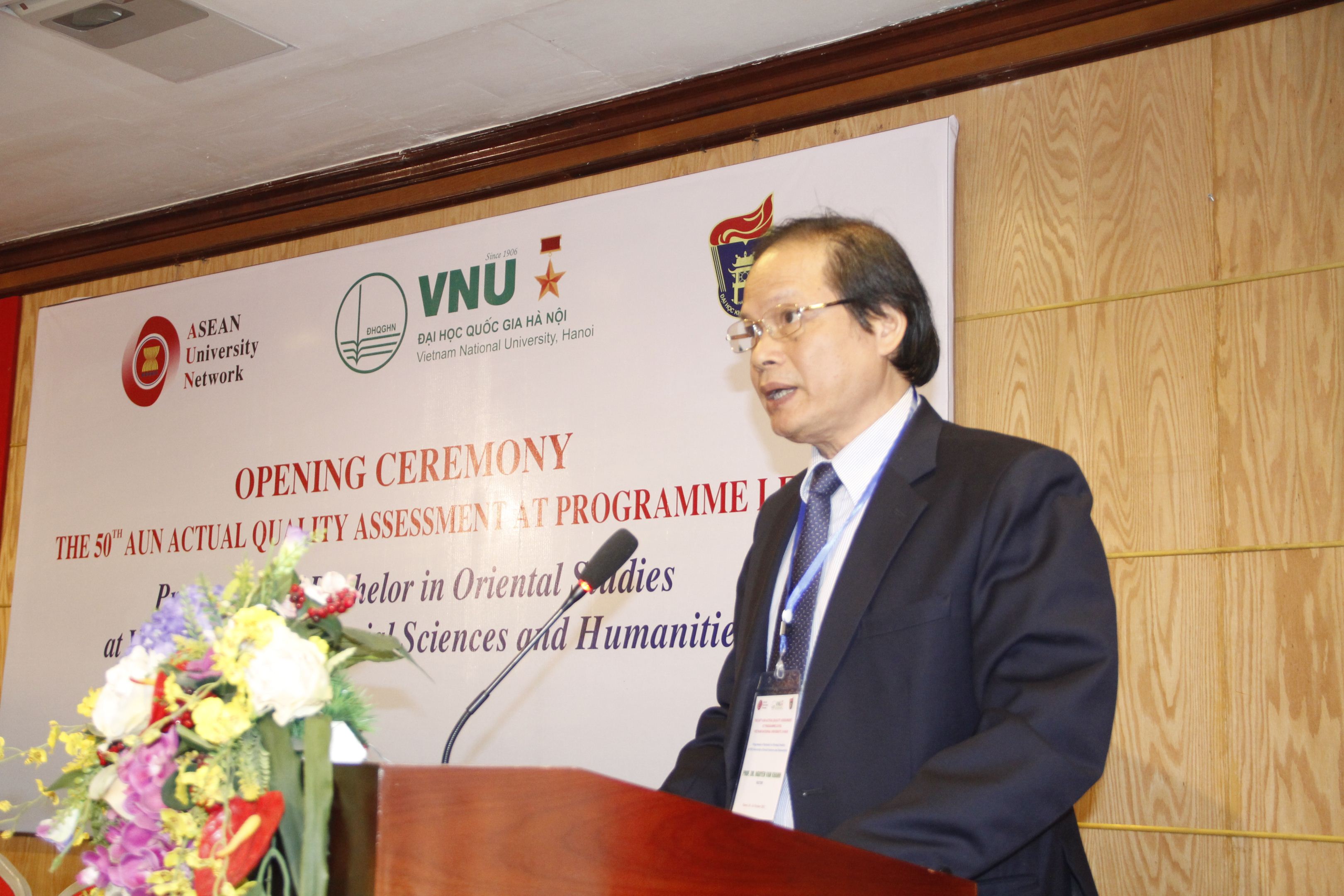
Professor, Doctor, and People's Teacher Nguyen Van Khanh delivered a speech at the opening session.
|
The Faculty of Oriental Studies, University of Social Sciences and Humanities (Vietnam National University, Hanoi) is responsible for training bachelor's degree holders in five specializations: Japanese Studies, Korean Studies, Chinese Studies, Indian Studies, and Southeast Asian Studies. Compared to other training institutions, students in the Faculty of Oriental Studies not only receive foreign language training but also have a solid foundation in regional studies. Each student in the Faculty of Oriental Studies must complete 138 credits divided into 5 program blocks. These program blocks, designated M1 to M5, include general subjects of the Social Sciences and Humanities as well as regional studies knowledge specific to the major. Modern, up-to-date, and systematic are the main features of the Faculty's training program. In addition to standard textbooks, the Faculty continuously receives support in terms of textbooks and research materials from universities in the region. |
Author:Text and photos: Sinh Vu
Newer news
Older news

