Many students are currently enrolling in the Department of Oriental Studies, attracted by career and study opportunities in countries such as South Korea, Japan, China, and Thailand. However, such opportunities are not always available, and not everyone gets them. But the Department of Oriental Studies also has a specialization where the chance to find a desired job and a better learning environment is accessible to all those passionate about this field of study.
Initially feeling awkward
The biggest difficulty for many students when enrolling in the Faculty of Oriental Studies is choosing a specialization. Most are drawn to the trend of "hot" specializations, and not many choose Indian Studies because it's a newly established specialization within the Faculty of Oriental Studies, and students are not yet familiar with the study and job opportunities available. Many students wonder what they will do after graduation. Some also believe that Indian English is difficult to learn and use. Addressing these concerns, Associate Professor Dr. Do Thu Ha (Vice Dean of the Faculty of Oriental Studies, and Head of the Indian Studies Department) stated: Although Indian Studies is a new specialization, only in its sixth year, most courses have textbooks and lectures, so students don't have to study without preparation. A key advantage of this specialization is that, in addition to the specialized subjects, students only study English as a foreign language, and the number of study hours is substantial. The lecturers in the Department of Indian Studies are all trained in India and possess professional knowledge and practical experience. Currently, the department's full-time faculty consists of 3 members, including 1 Associate Professor/Doctor of Science, 2 Master's degree holders/Doctoral candidates; in addition, there are part-time staff including 1 Associate Professor/Doctor of Science, 2 Doctors of Science, and 2 Masters who have recently returned from studying abroad and are participating in teaching. The lecturers are all very passionate about their profession and approachable to students. Furthermore, English is a widely used language. Many scholarships are available for students from English-speaking countries. Therefore, scholarship and job opportunities for students after graduation are very promising.
Like a family
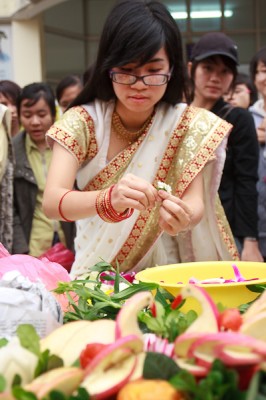
Associate Professor Dr. Do Thu Ha shared that students majoring in Indian Studies often confide: "We feel so lucky to be students of Indian Studies because here, we feel a closeness, love, and connection like a family." Besides learning English, students majoring in Indian Studies also learn about the culture and society of South Asian countries in general and India in particular. Furthermore, students develop soft skills, participate in singing and dancing, cooking, presentations, and engage in Embassy activities such as public speaking, sightseeing, and interacting with Indian students and youth… Notably, this part is used to calculate students' training points.

The Department of Oriental Studies and the Indian Embassy frequently collaborate on exchange activities, creating an environment where students can learn and gain practical experience. Therefore, when students later go to study and research in India, the time it takes for them to adapt to the new environment is significantly shortened. Associate Professor Dr. Do Thu Ha shared: "Initially, the students were unfamiliar with the environment and living conditions in India. However, after learning from experience and thanks to the close cooperation and regular exchanges between the two sides, the Department has selected regions with better and more suitable climates for students to study in. As a result, students now only need a month to get used to the new environment. Before leaving, they all prepare thoroughly, and once there, they receive support from the Embassy, the University, their teachers, and senior students." It can be said that the difficulty in adapting to the current environment is no longer an obstacle. Furthermore, the Department has received assistance and investment from Iran – a major oil power in the Middle East – so the number of scholarships for students in language and culture, as well as other fields of study during and after graduation, is very generous. Currently, the Department has 7 students who have studied here for 2 to 7 years and are about to return home, and will continue to send more students due to societal demand. In the 2010-2011 academic year alone, the Iranian Embassy awarded the Department ten scholarships, including 5 for Bachelor's degrees, 3 for Master's degrees, and 2 for Doctoral degrees.
What makes the difference?
Despite a relatively short development period, students of the Faculty of Oriental Studies in general, and the Indian Studies major in particular, are gradually establishing their reputation. The Indian Studies department has a clear development orientation, investing heavily in teaching materials, English language learning, and supplementing it with Hindi and Persian language instruction in native-speaking countries. Associate Professor Dr. Do Thu Ha believes that foreign languages are one of the tools that help Oriental Studies students have more job and study abroad opportunities. However, this is not the main strength of Oriental Studies students. The reason Oriental Studies students are in high demand is that, in addition to their foreign language skills, they are also equipped with knowledge of the culture, customs, and people of different cultures and countries.
Scholarships currently available for students and trainees majoring in Indian Studies at the Faculty of Oriental Studies:1. Hang Ha - Mekong: Scholarships specializing in culture, offering both postgraduate and undergraduate programs. 2. ITEC: Scholarships from the Indian Ministry of External Affairs for those with 5 years of work experience; this scholarship allows for a one-year master's program. 3. Hindi and Sanskrit Language Scholarships: Students can study for one year and then continue their studies or enter the workforce. 4. ICCR: Regular scholarships for undergraduate, master's, and doctoral students. 5. Iranian scholarships for undergraduate, master's, and doctoral degrees. 6. Short-term exchange scholarships in the USA, Netherlands, and Singapore, taught in English.
Through our discussions, we also learned that students majoring in Indian Studies (including South Asian and Middle Eastern studies) are currently in high demand from both domestic and international organizations. Graduates in Indian Studies can work in areas related to relations between Vietnam and South Asian and Middle Eastern countries, conduct research and teach at universities and colleges, scientific research institutes and centers, work in diplomatic agencies, embassies, representative offices of South Asian countries in Vietnam, domestic and foreign businesses, government and non-governmental organizations, export processing and tourism companies of South Asian and Middle Eastern countries in Vietnam, etc. In 2009, India invested up to US$6 billion in Vietnam, and many Indian companies are opening in Vietnam. Therefore, job opportunities are increasingly abundant. Not only are jobs readily available, but opportunities for further education are also plentiful. If they wish, all students in the major are eligible for scholarships to study abroad. Furthermore, it's particularly noteworthy that students can pursue postgraduate studies in any field such as International Relations, Journalism and Communication, Business Administration, Political Science, etc., not necessarily specializing in Indian Studies. Associate Professor Dr. Do Thu Ha affirms: "Job and study opportunities for students majoring in Indian Studies are currently abundant and equally distributed to everyone if students are passionate, hardworking, and determined." Through a process of striving and proving itself, the attractiveness of the Indian Studies major has been confirmed. In recent years, the number of students enrolling in Indian Studies has increased significantly. In 2009, the major only selected students who listed it as their first choice. In the coming years, the number of students enrolling in Indian Studies is likely to increase even more dramatically.