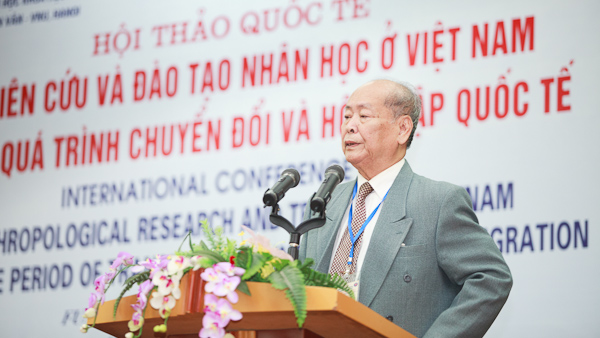
On November 17th, the University of Social Sciences and Humanities will hold a ceremony to celebrate its 65th anniversary. In the atmosphere of this grand occasion, generations of faculty members expressed their affection for the university with its rich history and contributed many ideas for its future development.
1. Prof. Dr. Phan Huu Dat (former Rector of Hanoi University): Integrating with the world using the strengths of Vietnam's social sciences and humanities.
I am very pleased to see that the University of Social Sciences and Humanities - Vietnam National University, Hanoi, since separating from the University of Hanoi, has had many opportunities to develop and maintain its leading position in research and training in social sciences and humanities nationwide. On the occasion of the University's 65th anniversary, I would like to share some lessons learned from the development of the former University of Hanoi: Firstly, to maintain its position as a leading and key university, the prerequisite is to focus on building a teaching staff that is sufficient in quantity, high in quality, and possesses high scientific qualifications. Secondly, under all circumstances, the quality of training must always be prioritized. To achieve this, the admissions process must be rigorous to select only the most talented individuals. During the learning process, the University must focus on cultivating scientific thinking and research methods in students, transforming the training process into a self-training process. Thirdly, teaching and research must be closely linked, with research serving as the foundation for teaching activities.

Fourth, political and ideological work within the university must fulfill the task of guiding and nurturing students' scientific ambitions and aspirations for academic excellence. We must have many individuals like Ngo Bao Chau, with their ambition to conquer scientific heights and elevate the country's position on the world scientific map. Fifth, to achieve the goal of reaching a high position in regional and global higher education, we need to clearly define the specific direction of integration in which fields and disciplines. In my opinion, our primary contribution to world science should be in the social sciences and humanities of Vietnam. We must be world leaders in Vietnamese history, literature, philosophy, etc., and produce world-class research in our own Vietnamese scientific fields, turning them into our strengths.
2. Assoc. Prof. Dr. Vu Thi Phung (Head of the Department of Archival Studies and Office Management): Creating a "Socialist-Humanistic" style to contribute to promoting and enhancing the school's brand.
Having studied and worked at the university for over 30 years, I have always felt proud. Every time I travel for work, simply mentioning the place where I studied and worked elicits praise and admiration from people when they talk about the university or mention the wonderful teachers of the former University of Hanoi, now the University of Social Sciences and Humanities.

I understand that the reason for such praise and pride is that over the years, generations of teachers and students at the school have built a very unique style, a "Synthetic" style, a "Socialist-Humanistic" style. This is an invaluable asset of the school, a brand that dozens of generations have diligently cultivated and continued. It is the style of teachers passionate about science, always seeking and explaining the problems of society and humanity with well-founded arguments, avoiding one-sided thinking, and always being creative and innovative. Then, from their profound research, they bring students passionate lectures, teaching with all their heart and soul, drawing students into a fascinating world of science imbued with humanistic values. It is the style of people who always consider knowledge, understanding, and human dignity as core values. It is the style of the teachers that shapes the style of generations of students, with broad knowledge, profound thinking, always creative in their perspective and interpretation of problems, always seeking and venturing into new things, and knowing how to bravely reject and overcome common temptations.
3. Prof. Dr. Do Quang Hung (Department of Political Science): Social sciences and humanities must aim for international standards in training and research.
The University of Social Sciences and Humanities, Vietnam National University, Hanoi, is highly committed to integrating with the world. I believe this is an inevitable trend for social sciences and humanities in general, and a leading university like ours cannot stand aside. Integration is not only about attracting resources to serve our development, but more importantly, it is time for Vietnamese people to contribute to world science on issues of global significance. The key is to clearly define the criteria for achieving international standards. In my opinion, these are the following factors: Firstly, social sciences and humanities today must be able to answer human and societal problems that are both broad and specific. Secondly, research and training in social sciences and humanities must aim for modernity and be up-to-date with global developments, reflected in research issues, research methods, knowledge systems, and the learning and application of new models, methods, and training programs.

Third, social sciences and humanities, along with natural sciences and other scientific disciplines, are not rigidly separated today; on the contrary, they are closely intertwined and influence each other. This close intertwining must be clearly demonstrated in research and training in social sciences and humanities. Currently, one of the weaknesses of social sciences and humanities in developing countries like Vietnam is the failure to fully utilize the knowledge and resources of natural sciences and technology in research and training, for example, the application of many research and measurement methods of mathematics or modern machinery and technology. Fourth, research in social sciences and humanities must aim at the goals of humanity and global issues, in addition to the goals of the nation. When defining research directions, Vietnamese social sciences and humanities must pay attention to anticipating and linking their research to issues of global significance, such as climate change, the impact of the environment on humans, and emerging psychological issues in modern society. Fifth, research and training in Vietnamese social sciences and humanities must be able to "interact" with other countries. This is also one of the most difficult points for Vietnam because, in reality, Vietnam's integrated research is not yet deep, or in other words, has not yet joined the global research channels. A concrete and very encouraging manifestation at the University of Social Sciences and Humanities today is the increasingly strong development of international joint training programs with world-class universities. This will be an effective activity contributing to strongly promoting the university's integration with the world.
4. Assoc. Prof. Dr. Pham Thanh Hung (Deputy Head of the Faculty of Literature): Effectively addressing the relationship between diversifying training types and promoting basic research.
In its development orientation towards becoming a multidisciplinary, high-level university, while also focusing on research, Hanoi National University clearly demands a harmonious and dialectical combination to overcome the inevitable contradiction between diversifying training types and promoting basic research. In recent years, the University of Social Sciences and Humanities has developed many new training programs with high practical application and professional skills. This is a legitimate development direction, promptly meeting the country's practical needs. The university has become a reliable institution for society to commission. Graduates from programs in Journalism, Tourism, Library and Information Science, Archival and Office Management, Social Management, International Studies, etc., easily find employment. However, this development trend has led to a certain degree of neglect of theoretical research and basic science. In my opinion, some traditional training departments such as Literature, History, and Philosophy, which once defined the identity and strengths of the former University, need more attention and investment.

For decades, these fundamental and traditional sciences have trained a large and capable workforce of scientists and cultural professionals, capable not only in research and teaching but also in a wide range of practical activities. In my opinion, this is not a reluctant acceptance or adaptation, but a strength forged from fundamental science training. Literature, History, and Philosophy, as taught in the traditional faculties of the past, were not simply about knowledge and understanding, but also, and importantly, about methods of thinking and skills for solving problems posed by science and life. That being said, this does not mean that the university needs to downsize or dismantle one faculty and expand another. The specific focus here is on the fundamental science disciplines and their respective training units. These scientific disciplines must become the spearhead of training, transforming into foundational knowledge for other professional fields of study.