Scientific research is one of the traditional activities and strengths of the faculty and students of Hanoi University. Famous scientific works and a style of in-depth scientific thinking have become characteristic of both teachers and students. Therefore, the title "Hanoi University student" has become a source of pride for generations of students.In line with the policy of promoting higher education in Vietnam, the Vietnamese Government decided to establish two National Universities at opposite ends of the country as the leading institutions of Vietnam's higher education system. Hanoi University is the core of one of these two universities – Hanoi National University. With favorable mechanisms and conditions, the University of Social Sciences and Humanities – as a core member of Hanoi National University – has achieved significant accomplishments in research and training, upholding the traditions of Hanoi University. One of these achievements is the scientific research work of its students. Looking back over the past 15 years, we can affirm that the scientific research work of students at the University of Social Sciences and Humanities has made significant progress in both quantity and quality. In addition to the general upward trend of student scientific research nationwide, from "
Student Science Research Week" arrive "
Student scientific research movement"Scientific research by students of the University of Social Sciences and Humanities has gone beyond..."
movementand gradually became an indispensable activity in the learning process of students.
1. First impressions (1996)
In 1996, 10 out of 12 faculties organized student scientific conferences.
(1)with 198 reports. Besides students from traditional faculties such as History, Literature, and Philosophy, students from newly established faculties such as Tourism Studies, International Studies, and Oriental Studies also actively participated in scientific research. Many students who actively participated in scientific research at that time have now become lecturers and administrative staff of the University, such as:
- Bui Viet Ha, a student of the K37 cohort, Faculty of Literature.
- Pham Van Dung, a student of the K39 cohort, Faculty of Literature.
- Pham Thuy Hong, student of K39, Faculty of Literature
- Nguyen Van Suu, student of K38, Faculty of History
- Ly Tuong Van, a student of the K38 class, Department of History.
- Le Thi Quynh Nga, student of K38, Faculty of History
- Lai Quoc Khanh, student of class K39, Faculty of Philosophy
- vv..(2)
With these examples, we can affirm that scientific research, even from the time students are still in school, has been, is, and will continue to be an important foundation in university education, especially in basic science fields.
2. Overall assessment of student scientific research activities 1996 – 2010
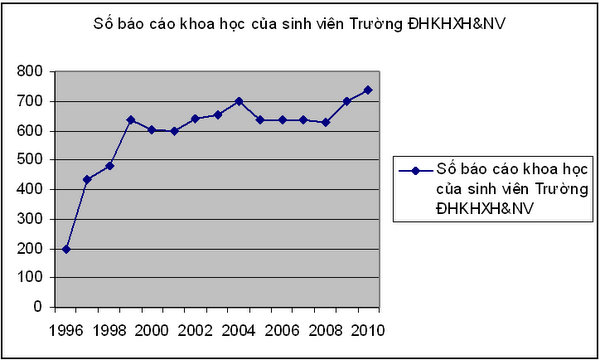
One of the significant advantages of the university's student scientific research activities is that students study in the environment of a traditional university with a long history of scientific research. In each lecture, students are instilled with a passion for exploring and discovering new things in science by the teaching staff. This learning environment has significantly contributed to encouraging a large number of students to actively and effectively respond to the policies of the Ministry of Education and Training, as well as the Vietnam National University, Hanoi and the university itself, regarding student scientific research activities. The number of students participating in scientific research is steadily increasing.
(Chart 1)In some exceptional years, a single student participated in up to two scientific presentations.

Notably, during their participation in scientific research, many students voluntarily formed groups to collaboratively conduct their research.
This shows that student scientific research not only improves the quality of education at the university but also plays a crucial role in developing and honing collaboration and teamwork skills – soft skills that are still lacking in current Vietnamese training programs.The faculty members of the University actively and effectively participate in guiding and assisting students in scientific research. In particular, there are senior professors and lecturers who, despite being very busy with the University's scientific research and postgraduate training activities, still enthusiastically dedicate their time to guiding students in scientific research, such as Prof. Vu Duong Ninh (Faculty of International Studies), Assoc. Prof. Dr. Nguyen An Lich (Faculty of Sociology), Assoc. Prof. Dr. Pham Xanh (Faculty of History), etc. The younger staff members also play an important role in contributing to the scientific research achievements of the University's students, such as Ms. Pham Anh Sao (Faculty of Literature), Mr. Nguyen Tuan Cuong (Faculty of Literature), Ms. Nguyen Thu Thuy (Faculty of Tourism Studies), Mr. Dinh Viet Hai (Training Department), Ms. Do Huong Thao (Faculty of History), etc. Faculty and departmental management, as well as the teaching staff, have always considered supporting and organizing student scientific research as a regular task. Therefore, supporting and guiding student scientific research has been identified by the University as one of the types of scientific research activities for faculty members, with specific hourly rates for those participating. Over the past 15 years, the Board of Directors and relevant departments have given due attention to directing and investing funds to encourage and motivate students to actively participate in scientific research. In addition to regular scientific research funding from the state budget, the University annually allocates hundreds of millions of VND from supplementary revenue to support student scientific research.
See Chart 2Faculty and departmental management, as well as the teaching staff, consistently identify supporting and organizing student scientific research as a regular task. Therefore, the University has recognized supporting and guiding student scientific research as one of the types of scientific research activities for faculty members, with specific hourly rates for those participating.

Student scientific research is one of the important and in-depth activities of the Youth Union and Student Association at all levels. Many branches of the Youth Union and Student Association have actively coordinated with class representatives to organize student scientific conferences for their respective classes. The Youth Union of the University of Social Sciences and Humanities has initiated the awarding of prizes to student scientific research projects that contribute to the development of the Youth Union and Student Association movement.
Moving beyond mere activities and becoming a regular part of teaching and learning at the University is one of the important developments in the scientific research activities of students at the University of Social Sciences and Humanities.Lecturers introducing new directions in the subject, assigning homework, and students asking questions and requesting suggestions for approaches and new materials have become regular activities in the classroom. This is especially evident since the university transitioned to a credit-based training system. Class time at the University of Social Sciences and Humanities is not simply a teaching and learning activity but also takes on the style of a scientific seminar. To enhance students' scientific research spirit, given the university's focus on basic sciences, the curriculum often requires students to write course essays and dissertations. This increased awareness of scientific research during their training has led many students to proactively seek and define their research direction, from identifying topics for course essays and dissertations to their research topics and graduation theses. Among them, a significant number of students have pursued their research at the postgraduate level. Many students have been invited to participate in scientific projects of faculty members at the university, and in particular, many have been invited by faculty members to contribute independent papers to major research projects. Because it has transcended mere participation and become a regular, indispensable part of the training process, in addition to the large number of participants, the scientific research activities of students at the University of Social Sciences and Humanities have achieved encouraging results in terms of quality.
On average, students at the university receive 6-8 ministerial-level awards annually. Over a 10-year period (2000-2009), students won 6 first prizes at the ministerial level; the university was awarded the title of "Outstanding Unit in Student Scientific Research" 6 times and received a Certificate of Merit from the Ministry of Education and Training.According to statistics, students who are active in scientific research achieve very good academic results and are promoted to master's and doctoral programs.
See Table 1Based on experience, these students can absolutely obtain a doctoral degree within 4-8 years of graduating from university. The practice over the past ten years shows that many students from cohorts K38 and K39 (graduated in 1997 and 1998) who were active in scientific research now hold doctoral degrees and occupy management positions at the faculty and university levels.
| Year |
1996 |
1997 |
1998 |
1999 |
2000 |
2001 |
2002 |
2003 |
2004 |
2005 |
2006 |
2007 |
2008 |
2009 |
2010 |
| Transfer students |
Not yet regulated |
Not yet regulated |
Not yet regulated |
Not yet regulated |
Not yet regulated |
17 + 1 (Master's + Doctoral Candidate) |
11 + 0 (Master's + Doctoral Candidate) |
37 + 2 (Master's + Doctoral Candidate) |
42 + 0 (Master's + Doctoral Candidate) |
94 + 10 (Master's + Doctoral Candidate) |
0 + 0 (Master's + Doctoral Candidate) |
1 + 0 (Master's + Doctoral Candidate) |
3 + 1 (Master's + Doctoral Candidate) |
0 + 0 (Master's + Doctoral Candidate) |
Not yet considered |
Table 1. Number of research students transferred to postgraduate training (1996 – 2010)
A very important qualitative outcome of students' scientific research activities is the development of their ability to identify scientific and practical problems requiring research, their ability to approach and develop solutions to those problems, their ability to apply research methods, and their ability to write and present research results.Although these are qualitative results, we believe this is the expected outcome of student scientific research in universities. These results allow us to identify talented individuals in science and technology early on, enabling the development of training, nurturing, and utilization policies. They also help bridge the gap between academic knowledge and the demands of the workplace. Furthermore, these results reflect a training philosophy that transforms the training process into a self-training process, developing the capacity to become lifelong learners. From 15 years of organizing and implementing student scientific research activities at the University of Social Sciences and Humanities, Vietnam National University, Hanoi, we can draw some typical experiences – experiences that have contributed to significant achievements in student scientific research.
3. Some typical experiences in organization and management
- Recognizing that student scientific research is a regular activity in the training process, at the beginning of the academic year (September), the University of Social Sciences and Humanities organizes a conference for leaders and assistants of faculties/departments responsible for scientific research, along with representatives of the Youth Union, Student Association, and relevant departments, to discuss, exchange ideas, and develop specific and detailed plans regarding funding, time, organizational methods, etc. This allows individuals and relevant departments to proactively and effectively implement student scientific research early on. - Faculties, departments, and Youth Union/Student Association organizations at all levels, and especially the teaching staff, actively participate in initiating, supporting, assisting, and guiding students in selecting and registering research topics and supervisors; students also take advantage of opportunities to seek advice from their teachers during class time. The Youth Union and Student Association also organize discussion sessions and share experiences on writing and presenting scientific reports for students, especially first-year students who lack research experience. - Student scientific conferences are organized and selected at the class, department, faculty, and group levels, and based on that, the University organizes a university-level student conference. The annual publication of the student scientific conference proceedings, structured in three parts (Part I. Award-winning works at the Ministry level, Part II. Summary of award-winning works at the University level, and Part III. List of student scientific reports by year and faculty), is not only valuable as an archival document but also serves to encourage individual students and classes to actively participate in scientific research in subsequent years. - Policies and regulations regarding financial support, scientific research hour calculation, and criteria for evaluating year-end labor achievements for teaching staff; The system regarding financial support, bonus points, and postgraduate transfer standards for students participating in scientific research is documented, publicly available, transparent, and strictly implemented. - The university assigns a dedicated specialist (at the university level) along with a scientific assistant and a student affairs assistant at the faculty level to regularly monitor and supervise the work. - Investment in funding is in-depth and effective: In addition to regular budget allocations, the university allocates funds from supplementary revenue sources to support student scientific research. However, the most important aspect is the investment method: Only students with scientific reports receive financial support from the university, and especially, after the university-level conference, promising projects receive more funding through scientific research contracts, allowing students to further refine their research.
4. Some solutions to improve the effectiveness of scientific research activities of students.
- Streamline the curriculum to allow students time for self-study and research; lecture outlines should clearly address and explain new research directions in the subject and include mandatory assignments to help students gradually become familiar with these new directions. - Innovate the content and methods of teaching: enhance the atmosphere of exchange and discussion in class to stimulate curiosity, passion, and exploration in students. - Increase funding for scientific research in universities, focusing on regular research funding to encourage and compel faculty to conduct scientific research. Based on this, encourage and create mechanisms for students to participate in research programs and projects of faculty members. - Encourage and facilitate students to publish their scientific research results in the university's scientific journals, and even specialized journals. - Innovate the activities of student associations and unions towards greater depth: Consider student scientific research as one of the key contents of their activities. This is particularly suitable for the credit-based training method, where the role of the department or faculty in relation to the student is less closely tied than in the traditional semester-based system, especially in the early years when students are still taking common courses organized into class groups.
5. Some recommendations
- The Ministry needs to have mechanisms and policies to invest in training high-achieving students with a level of funding similar to or higher than that for postgraduate training abroad using state budget. Student scientific research can be considered one of the methods for identifying talent in the field of science and technology. And if this is true, then the next steps must certainly be...
training and developmentand
important- Besides the formal award ceremony, the Ministry should organize direct exchanges and discussions, and furthermore, create a dedicated forum for students to exchange experiences in scientific research. This forum would also serve as a tool to monitor the academic and career paths of promising individuals, providing support when needed. - There should be separate scoring and selection criteria for awards in basic sciences, as this is a difficult but essential research area. - There should also be separate scoring and selection criteria for awards in specialized fields such as social sciences and humanities, as works in this field are less likely to receive high scores, especially perfect scores, compared to natural sciences and exact sciences. In practice, over the years, the social sciences and humanities have generally received fewer awards, especially first prizes, compared to natural sciences and exact sciences. - The guidelines for judging and selecting awards should focus more on methodology and ideas rather than research results, given the limited capacity, time, and research budget of students.
Note
(1) At that time, the Faculty of Law and the Faculty of Economics still belonged to the University of Social Sciences and Humanities. The two faculties that did not organize the Student Scientific Conference were the Faculty of National Defense Education and the Faculty of Vietnamese Language and Culture for Foreigners, these two faculties did not directly train full-time students. (2) See Proceedings of the First Student Scientific Conference. University of Social Sciences and Humanities, May 1996.