
School - prison
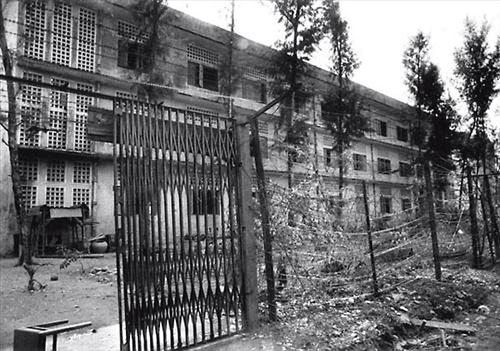
The Toulsleng Memorial Museum is located in the heart of Phnom Penh. The bustling street is a constant source of life, but stepping inside evokes a chilling feeling, as if time has stopped. Before the genocide, this place was a school with three U-shaped buildings embracing a courtyard shaded by ancient trees. One imagines children in uniforms, backpacks slung over their shoulders, carefree, dancing and singing. But then, as if from the heavens, a cold, chilling shout, the deafening sound of gunfire, and innocent lives were lost.
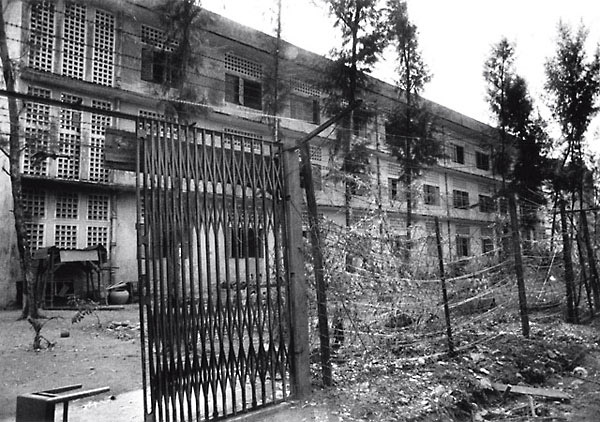
A view of the Toulsleng Memorial Museum in the heart of Phnom Penh (Photo: me.zing)
The first building in this historical museum complex was a prison for Cambodian revolutionary cadres. When the Cambodian army and Vietnamese volunteer troops stormed in to liberate the area, Pol Pot's forces had just executed 14 Cambodian cadres whom they considered dangerous elements. Each cell held one prisoner, with an iron bed that they forced the prisoner to lie on and then locked with an iron padlock.
The next row of buildings was the detention area for those whom Pol Pot suspected of opposing them. At times, this area held thousands of people. The outer railings were woven with barbed wire so tightly that not even a chicken could get through. Following the principle of "better to arrest the wrong person than let the guilty one escape," regardless of age or gender, anyone showing any suspicious behavior was arrested or shot on the spot.
In the last row of buildings was where they tortured and abused prisoners. The simulated images of their torture were truly brutal. They did everything they could to inflict extreme and prolonged pain. They twisted limbs behind their backs, tied them up, carried them on their backs, and beat them like animals. Then there was the horrifying scene of forcing prisoners to jump from a height onto sharp swords below, etc. Another extremely cruel and haunting scene was that of the wife of Mr. Kuy Thuon - the Minister of Commerce at the time - being subjected to the horrific torture of having iron drilled into her head. The drill slowly went in, causing a great deal of horror, simply because they considered the minister a capitalist, an enemy they regarded as someone to be eliminated.
O Cun Vietnam!
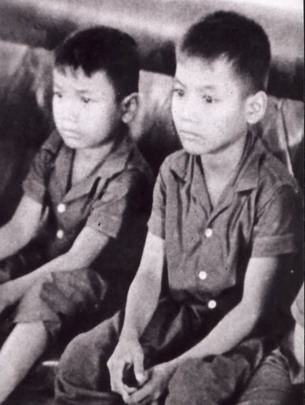
The two brothers, Norng Chan Phal and Norng Chan Li, were rescued from genocide by Vietnamese volunteer soldiers (Photo: tuoitre.vn).
The first Cambodian we spoke to was Mr. Norng Chan Phal. As the group was beginning to listen to our guide, Thach Da Ra, introduce the group, a middle-aged man approached and asked permission to speak. After receiving the group leader's permission, he clasped his hands in front of his chest in the Cambodian custom and said: "I would like to thank the Vietnamese people, thank the Vietnamese volunteer soldiers for saving us from death, from the genocide." He pointed to a large banner depicting Cambodian soldiers and Vietnamese volunteer soldiers rescuing children. Two of those children, completely naked, were Mr. Norng Chan Phal and his younger brother, Norng Chan Li. Thirty-five years have passed, but Mr. Norng Chan Phal cannot forget that rare moment when he escaped death and was given a second chance at life. And, fortunately for him, his brother, Norng Chan Li, also escaped the genocide thanks to the protection of the Vietnamese volunteer soldiers. Mr. Thach Da Ra said that Mr. Norng Chan Phal now has a family, a wife and two children. He works as an employee at this historical museum. Every time a delegation from Vietnam comes to visit or work, he always insists on meeting them to express his heartfelt gratitude: Thank you Vietnam, thank you Vietnamese volunteer soldiers!
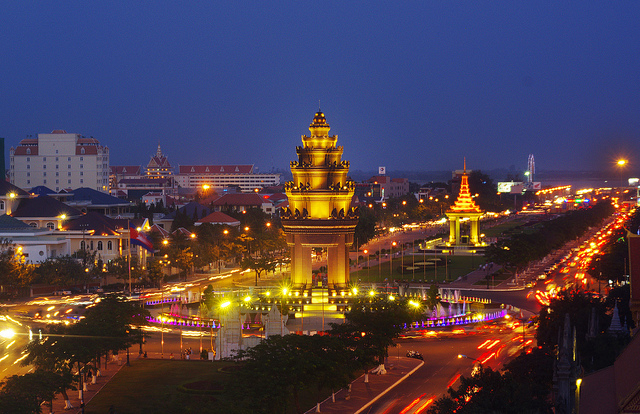
Cambodia today: Phnom Penh streets at night / Photo: worldtravel-tour.com
Epilogue
That's what war is like. The ultimate evil between people, between fellow human beings, between those of the same blood, the same clan. When there is no longer love for one's fellow human beings, when evil becomes瘋狂 and disregards everything, actions become worse than animalistic. Who knows how many killing fields, how many prison camps like Toulsleng, how many mass graves are there in this country of over one hundred thousand square kilometers?
Cambodia has been liberated, freed from genocide. Now Cambodia is on the path of renewal and development. Her smile is as bright as a Ph'ca-colap (rose), as gentle as an Apsara dance, and as captivating as a heartwarming melody. They want to forget what the entire Cambodian nation has gone through, what it has endured. But there is one thing they will not forget, never forget, and it is so simple:O Cun Vietnam, O Cun Vietnamese volunteer soldiers!"Thank you Vietnam, thank you Vietnamese volunteer soldiers!"
Author:Pham Dinh Lan
Newer news
Older news

