
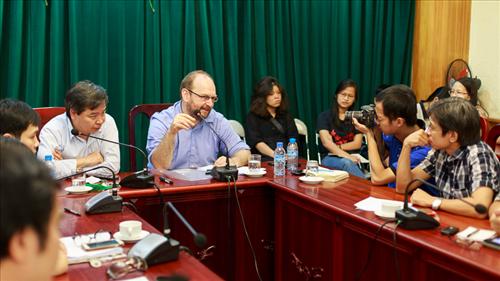
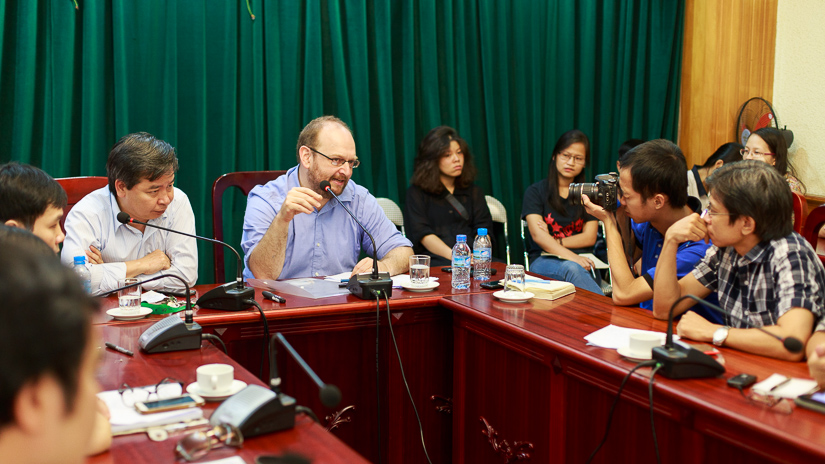
(Photo: Jackie Chan/USSH)
Professor Peter Zinoman is an Associate Professor of History in the Department of History and the Department of South and Southeast Asian Studies at the University of California, Berkeley; co-founder and former Editor-in-Chief of The Journal of Vietnamese Studies. He is the author of the book "The Colonial Bastille: A History of Imprisonment in Vietnam, 1862-1940" (Berkeley: University of California Press, 2001) and the translator of Vu Trong Phung's novel "Dumb Luck" into English. Professor Zinoman's research areas include the cultural, social, and political history of modern Vietnam, as well as the history of Vietnamese literature in the 20th century.
Professor Peter Zinoman's talk focused on three main points:
- What is the history of the formation of the main research directions on Vietnamese history in the United States, and what factors have influenced the development of this field of study?
- The structure and current state of research on Vietnamese history in the United States: listing the universities, prominent scholars, and major research works, as well as the impact of such research on the scientific community and on American political and social life.
- The relationship between Vietnamese historians in the US and the Vietnamese historical community, and the need for scientific exchange and collaboration between the historical communities of the two countries in the current context.
The presentation included quite elaborate and detailed data and research, painting a comprehensive picture of the development process, influencing factors, and research trends on Vietnam in the US to date.
Concluding his speech, Professor Peter Zinoman emphasized that Vietnamese studies in the United States are experiencing unprecedented growth. Among researchers, there are emerging young historians capable of forging their own paths, daring to explore challenging and interesting research topics with diverse approaches. Their Vietnamese language skills have also improved significantly; most are proficient in Vietnamese, and some can conduct in-depth research using Chinese and Nôm scripts. However, there remains a significant imbalance in the number of researchers studying pre-modern and modern periods.
Speaking about the connection between history researchers from the two countries, Professor Peter Zinoman shared his thoughts humorously: "TMembers of the American and Vietnamese historical communities do not dedicate enough time to reading each other's research."American scholars are not very familiar with the research of Vietnamese historians, nor have they made any effort to publish their research in scientific journals in Vietnam. Very few Vietnamese and American scholars have undertaken the translation of their research into the other language so that, through translation, their work can reach a larger readership."
The speaker also stated:I think this is a laborious but worthwhile endeavor because researchers in both countries have much to learn from each other."
The delegates asked questions and exchanged views with Professor Peter Zinoman on many issues related to the presentation content: Clarifying the influence of political factors on Vietnamese studies by American researchers? Why haven't the works of Vietnamese researchers received attention from American researchers? How can we delve deeper into difficult topics in Vietnamese history such as land reform, the 1979 border war, and the "humanist literary movement"? What are the approaches and methods used by American scholars in accessing and utilizing historical documents about Vietnam from various sources?
Author:Thanh Ha
Newer news
Older news

