
In an interview with us, Associate Professor Vu Quang Hien, from the Department of History, University of Social Sciences and Humanities (Vietnam National University, Hanoi), affirmed that the deployment of the Haiyang 981 oil rig deep within Vietnam's continental shelf and exclusive economic zone was a carefully calculated move by China to pressure Vietnam and several other countries in the region, further expand its influence, and ultimately dominate the South China Sea...
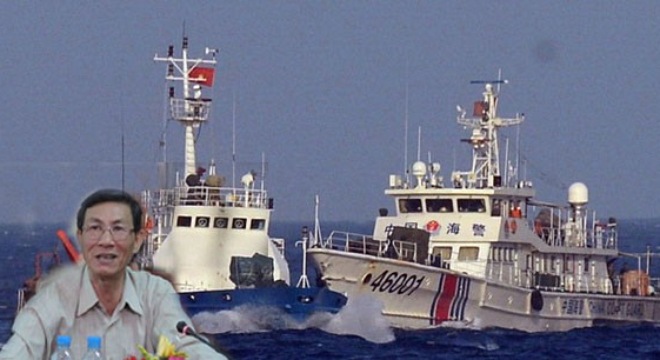
PV: Professor Vu Quang Hien, more than a month has passed since China illegally placed the Haiyang 981 oil rig in Vietnam's exclusive economic zone, and they have not hesitated to threaten and use violence, causing consequences such as sinking Vietnamese fishing boats and damaging Vietnamese law enforcement vessels. As a historian, what are your thoughts on this?
Associate Professor Vu Quang Hien: Personally, I'm not too surprised by China's recent actions, because I understand China's strategy is its ambition to control over 80% of the South China Sea. In essence, their intention is to seize most of the South China Sea.
Therefore, the deployment of the Haiyang 981 oil rig is merely the next step in a long series of previous military and economic actions by China, reflecting its expansionist ideology, as we have witnessed.
First, in the media sphere, China frequently propagates false information about its sovereignty in the South China Sea. Even on some Chinese flights, there are always maps displaying inaccurate information, placing the Paracel and Spratly Islands, which are under Vietnamese sovereignty, within what China unilaterally claims as its own "nine-dash line."
Moreover, some Chinese leaders have even put forward the view that this is a core national interest, meaning they consider the sovereignty of other countries as their own core interest. Here, the true nature of China's great-power and hegemonic ideology is clearly revealed.
From a military standpoint, a series of actions in 1974, when China illegally seized the Paracel Islands from Vietnam, and then occupied Gac Ma Reef in 1988, clearly demonstrated their hegemonic nature and ambitions. Not to mention, China's blatant establishment of the so-called Sansha City and construction of an airstrip...
Furthermore, Chinese ships have repeatedly rammed, collided with, and even sunk Vietnamese fishing boats, and cut the cables of Vietnamese vessels while they were operating normally in Vietnam's sovereign waters...
In various ways and at different levels, over the past period, and especially since China illegally deployed the Haiyang 981 oil rig, Vietnam has repeatedly protested against China's arrogant and illegal actions.
It is also clear that over the past month, despite China's numerous threats and actual use of violence, we have persistently pursued a peaceful and diplomatic path. This is a necessary and just cause, and it reflects the peace-loving spirit of our nation.
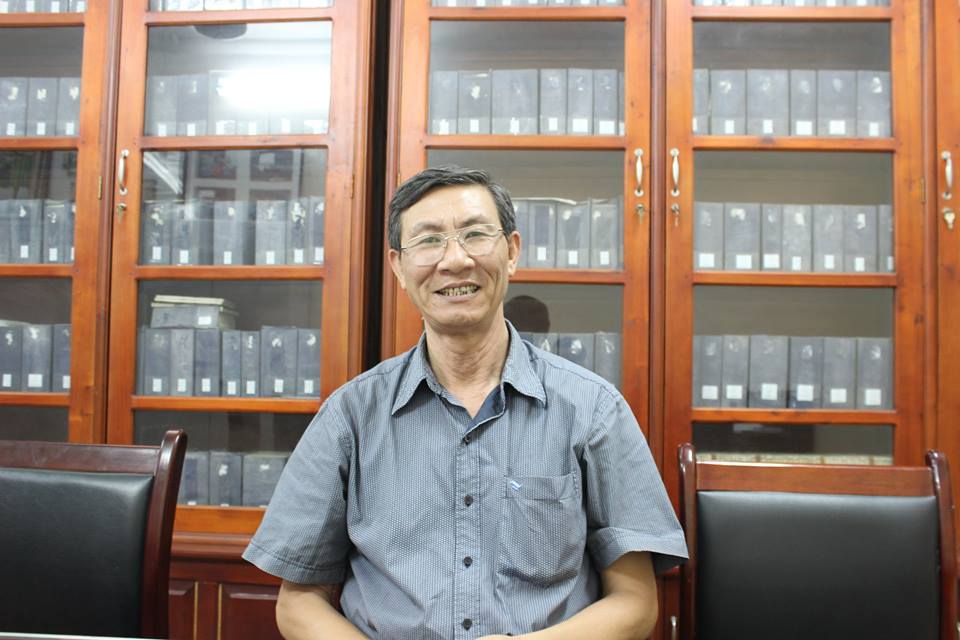
Assoc. Prof. Dr. Vu Quang Hien, Department of History, Faculty of Social Sciences and Humanities (Vietnam National University, Hanoi)
PV: Professor, could you explain why China, a major power and a permanent member of the United Nations Security Council, engages in such arrogant actions and blatant violations of international law?
Assoc. Prof. Dr. Vu Quang Hien:I think that the Chinese people are not like that, but the leaders in Beijing often say one thing and do another.
Here, there seems to be a resurgence of Greater Han expansionism, a deeply ingrained disease of the ancient Chinese emperors who often considered themselves the rulers of the world, coupled with chauvinism, great-power ideology, and a nationalistic mindset, believing themselves to be the ultimate truth and using themselves as a frame of reference for all nations and values in the world.
Moreover, they seem to consider themselves the epitome of the world's moral and legal values, and therefore, they disregard everything else.
From a moral standpoint, in their relationship with Vietnam, China has spoken very kind and positive words, but their actions are completely contradictory. It should also be added that while the leaders speak to Vietnam in a seemingly friendly manner, the Chinese propaganda and media system frequently engage in slander and defamation against Vietnam.
All nations and countries deserve equality, but in its relations with smaller countries, China never achieves equality and always maintains a great-power mentality.
In addition, they possess strong economic and military capabilities, are a rising nation with a need for development, and they consistently emphasize that this rise and need should be peaceful. However, peace cannot be based on disregard for morality and international law, and the sovereignty of another country cannot be considered the sovereignty of one's own.
PV: Professor, is it possible that this very nature has led to China always demanding that other countries respect history, yet they themselves are incredibly arrogant and disregard history?
Assoc. Prof. Dr. Vu Quang Hien:That's absolutely true. From an international legal standpoint, China knows full well that it is in the wrong and is not complying with any laws. That's precisely why China refused to participate in the arbitration proceedings with the Philippines.
So, they want to use historical grounds, but what kind of history are they referring to? China always wants to gravitate towards a particular historical basis, but it's a history they've fabricated themselves.
China's historical foundation is not solid, or rather, it is nonexistent. Therefore, they never dare to confront or engage in dialogue, only wanting people to accept the fabricated history they themselves have created.
It should also be added that China's forceful occupation of Vietnam's Paracel Islands and Gac Ma Reef was a military act, not an act of peaceful appropriation. History also records that China has never exercised administrative control over the Paracel Islands and the islands it illegally occupies belonging to Vietnam.
PV: Besides China's strengths, what weaknesses do you think it has?
Associate Professor Vu Quang Hien: I believe that resorting to shouting, intimidation, threats of force, and other threats of violence against other countries that hinder China's actions is a product of weakness.
These actions and products of militarism only tarnish the image of the country and its leaders in the eyes of humanity, and will never make China stronger. China's greatest weakness is its lack of righteousness.
The second weakness, as I mentioned, is that China has no legal or historical basis to assert its sovereignty over the Paracel Islands and other islands and reefs it has illegally occupied from Vietnam. China is weak in terms of justice, legal grounds, and even its attitude and thuggish actions in the South China Sea, as seen recently.
PV: Could you elaborate on the statement that Vietnam always respects China but never fears China?
Associate Professor Vu Quang Hien: This is absolutely correct. Vietnam has always respected and maintained friendly relations with its neighboring countries, whether large or small. Since ancient times, our ancestors have said, "Sell distant relatives, buy close neighbors," because close neighbors are more readily available to each other in times of need than distant relatives. Clearly, having good neighbors is wonderful.
We never speak ill of the Chinese people or country; whatever we say is very specific. Those are irrational actions, and the responsibility lies with the Chinese authorities, not the Chinese people or country.
But despite respecting China, Vietnam has never feared it. This is because, throughout our nation's history, the northern dynasties, primarily China, have ruled Vietnam for thousands of years, and frequently invaded during the period of feudal independence, yet they have never been able to take away our national culture.
And no matter how powerful the northern dynasties were, they ultimately had to surrender; we always regained our independence, self-reliance, and sovereignty.
In the historical context, we may have been conciliatory towards China, but this is not weakness or fear; it is simply a desire for China to respect Vietnam's fundamental national rights. However, if our sovereignty and territorial integrity are violated, the Vietnamese people will resolutely stand up, fight, and defend them to the end using all possible means.
PV: So, what do you think about taking this neighbor to court?
Associate Professor Vu Quang Hien: Taking China to an international court is also a measure we have considered, and this is a civilized way to resolve the issue at this time. With our just cause and history, winning the case in court is certainly a given.
However, this also requires careful consideration and thorough preparation, and moreover, it is a measure that should only be taken if China forces us to do so.
Thank you for this conversation!
Author:Hoang Dan
Newer news
Older news

