
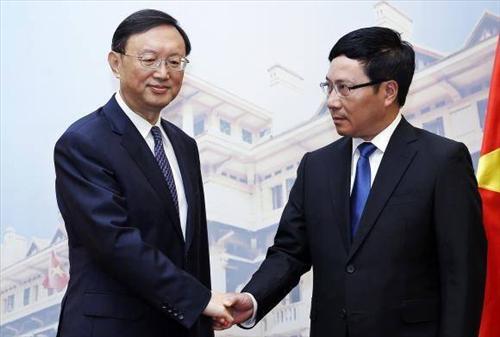
Vietnam earnestly desires peace, friendship, and development among nations, and frankly speaking, throughout its history, including to this day, Vietnam has had to confront unhealthy and inappropriate "border behaviors" originating from China. The statements made by the spokesperson of the Chinese Ministry of Foreign Affairs and the Chinese press from the beginning of May this year, up to the recent visit of Chinese State Councilor Yang Jiechi to Vietnam, speak volumes about this.
To date, despite the absurdity, China insists that its illegal placement of the Haiyang Shiyou-981 deep-sea drilling rig in Vietnamese waters is a normal activity within its own territorial waters. When Vietnamese fishing vessels operate in their traditional fishing grounds and coast guard ships carry out their duties, and when Vietnamese ships, in Chinese, English, and Vietnamese, demand that China cease violating Vietnam's sovereignty, they are obstructed, chased, rammed, and damaged by Chinese vessels. Furthermore, Chinese iron-hulled fishing vessels have even rammed and sunk the Vietnamese fishing vessel ĐNa 90152. Following this, China continuously distorts and falsely accuses Vietnam of deploying military vessels and frogmen to harass the Haiyang Shiyou-981 drilling rig; spreading rumors that Vietnamese ships have rammed their vessels more than 1,500 times; and even having Chinese vessels reverse close to Vietnamese coast guard ships to falsely accuse Vietnamese ships of ramming theirs. This clumsy charade has been exposed by international journalists. The world doesn't believe what China says; they are interested in, comment on, and judge what China does in its so-called "peaceful rise."
China advocates a 16-character motto of friendship: "Friendly neighborliness, comprehensive cooperation, long-term stability, and a future-oriented approach," and the spirit of the four "goods": "Good neighbors, good friends, good comrades, and good partners," leveraging the advantages of "connected mountains and rivers, shared ideals, similar cultures, and intertwined destinies." We welcomed this principle and at one point called it the "16 golden words," because it was so wonderful, why wouldn't we welcome it! Because of this "connected mountains and rivers," we greatly needed this spirit of friendship and strived together with China to make it truly friendly in practice. Alas, it turns out that "what is said is not so!" Even during a time when both China and Vietnam are obligated to uphold the spirit of the 16-character motto and the four "goods," when Vietnamese fishermen from the central provinces fish in their traditional fishing grounds under their sovereignty, China has repeatedly chased away, attacked, beaten, and arrested Vietnamese fishermen along with their fishing gear, then demanded ransom for their fishing boats. For the sake of the greater good, our press often refers to these as "foreign ships" harassing Vietnamese fishing boats, but the Vietnamese people and the world know that these "foreigners" are the very ones who initiated the "spirit of the 16-character motto and the four "goods."
Next, on May 15, 2011, Chinese coast guard vessel number 84 cut the cable of the Vietnamese vessel Binh Minh 2 while it was on duty in Vietnam's sovereign waters, 110 nautical miles from Dai Lanh Cape (Phu Yen). Yet, on May 31, 2011, the People's Daily Online (China) brazenly distorted the truth, stating: "Vietnam has aggressive intentions in the South China Sea; China cannot continue to restrain itself forever." On June 9, 2011, the Vietnamese oil and gas exploration vessel Wiking 2 was again attacked by three Chinese paramilitary vessels that cut its cable within 200 nautical miles of the baseline.
On October 12, 2011, high-ranking leaders of the two countries signed an Agreement on the Basic Principles Guiding the Resolution of the Vietnam-China Maritime Issue. The first principle states: “Taking the overall relationship between the two countries as paramount, starting from a strategic and comprehensive perspective, under the guidance of the motto ‘friendly neighborliness, comprehensive cooperation, long-term stability, and a future-oriented approach’ and the spirit of ‘good neighbors, good friends, good comrades, and good partners,’ we will persistently handle and resolve maritime issues appropriately through friendly consultation, making the South China Sea a sea of peace, friendship, and cooperation, contributing to the development of the comprehensive strategic cooperative partnership between Vietnam and China, and contributing to maintaining peace and stability in the region.”
That was one of the six guiding principles agreed upon by the high-ranking officials of both countries, and even during the days leading up to the signing in Beijing, Vietnamese fishing vessels were still being chased away and threatened by Chinese authorities in their traditional fishing grounds.
This year, in early May, China again deployed dozens of vessels of various types, including armed ships escorted by aircraft, to transport the Haiyang Shiyou-981 deep-sea drilling rig to Vietnam's waters (a sea area over which Vietnam has sovereignty in accordance with the 1982 UNCLOS Convention). This incident is known worldwide. Images of Chinese aircraft hovering threateningly and Chinese vessels using water cannons and ramming into Vietnamese police ships have appeared repeatedly not only on Vietnamese television but also on television in many countries around the world. The world is concerned about China's disregard for international law, threatening international maritime security. The Vietnamese people vehemently protest China's actions that show contempt for both law and morality. This morality does not genuinely uphold the spirit of the "16 words," the "four good principles," and the "Basic Principles Guiding the Resolution of the Vietnam-China Maritime Issue."
***
Following the visit to Vietnam by Chinese State Councilor Yang Jiechi, according to a BBC report on June 18, 2014, Xinhua News Agency (China) reported that the Chinese government and Communist Party always emphasize the importance of Sino-Vietnamese relations in their long-term strategic vision and are ready to cooperate with the Vietnamese government and Communist Party to jointly build a comprehensive, stable, and healthy strategic cooperative relationship. Furthermore, regarding the current maritime issue, both sides need to consider the overall picture, preserving relations between the two parties and countries, avoiding expansion, complicating, and internationalizing the issue. Whether these statements align with China's actions is unclear. Without needing politicians, the Vietnamese people can easily answer with the simple phrase, "That's impossible!"
According to a report from the China Maritime Safety Administration, another oil rig will enter the South China Sea. Public opinion suggests that the appearance of this second deep-water rig, while the Haiyang Shiyou-981 rig is causing tension in Vietnam's sovereign waters, is not a coincidence.
China's long-term strategy is to unilaterally assert control over maritime areas and resources in the South China Sea through its "nine-dash line" claim. This strategy is well-structured and systematic, with specific timing for its implementation, gradually "shaking the nerves" of world public opinion, and advancing or retreating depending on the "global political climate." The policy is to resolve disputes bilaterally, avoiding multilateralism and internationalization. However, in the case of the Haiyang Shiyou-981 oil rig, China essentially unilaterally ruled by blatantly asserting to the public that Vietnam and China have no dispute over the Paracel Islands (also known as the Xisha Islands).
In its dealings with Vietnam, China's actions, which have been incompletely systematized since the emergence of the "16-character and 4 good" ideology until today (end of June 2014), are like a fluctuating melody, sometimes somber, sometimes soaring, serving as a theme song for China's "soft invasion" and "hard invasion" programs. Listening to that theme song, one can clearly see the "program" to seize nearly 80% of the South China Sea, including the sovereign territories of many Southeast Asian countries, and first and foremost, the sovereign territory of Vietnam. China uses this as a springboard to realize its dream of Southeast Asian hegemony, and it will certainly not stop there. Could it be that, for China, the spirit of "16 words and 4 good things" is merely to lull Vietnam into complacency?! How can this nation be so blind to actions that say one thing and do another, to slander and fabricate lies, which are not the qualities of a gentleman? However, Vietnam advocates resolving all international disputes today through peaceful solutions. This is the trend of the civilized era, not that the Vietnamese people are ignorant of their cunning, devious, and insidious neighbor. The so-called "shared ideals" are met with skepticism by the Vietnamese. Because when discussing the model of national development, Deng Xiaoping, the man who ordered the attack on Vietnam in 1975, In 1979, he also advocated the ideals of "White cat or black cat, as long as it catches mice," and "The muddier the water, the more fish you catch." Vietnam does not share that ideal!
The information published in the Chinese press regarding Yang Tiechi's recent trip to Vietnam has given this author much to think about, at least in the following aspects:
- Vietnamese people and the world wonder, if it's for the greater good of relations between the two parties and two countries, why, despite the fact that in 1974 China invaded and occupied the Paracel Islands, which were under the administration of the Republic of Vietnam—a clause enshrined in the 1954 Geneva Accords and are now under the sovereignty of the Socialist Republic of Vietnam—does China still brazenly claim there is no dispute over the Paracel Islands (i.e., the Xisha Islands)?
- China's insistence on clinging to the diplomatic note of former Prime Minister Pham Van Dong, a document with no legal validity since the former Prime Minister did not represent the government of the Republic of South Vietnam, speaks volumes about the overall situation of the two parties and two countries.
How can the Vietnamese people, for the sake of the greater good between the two countries, not oppose China's occupation of the Paracel Islands and its baseless "nine-dash line" that encroaches on the territorial waters of Vietnam and several other Southeast Asian countries? The South China Sea is a gateway for international maritime trade, and disputes over maritime sovereignty in the South China Sea must be resolved within the framework of international relations. Why is China afraid of "multilateralism," insisting only on "bilateral" solutions? Why is China afraid of Vietnam bringing the maritime dispute to an international court?
- How can the dream of turning the South China Sea into a private pond, disregarding and ignoring the 1982 United Nations Convention on the Law of the Sea, be supported by law and morality? At best, it will only receive fierce criticism, condemnation, and opposition!
What benefits do disputes and aggressions over maritime sovereignty, the unilateral determination of airspace, and the unilateral announcement of fishing bans in disputed waters in the South China Sea bring to the overall regional situation and to Vietnam?
- And, does China's "deepwater drilling rig" violation of Vietnam's sovereignty benefit the overall interests of both countries?
- If it was for the greater good, then why, throughout the duration of the incident, did Vietnam send dozens of diplomatic notes to China while the Chinese side remained completely silent?
So, who betrayed the spirit of the "16 words and 4 virtues"? Answering that question isn't difficult at all. "Judging the program by the theme music" is something not only any Vietnamese citizen but also progressive people around the world, including decent and upright Chinese people like the scholar and gentleman Li Linghua, can recognize.
***
Those words of national importance cannot lull the people of this country into complacency, plotting to steal the "magic crossbow" of today, which is the strength of national unity of the Vietnamese people combined with the strength of the times. The mistake more than two thousand years ago, when "the magic crossbow was carelessly handed over to the enemy, causing the kingdom to sink into the deep sea" (Tố Hữu), remains a valuable historical lesson reminding us to be vigilant, alert, and always cultivate the strength of national unity and international solidarity. Only such strength has the wisdom and power to build a powerful country and protect the Fatherland, because that strength represents the convergence of the people's hearts at its highest level. And the people's hearts are the destiny of the nation. Regardless of the circumstances, we must protect the Fatherland according to the truth: "The mountains and rivers of the Southern land belong to the Southern Emperor" (Nam Quoc Son Ha), "Using righteousness to overcome brutality, using benevolence to replace tyranny" (Cao Binh Ngo); "Fight so that history knows that this heroic Southern land has a master" (Hich Quang Trung). "Nothing is more precious than independence and freedom" (Ho Chi Minh).
(According to Dai Doan Ket Newspaper, June 23, 2014)
Author:Assoc. Prof. Dr. Pham Xuan Hang
Newer news
Older news

