Professor Nguyen Thien Giap is one of Vietnam's most renowned linguists. He is interested in issues of linguistic theory, Vietnamese vocabulary and semantics, and Vietnamese pragmatics.
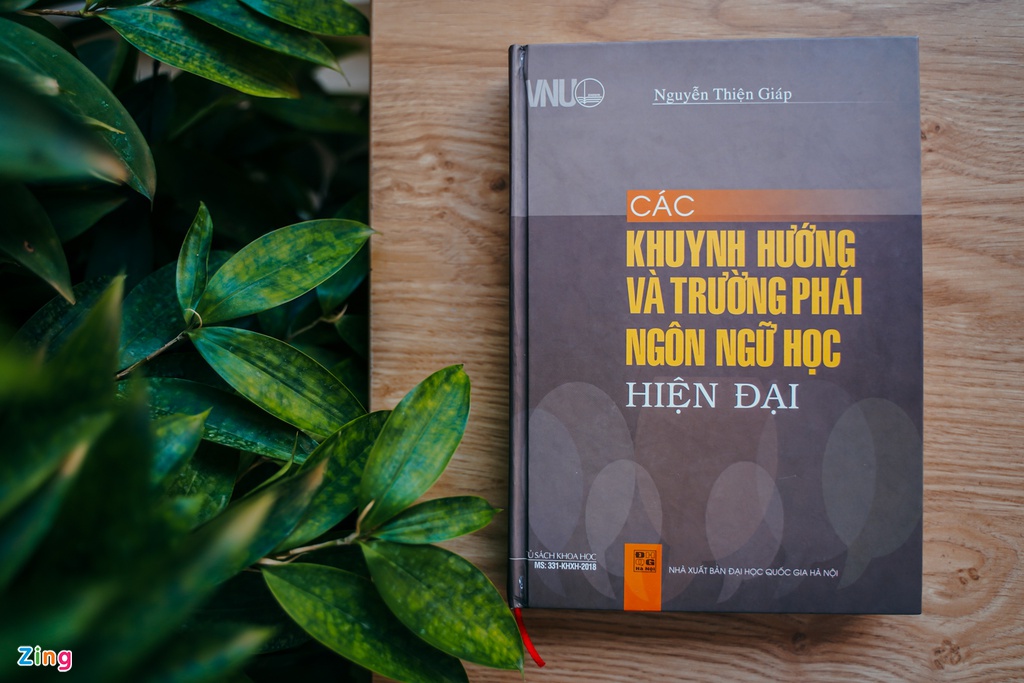
He has published numerous works on linguistic issues, including the bookModern linguistic trends and schools of thoughtIt is considered the first work that most clearly demonstrates the movement and transformation of linguistics.
Talking to him about the book revealed a lot of interesting information about the languages of Vietnam as well as the world.
Mastering Vietnamese Linguistics and the Linguistics of other countries.
- "Modern Linguistic Trends and Schools" is a massive work, nearly 600 pages long and divided into 10 chapters. How long did it take him to write this book, and what difficulties did he encounter during the process?
- The bookTrends and schools of modern linguisticsPublished by Hanoi National University Publishing House in late 2018 and early 2019, this book is the result of at least 20 years of research and teaching by lecturers from the Faculty of Linguistics, University of Social Sciences and Humanities (Hanoi National University) and many other universities nationwide.
Completing this task requires the author to have a broad understanding of various linguistic traditions in different countries. The author must not only have a firm grasp of the Vietnamese linguistic tradition but also delve deeply into the linguistic traditions of China, France, Russia, England, and the United States, among others.
|
|
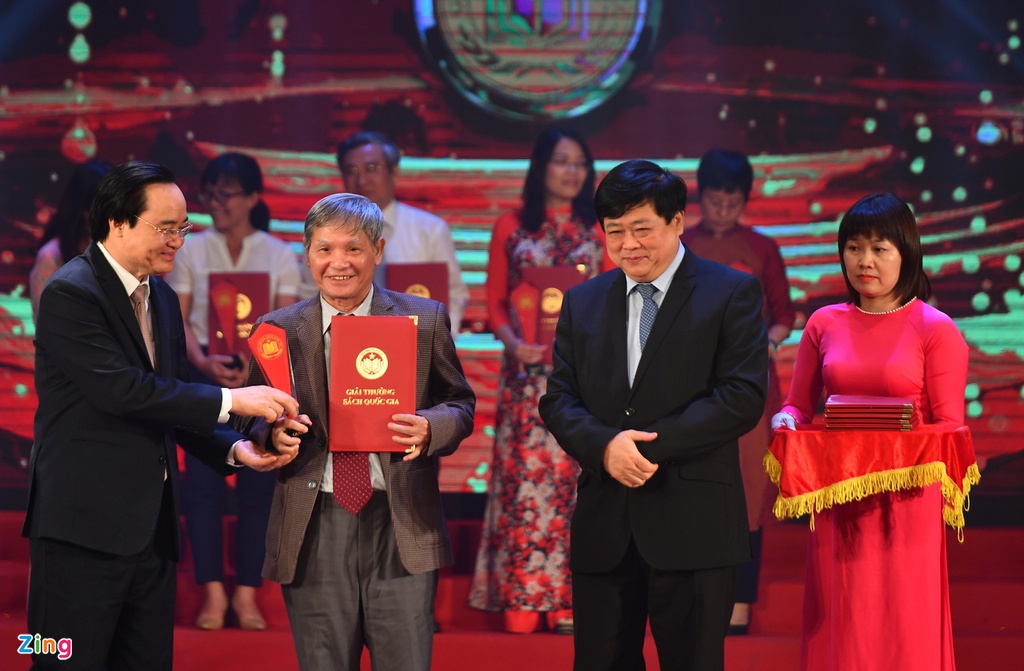
Professor Nguyen Thien Giap received the B prize at the 2020 National Book Awards ceremony on the evening of October 9th. Photo: Quynh Trang.
Classifying a particular research topic into a specific trend is also a problem. For example, generative linguistics is sometimes considered simply a school of structural linguistics.
When I was retained by the university as a teaching staff member, I witnessed a heated debate about whether a Marxist linguistic system actually existed.
In this work, I have generalized these into five main trends. The structural trend comprises five schools: the Geneva School; the Prague School; the London School; the Copenhagen School; and the American School.
The rationalist tendency is reflected in N. Chomsky's generative linguistics. The materialist tendency is reflected in Marxist linguistics. The cognitive tendency is reflected in cognitive linguistics. The cultural tendency is reflected in anthropological linguistics.
- The work is considered to have significant scientific value in teaching, training, and research in linguistics today. What aspects of the book's publication do you cherish or regret the most?
- Previously, I have published several works, such asMethodology and research methods in linguistics,Methods of language research, Linguistics textbook...
What has been written in this work reflects my current understanding of the issue. Upon completing this book, I had no concerns whatsoever.
- The book discusses many linguistic trends and schools of thought, but only Anthropological Linguistics seems relevant to us. Does this indicate that the field of Linguistics in Vietnam is not yet fully developed?
- In fact, Anthropological Linguistics is an interdisciplinary field that studies the relationship between language and culture. It's a relatively new field, and its achievements are still modest. However, linguistics, and especially Vietnamese linguistics in Vietnam, has already made many successes.
To find out more, you can readA Brief History of Vietnamese Linguistics, edited by Nguyen Thien Giap, Tri Thuc Publishing House, 940 pages, published in 2017. Of course, compared to the requirements, we still have to try much harder, but it's not to the point of being "not really developed" as you mentioned.
- As someone with a long history in linguistics, what issues have you observed facing languages worldwide, and particularly in Vietnam?
Currently, issues in pragmatics are attracting much research interest. It is in pragmatics that theoretical perspectives on cognition and culture are applied.
This is most clearly seen through the book.Theoretical linguisticsPublished by Hanoi National University Publishing House in 2020. The work has 320 pages, out of a total of 955 pages, and discusses pragmatics.
- Recently, there has been much debate surrounding proposed reforms to the language and writing system. What are your thoughts on this issue?
Actually, we shouldn't talk about "language reform." Language itself is always in motion and changing. Humans influence the development of language through movements such as "preserving the purity of the language, standardizing the language," etc.
Writing systems may or may not be improved. It's a mistake to think that the Vietnamese writing system is already perfect and doesn't need further improvement. The Vietnamese writing system still has certain limitations.
However, reforming the writing system is a matter of national importance, not a personal one. It is a practical scientific issue that requires ensuring continuity and development.
Currently, the government has not raised the issue of "writing reform," so we will not discuss it. Scientists are free to discuss this issue as a purely scientific matter.
Readers can find more information in my article "Some Issues Regarding the Vietnamese Script" here.Vietnamese script: Its formation, development, and contribution to Vietnamese culture.Published by Ho Chi Minh City National University Publishing House in 2017.
 |
- In your opinion, what role does language play in people's practical lives?
- To answer this question, I would like to quote two sentences that I wrote inIntroduction to LinguisticsFirst published in 1993 and now reprinted 21 times:
"Language is an indispensable companion of humankind. The wonder, beauty, and meaning of human language constantly stir curious and sensitive hearts and minds, and humanity has formed a science about it: linguistics."
"Knowledge of linguistics is useful for everyone. It is essential for those involved in teaching and research. People who use language as a professional tool, such as writers, journalists, and public relations officers, also need to know linguistics."
According to Zing News
Author:Thien Ai
Newer news
Older news