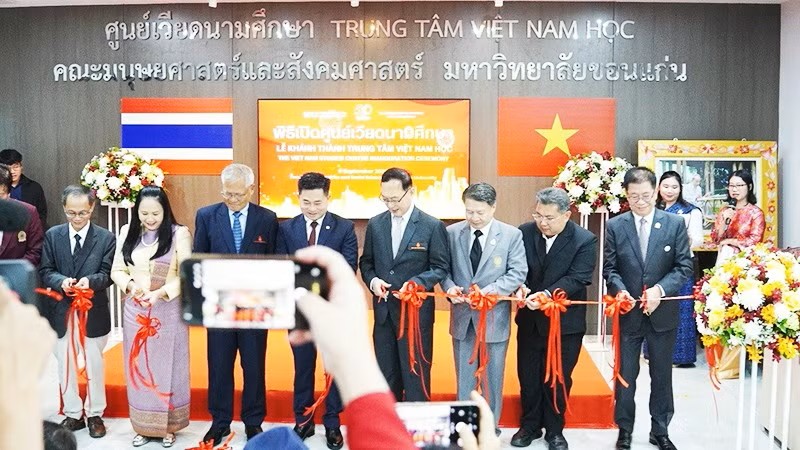
Inauguration ceremony of the Center for Vietnamese Studies at Khon Kaen University.
Preserving the Vietnamese language, continuing Vietnamese culture.
From that perspective, establishing centers for teaching Vietnamese and researching and promoting Vietnam abroad has lasting value. This both supports the Vietnamese community in maintaining their mother tongue and creates opportunities for people in other countries to better understand Vietnam through its language and cultural values.
In Thailand, this significance is clearly demonstrated through the establishment of the Center for Vietnamese Studies at Khon Kaen University. On September 9th, the University of Social Sciences and Humanities (Vietnam National University, Hanoi) attended the inauguration ceremony of the Center. The event took place on the occasion of the Day of Honoring the Vietnamese Language in the Overseas Vietnamese Community, which the Prime Minister decided to honor on September 8th every year according to Decision No. 930/QD-TTg dated August 3, 2022. On the same occasion, the Faculty of Linguistics and Vietnamese Studies of the University of Social Sciences and Humanities signed a Memorandum of Understanding on cooperation in language and culture with the Faculty of Humanities and Social Sciences, Khon Kaen University.
Dr. Nguyen Ngoc Binh, Head of the Department of Linguistics and Vietnamese Studies, believes that language is one of the closest paths for nations to understand each other. According to him, the trust built through the long-term cooperation between the two universities, and the joint teaching of Vietnamese, research, and introduction of Vietnamese culture in Thailand, goes beyond a mere educational cooperation program: bringing Vietnam closer to the Thai people, helping the younger generation of Vietnamese in Thailand remain connected to their mother tongue, and thereby contributing to strengthening understanding and ties between the people of the two countries.
The Center for Vietnamese Studies at Khon Kaen University was established with two main groups of learners in mind: Thai students and young Vietnamese people in Thailand. The center provides Vietnamese language training and introduces the history, culture, country, and people of Vietnam. For Vietnamese people in Thailand, having an additional place to learn and use Vietnamese is of practical significance in preserving their mother tongue, especially for the younger generation. When the Vietnamese language is maintained, knowledge about their homeland and Vietnamese culture has more opportunities to be passed on within the community.
For Thai students, learning Vietnamese opens up opportunities to learn about Vietnam more directly. The language helps learners access materials, works, and knowledge about Vietnam, and facilitates communication, study, and research with Vietnamese people.
Placed in the current context, this is also linked to the need to strengthen work with the Vietnamese community abroad. Resolution 23-NQ/TW dated August 2, 2026, of the Politburo on work with Vietnamese people abroad affirms that Vietnamese people abroad are "an inseparable part of the Vietnamese national community, one of the important strategic resources, and a bridge between Vietnam and the world," while also emphasizing the task of preserving the Vietnamese language, cultural identity, and promoting the role of overseas Vietnamese as "cultural ambassadors of the country and people of Vietnam."
The establishment of the Center for Vietnamese Studies – a place for training in the Vietnamese language and introducing the history, culture, country, and people of Vietnam to Thai students and young overseas Vietnamese – is a concrete step in realizing the requirement to "elevate thinking from advocating and caring to accompanying, creating mechanisms, and mobilizing resources of overseas Vietnamese" as set forth in the Resolution.
Notably, the center is located at Khon Kaen University, a major university in northeastern Thailand with a long-standing Vietnamese community. Therefore, teaching Vietnamese and introducing Vietnam here serves both the learning needs of Thai students and helps the younger generation of Vietnamese maintain their mother tongue and understand their roots. This is how policies aimed at preserving the Vietnamese language and promoting the role of the Vietnamese community abroad are implemented through concrete activities, starting with education and culture.
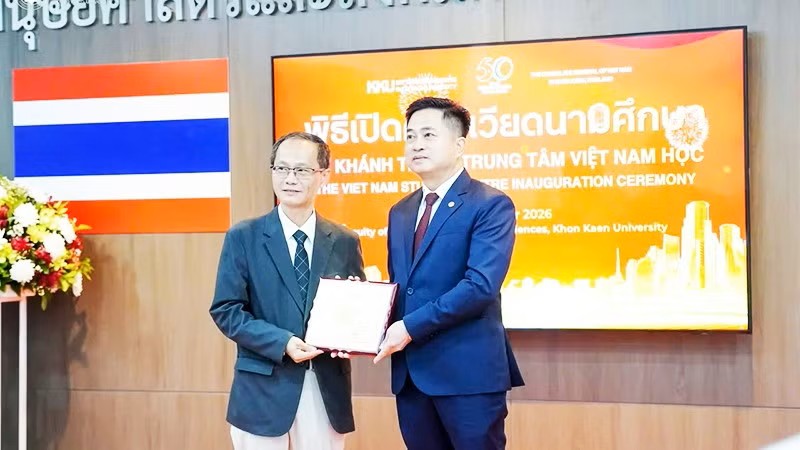
Award Ceremony for the Commemorative Medal honoring the University of Social Sciences and Humanities (Vietnam National University, Hanoi).
From collaboration between the two departments to cultural diplomacy.
The Faculty of Linguistics and Vietnamese Studies at the University of Social Sciences and Humanities and the Faculty of Humanities and Social Sciences at Khon Kaen University share many similarities in their research and training fields. Therefore, cooperation between the two faculties could involve teaching Vietnamese, research on Vietnam, academic exchange, and cultural promotion activities.
This relationship also has a unique aspect: While Vietnam has a Thai Studies program to research the country and people of Thailand, Thailand has a Center for Vietnamese Studies to research and promote Vietnam. Associate Professor Dr. Nguyen Tuong Lai, the founder of the Thai Studies program at the Faculty of Oriental Studies, University of Social Sciences and Humanities, serves as the Director of the Center for Vietnamese Studies at Khon Kaen University. This connection demonstrates that mutual understanding is taking place from both sides, with education and research being important channels.
Prior to the Center's inauguration, the University of Social Sciences and Humanities had already collaborated with Thai universities in student exchange, postgraduate training, research, conferences, and publications. The university also organized free online Vietnamese language classes, provided training in Vietnamese language teaching methods, and participated in promoting the idea of establishing a Vietnamese Studies Center in Khon Kaen.
These efforts were recognized at the inauguration ceremony when the Consul General of Vietnam in Khon Kaen, Dinh Hoang Linh, presented a Commemorative Medal for Achievement and honored the University of Social Sciences and Humanities for its contributions to spreading the Vietnamese language and culture in northeastern Thailand.
From here, the Vietnamese language has another place to be taught, Vietnamese people have more opportunities to preserve their mother tongue, and Thai students have more opportunities to learn about Vietnam. More importantly, the collaboration between two universities and two specialized departments in language teaching, research, and cultural exchange fosters understanding between the two countries through educational activities.
That is also the value of cultural diplomacy built through concrete actions. When Thais learn more about Vietnam and Vietnamese people in Thailand have the opportunity to preserve their mother tongue, the gap between the two communities is narrowed through knowledge and understanding. Through Vietnamese language classes, research on Vietnam, and cultural activities, the Vietnam-Thailand relationship has another way to be nurtured sustainably.
Author:According to Nhan Dan Newspaper
Newer news
Older news

