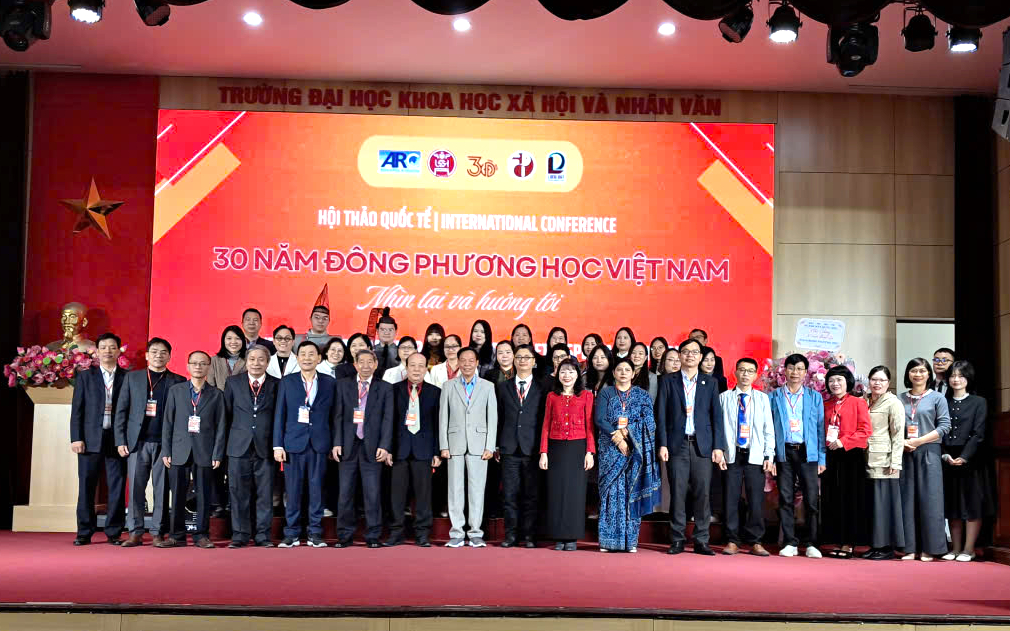
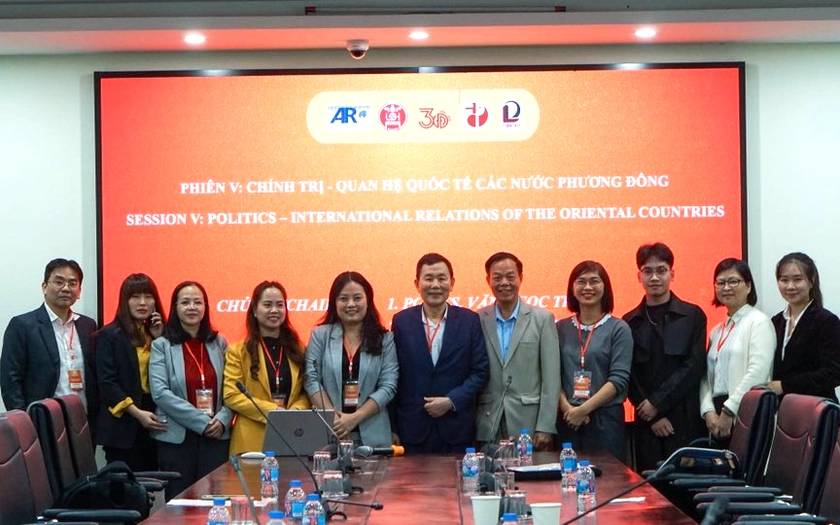
The Faculty of Oriental Studies, University of Social Sciences and Humanities, Vietnam National University, Hanoi has just organized an international scientific conference with the theme: "30 years of Vietnamese Oriental Studies: Looking back and Looking forward", with the participation of many domestic and international researchers.
The workshop is part of a series of events celebrating the 30th anniversary of the establishment of the Faculty of Oriental Studies - one of the core training units of the University of Social Sciences and Humanities. This is also a prestigious academic forum to conduct scientific consultation and strategic positioning for the field of Vietnamese Oriental Studies in the context of globalization and integration.
International scientific conference with the theme: "30 years of Vietnamese Oriental Studies: Looking back and Looking forward", with the participation of many domestic and international researchers. Photo: DPH
Faculty of Oriental Studies: "Looking back" on 30 years of shaping a field of study and "Towards" new horizons of knowledgeThe international scientific conference with the theme: "30 years of Vietnamese Oriental Studies: Looking back and Looking forward" is a forum for members of the Faculty of Oriental Studies to carry out the core mission of scientists, to "Look back" on the 30-year journey of shaping a field of study, and together "Look forward" to new horizons of knowledge in the context of the region and the world that are changing rapidly.
60 papers participated in the conference with 20 selected reports presented directly with high scientific content from lecturers and researchers of the Faculty of Oriental Studies, Hanoi National University, scholars from the Vietnam Academy of Social Sciences, universities in Quy Nhon, Ho Chi Minh City, especially international scholars, diplomats from the Embassy of India, Japanese and Korean partners...
Through that, we can see a vivid panorama of contemporary Vietnamese Oriental studies: From fundamental studies on History and Culture such as Oc Eo Culture or the reception of Japanese culture; to hot Socio-Economic issues such as International Migration, Logistics in RCEP, or the self-development of Korean workers;
From subtle linguistic and artistic analysis through comparisons of conceptual metaphors or cinematic discourses in adapted works; to strategic discussions on politics and international relations such as China's public diplomacy, or non-traditional security issues such as plastic waste in the ocean.
It shows that Oriental studies in Vietnam are undergoing a strong shift: from traditional monodisciplinary studies to interdisciplinary approaches, and from academic research to closely linking with solving practical problems of the country and the region.
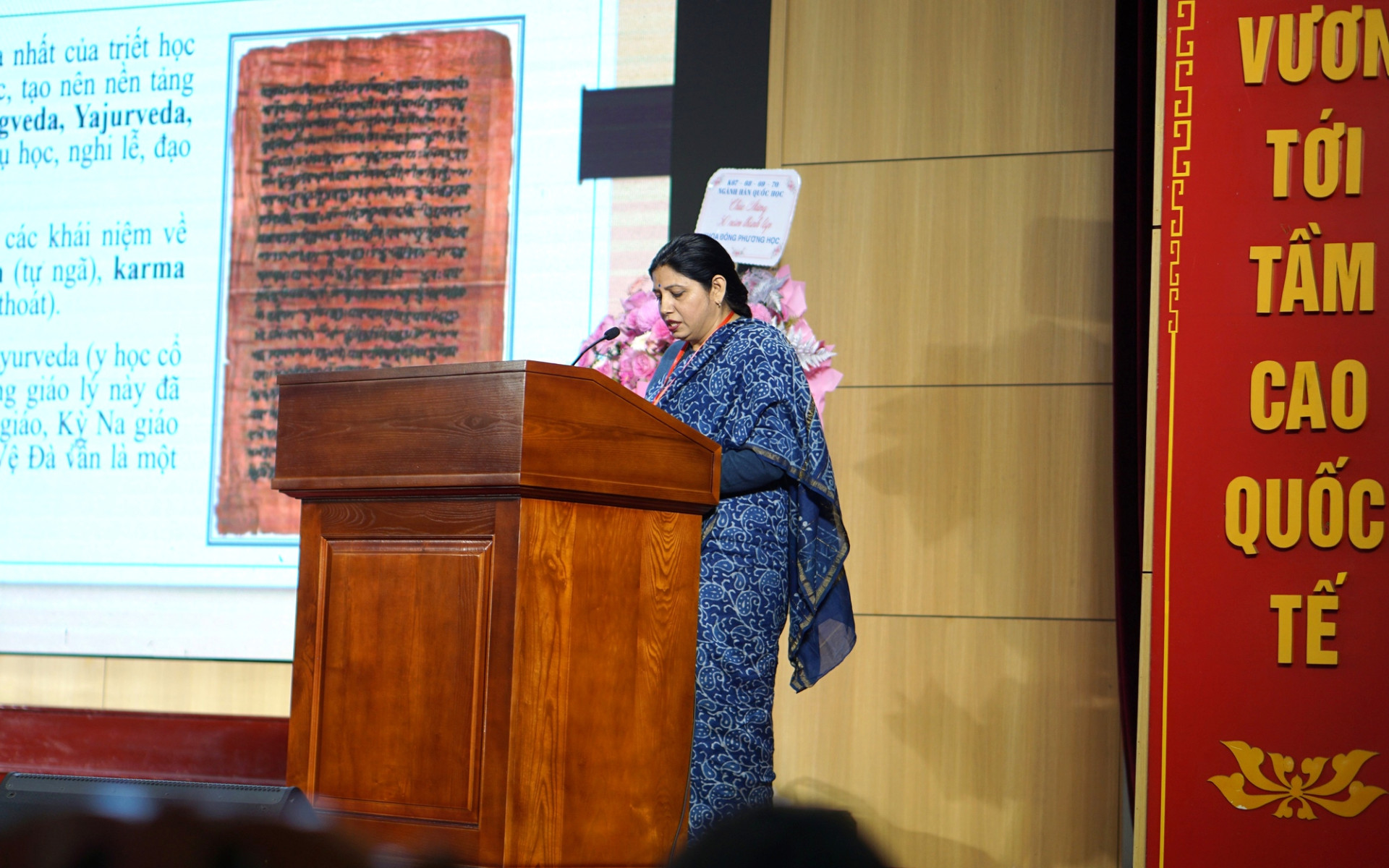
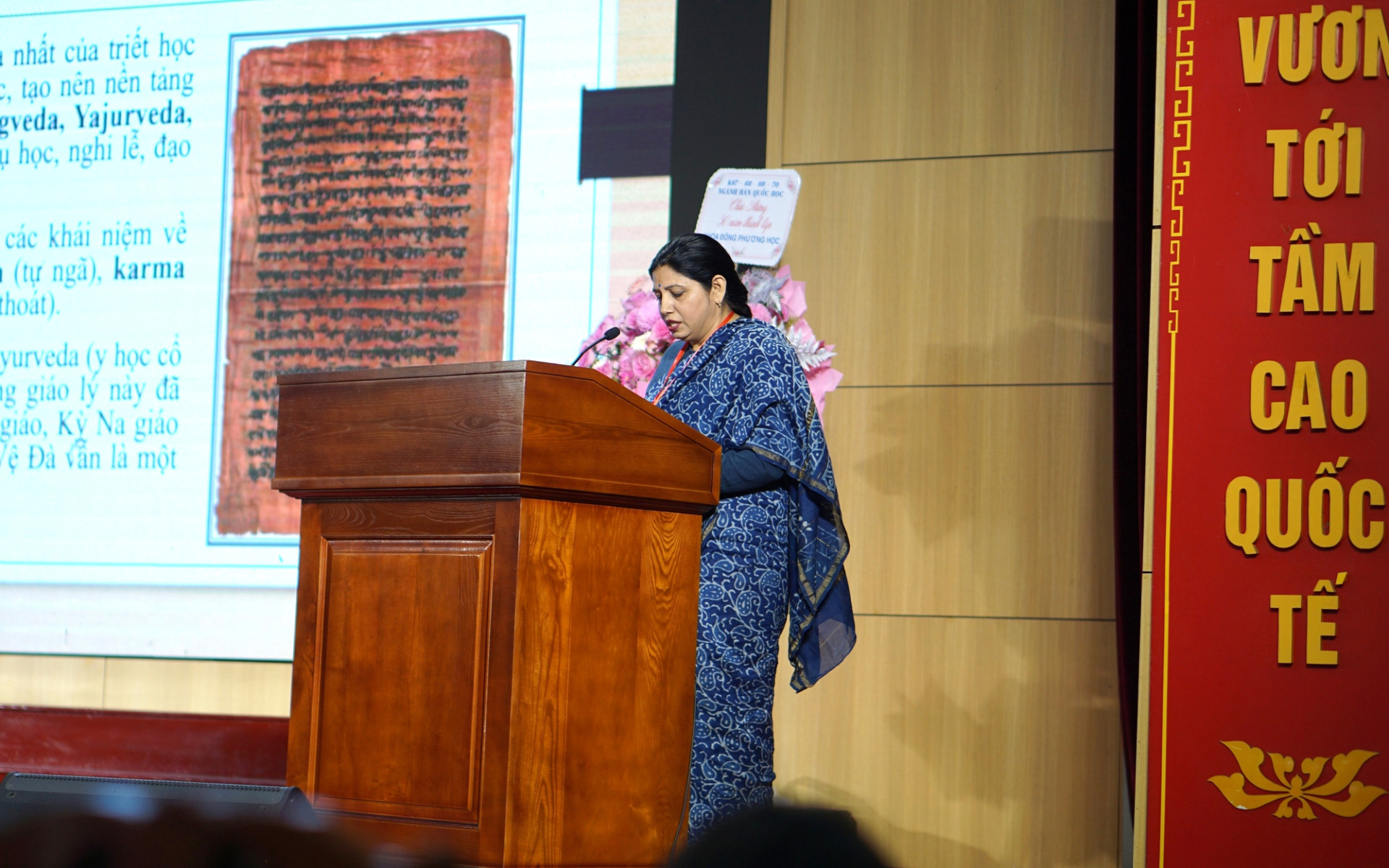
International scholars present their speeches at the International Scientific Conference with the theme: "30 Years of Vietnamese Oriental Studies: Looking Back and Looking Forward". Photo: DPH
Prof. Dr. Mai Ngoc Chu - Former Head of the Faculty of Oriental Studies (University of Social Sciences and Humanities, Vietnam National University, Hanoi) said that the research papers from domestic and international scientists focused on 3 main contents, including:
First, methodological and theoretical issues of Oriental studies:This is a difficult issue, but there have been bold reports criticizing Western Orientalism, pointing out the need to escape from exogenous knowledge models and conceptual systems shaped by the West, to create an endogenous conceptual system that correctly reflects the characteristics of Asian civilizations, and then carefully examine the research history of French scholars in Vietnam, posing the requirement to filter and restructure historical sources/texts, to serve national interests and regional vision.
Regarding the Industry creation model, some scholars suggest that Vietnamese Oriental Studies should move towards research that does not stop at language and literature, but must integrate more deeply analytical tools from International Political Economy, International Relations and Data Science. Only then can we train experts with multi-level analytical capacity and the ability to advise on policies.
Second, the axes/planes of contemporary research:These are new research directions, reflecting the expansion of the scope of Oriental studies. Accordingly, some axes that scholars mentioned in the discussion can be mentioned as:
Economic – Geographical Axis:Studies not only focus on macroeconomics but also explore economic history, for example, the study of Hoi An Commercial Port in the context of the Southeast Asian Maritime and Continental Trade Network. Studies on Technology Transfer from Japan emphasize the importance of East Asian business and management models for Vietnam's industrialization process.
Political – Administrative Axis:This is the axis that shows the highest topicality and policy application. The reports mentioned are: Water Security and International Law; Indonesia's Foreign Policy; Singapore's Anti-Corruption Education Policy...
Cultural Axis – Soft Power: What is noteworthy here is that the reports have shifted from describing culture to analyzing the operating mechanism of culture as a foreign policy tool. In this field, there are reports such as Cultural Diplomacy of Japan and Korea; Confucianism and Bushido, Oc Eo Culture...
Third, strategic orientation for the development of Vietnamese Oriental studies in the future:Based on the issues and contents presented at the workshop, three key strategic orientations are proposed as follows:
"Asian Community" Vision Framework:Vietnamese Oriental Studies must position itself as an active member in the process of building an Asian Community. In this regard, two things need to be noted: First, Systematizing Comparative Research, focusing on comparative studies of national development models, crisis management (e.g., pandemics, climate change), and non-traditional security (plastic waste). Second, Forecasting analysis, shifting from descriptive research to forecasting research on regional economic, technological, and political trends (e.g., the Impact of AI and Digital Transformation on East Asian Economies).
Strengthening high-level interdisciplinarity:It is necessary to break down the barriers between traditional sub-disciplines by building an Open Curriculum: Building training programs that integrate specialized knowledge with subjects on Regional Econometrics, Foreign Policy Analysis, and International Law/Regional Trade. Building an Academic Cooperation Network: Expanding cooperation with the world's leading Area Studies centers (especially Japan, Korea and ASEAN countries) to jointly implement cross-border research projects.
Positioning as a Strategic Advisory Body: Vietnamese Oriental Studies needs to strongly transform from a purely academic role to a role of providing strategic knowledge to national policy-making agencies. Specifically: Output products must be highly applicable: Focus on in-depth reports on hot issues such as China-India Relations, East Sea Strategy, East Asia's Blue Strategy...; Training policy human resources: Training a new generation of Oriental Studies experts, capable of working directly in foreign affairs, trade and cultural agencies.
Associate Professor, Dr. Dang Thi Thu Huong - Vice Principal of the University of Social Sciences and Humanities (Vietnam National University, Hanoi) spoke at the conference. Photo: DPH
Strategic vision of the Faculty of Oriental Studies: "Strive to become a training and research facility approaching international standards"Associate Professor, Dr. Dang Thi Thu Huong - Vice Principal of the University of Social Sciences and Humanities (Vietnam National University, Hanoi) assessed that the conference is an opportunity to position the development trends and scientific propositions in the new period, approaching international research standards. The strategic vision of the Faculty and the University is "to strive to become a training and research institution approaching international standards".
The conference was held at a time when Asia was becoming the center of the world, with rapid changes in economics, politics and culture. The need to deeply understand the Asian community, decipher the layers of history and culture, and forecast development trends was extremely urgent.
The theme "Looking back and looking forward" is of special importance. "Looking back" is not only to evaluate achievements but also to identify the challenges that are arising, thereby learning from experiences to outline a development roadmap. "Looking forward" is the strategic vision of the Faculty and the School: Striving to become a training and research institution approaching international standards, especially in the field of interdisciplinary research in national studies and regional studies.
"We need to increase interdisciplinary and applied training, supplement knowledge on digital economy, non-traditional security, international relations and multimedia communication in Asia. This is the key for Oriental studies students to adapt and lead in the context of globalization and the era of integration and development of the country" - Associate Professor, Dr. Dang Thi Thu Huong commented.
Believing that the 30-year journey has completed its historic mission, Associate Professor, Dr. Dang Thi Thu Huong - Vice Principal of the University of Social Sciences and Humanities, Vietnam National University, Hanoi emphasized: "Now is the time for us to together initiate a new development direction based on three strategic pillars, including:
Prioritizing Methodological Innovation:The core development direction of the Faculty of Oriental Studies must be a strong shift towards the model of applied and comparative Area Studies. This requires the Faculty to constantly update advanced theoretical frameworks, strengthen quantitative and qualitative research, and integrate interdisciplinary knowledge to address global and regional challenges such as climate change, cyber security, and social governance in the digital age.
Expanding the scope of strategic research:Oriental Studies needs to broaden its academic horizons, moving beyond focusing on individual countries to exploring inter-regional dynamics and transnational issues. Research should prioritize forward-looking topics, especially in emerging areas such as the Asian Digital Economy, Public Diplomacy, and Multilateral Mechanisms in East and Southeast Asia.
Promoting International Convergence:The University of Social Sciences and Humanities is committed to continuing to create maximum conditions for the Faculty of Oriental Studies to realize its vision of approaching international standards, through strengthening internationalization programs, training cooperation, attracting international lecturers and experts, and bringing the Faculty's scientific publications into prestigious citation systems around the world.
Delegates and scholars attending the International Scientific Conference with the theme: "30 years of Vietnamese Oriental Studies: Looking back and Looking forward". Photo: DPH