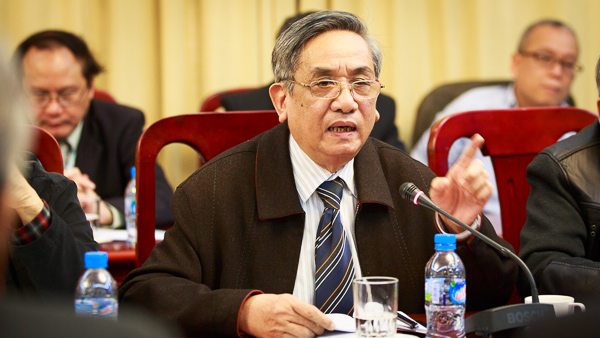
The need for a more accurate understanding of the role of Vietnamese social sciences and humanities was the central theme of many opinions expressed by professors and scientists from the University of Social Sciences and Humanities at a meeting with the Minister of Education and Training, Pham Vu Luan, on February 27, 2013. The direct and frank exchange between the Minister and the educators covered a wide range of issues: educational reform, policies for teachers; decentralization of higher education management, and solutions for building and developing the social sciences and humanities sector in the current context…In his report on the university's development over the past year, Professor Dr. Nguyen Van Khanh, Rector of the University of Social Sciences and Humanities, stated: The past year was a very successful one for the university in the field of scientific research. The university successfully bid for 9 state-level research projects, implemented 10 Nafosted-funded projects, and dozens of other projects at various levels. The university also successfully organized more than 30 domestic and international conferences and seminars; published over 600 articles, including more than 30 international scientific papers; and 5 faculty members were honored with the Ho Chi Minh and State awards for science and technology. Regarding training, the university continuously improved the quality of training across all systems, made significant progress in reforming teaching and learning activities, successfully adjusted 23 undergraduate and 52 postgraduate training programs, and continued to open many new majors and specializations to serve societal needs. To enable the University to make even greater contributions, worthy of its assigned position and mission, the University of Social Sciences and Humanities also proposes: Firstly, that the Ministry promptly submit documents to the Government for promulgation of regulations on the operation of Vietnam National University, Hanoi, including provisions on autonomy and self-responsibility related to the University of Social Sciences and Humanities as well as its member universities; Secondly, that the Ministry promptly approve the inclusion of several pilot training programs and specializations that have proven effective and high-quality through practical training at the University into the State's official list of major codes; Thirdly, that the Ministry promptly consider authorizing the University or Vietnam National University, Hanoi to approve international joint training programs to leverage domestic and international resources to develop some pioneering academic fields based on cooperation with reputable and reliable partners. Fourth, we propose that the Ministry assign the University as the focal point for organizing and implementing Project 911 and preparing the necessary conditions for sending doctoral candidates in the fields of social sciences and humanities to study and conduct research abroad. Fifth, we propose that the Ministry support and assign the University to focus its resources on building and developing the University of Social Sciences and Humanities into a leading national center for research and training in social sciences and humanities; and to establish mechanisms to support the basic science disciplines, which are the University's strengths, in training scientists, experts, and high-quality human resources. Sixth, we propose that the Ministry and relevant agencies assign the University to lead or participate in the development and implementation of several research programs and projects, with a focus on the social sciences and humanities program and the East Sea program in the coming period.

During the meeting, the professors proposed several solutions to the Minister regarding the need to build a correct understanding of the position and role of social sciences and humanities in contemporary society, as well as the need for positive policies to support and promote the development and contribution of the field to the overall development of the country. Professor Vu Duong Ninh, a People's Teacher, argued that the biggest challenge for social sciences and humanities lies in the incorrect understanding of their mission, role, and position in society today. Social sciences and humanities have not been recognized and appreciated for their value and importance to society. And "this is a threat to the survival of the nation," Professor Ninh affirmed. Professor Ha Minh Duc stated: Social sciences and humanities must be considered a valuable asset of the country, not just a matter for one scientific discipline. There are many issues in the social sciences and humanities that need addressing, which we can see daily in society: ethics, discipline in education, national sovereignty, social psychology, preservation of cultural values, etc. And it seems that the continuity and succession in Vietnamese social sciences and humanities have not received adequate attention. The staff in the social sciences and humanities also face many difficulties in their lives, affecting their dedication to their profession. Professor Dinh Van Duc recommends that the State urgently establish a special mechanism to support the development of social sciences and humanities disciplines, support social scientists in publishing their research works, and have appropriate policies on salaries and income to ensure a decent life for scientists. Considering scientific research a weakness of Vietnamese universities today, Professor Duc suggests that the Ministry should promote many feasible solutions to improve this situation. In addition, other opinions discussed the autonomy of universities, the decentralization of management of joint training programs, regulations on opening pilot training programs, textbooks in training, and promoting research activities at universities...

Highly appreciating the heartfelt statements of the educators, Minister Pham Vu Luan expressed his satisfaction with the results achieved at the working session. The Minister stated: “This field trip to the University at the beginning of the new year aims to send a message of appreciation to the University of Social Sciences and Humanities – a leading training center in social sciences and humanities, a prestigious undergraduate and postgraduate training institution in Vietnam's higher education system, receiving the trust of many universities in the region and the world. In the future, there needs to be closer coordination between the University, Vietnam National University, Hanoi and the Ministry for the development of Vietnam National University, Hanoi, its member units, and the education and training sector.” In his exchange with the educators, the Minister said that starting in 2012 and even more decisively from 2013, the entire education sector will accelerate the transformation of its development model from one based on quantity and scale to one based on quality and efficiency. Furthermore, in accordance with the Prime Minister's directive, the education sector continues to implement management reforms throughout the sector, focusing on eliminating the practice of granting favors and increasing the proactive role and accountability of educational institutions. State management by the Ministry and provincial departments will be clearly separated from the professional management of school principals. The Ministry's activities aim to serve the proper and favorable development of schools, contributing to inspection, correction, and handling of violations. Regarding learning from foreign educational management experiences, the Minister expressed the view that it's not enough to simply observe what other countries are doing; it's also crucial to understand why they do it that way, as all policies must be linked to the unique economic, cultural, and social characteristics of each country. Some policies that are effective in other countries may not be successful when applied to Vietnam. Regarding the development of operational regulations for member universities of national and regional universities, the Ministry believes it is necessary to ensure that these universities have autonomy and accountability at least on par with other large universities under the Ministry. Regarding international joint training programs, the Ministry will no longer directly approve or manage them, but will only provide criteria for universities to follow. The Ministry will only conduct inspections and audits of this work. Concerning Project 911, the Minister acknowledged that the University of Social Sciences and Humanities has been and will continue to be an important professional focal point advising and consulting the Ministry. Affirming the State's special attention to social sciences and humanities in the current context, the Minister stated that all ideas, sentiments, and even concerns from educators regarding the aforementioned issues will be considered. These insightful and valuable opinions will help the Ministry to think carefully and propose specific mechanisms to bring about the worthy and appropriate development of the social sciences and humanities in Vietnam.

Also at the meeting, Associate Professor Phung Xuan Nha, alternate member of the Central Committee of the Communist Party of Vietnam and Director of Vietnam National University, Hanoi (VNU), expressed VNU's support and agreement with many of the Ministry's policies and the opinions expressed by the educators. In the near future, VNU will develop a new decree and operational regulations that will ensure the highest level of autonomy for its member units, outside the framework of the Higher Education Law passed by the National Assembly. Regarding the opening of pilot training programs and the implementation of international joint training programs, VNU intends to continue promoting them while ensuring the quality of training. VNU also requested the Ministry of Education and Training's support for VNU's stronger participation in Project 911, based on its existing advantages such as prestige, capacity, multi-disciplinary structure, and the conditions for using shared resources to ensure quality. Also in an effort to support the development of basic science disciplines, Vietnam National University, Hanoi (VNU) and regional universities have planned to jointly develop a plan for the development of basic science personnel, hoping for early approval from the Ministry. Implementing the policy of reforming the financial autonomy mechanism for public non-profit organizations, VNU has recently pioneered, together with the Ministry's training institutions, the development of five projects with innovative content prioritizing basic science disciplines. Sixteen basic science disciplines at VNU, including six in the social sciences and humanities, have received priority investment in both tuition fees and student recruitment support. This program will continue to receive in-depth investment in the future to help social sciences and humanities disciplines access the best conditions for development. VNU has also decided to assign the University of Social Sciences and Humanities to implement two key research projects: one on evaluating Vietnam's human resources in social sciences and humanities, and another on ethics and lifestyle. Vietnam National University, Hanoi also supports the University's participation in major national research programs such as the Northwest Program, the East Sea Research Program, and the Social Sciences and Humanities Research Program, aiming to further enhance the capacity, position, and pioneering responsibility of a leading training institution in the industrialization, modernization, and international integration of our country.