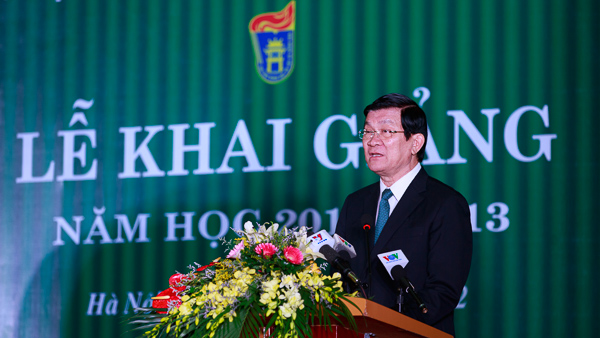
“We are focusing all resources on improving the quality of training, prioritizing quality as the primary factor to affirm the brand and prestige of the University. In addition, the University is also striving to diversify training programs, open many new majors, and make many innovations in admissions to better meet the needs of society…” - Professor Dr. Nguyen Van Khanh - Rector of the University of Social Sciences and Humanities, shared some opinions on various issues related to the University's admissions and training.
- The University of Social Sciences and Humanities is often known for its traditional strengths in basic sciences. What significance does this have for the development of the University?Inheriting from the University of Hanoi, the University of Social Sciences and Humanities (USSH) continues to affirm its identity and strength in fundamental social sciences and humanities disciplines. However, this does not mean the University is confined to these basic sciences; on the contrary, building upon this foundation, the University has pioneered the opening of a series of new training programs to meet societal needs, such as Journalism, Oriental Studies, Tourism Studies, International Studies, Information Science, Archival Studies and Office Management, Social Work, etc., which are of great interest to society. Some programs are relatively new, but despite their recent establishment, they have attracted significant interest from students, such as Political Science (2008), Anthropology (2009), and Vietnamese Studies (2010). Most recently, in 2013, the Public Relations program began its first enrollment, which is sure to attract many students. It can be affirmed that a strong foundation in basic science has enabled the university's new disciplines to develop rapidly, with high quality and a distinct identity.
- But some argue that the social sciences and humanities fields are not as attractive as other trendy professions. How does the University view this issue, Professor?Society is often influenced by fleeting trends, which can also manifest as a shortage of manpower in a particular field at a given time. However, this does not mean that other fields are worthless. The social sciences and humanities hold an extremely important position and role in shaping the development direction, cultural foundation, society, and human resources of a nation and a country. Those working in the social sciences and humanities have a vast and distinct professional field within the broader professional landscape of society. Recently, many Party leaders and leaders from various ministries and sectors have visited and worked at the University, including President Truong Tan Sang, Deputy Prime Minister Nguyen Thien Nhan, and Minister of Education and Training Pham Vu Luan. The results of these meetings demonstrate the Party and State's interest in and high regard for the role of the social sciences and humanities in the country's development. The University of Social Sciences and Humanities is well aware of its role and mission. On the one hand, it continuously strives to improve the quality of its training, prioritizing quality to affirm its prestige and brand; on the other hand, it is also very dynamic in diversifying its training programs and innovating in the admissions process (including entrance exams) to better reach its students. The reality of training and admissions over the years shows that the demand for social sciences and humanities has not decreased: the number of applicants to the University in 2012 increased by 27% compared to 2011, and many of the University's training programs have had very high entrance scores for many consecutive years. While changes in demand for social sciences and humanities exist, they are reflected differently in each field and each training program.
 Professor, could you please elaborate on the innovations implemented by the School to improve the quality of its training in recent times?
With the goal of providing high-quality education and integrating with regional and global higher education, the University has undergone significant reforms to improve the quality of training, better meet societal needs, and approach international standards. The University has transformed its training programs based on output standards, with notable advantages such as: clearly defining output standards in knowledge, skills, and career paths for students, tailored to each training program; developing flexible training programs that provide students with opportunities to participate in various combined training models such as major-minor majors, double majors, and double degrees. With the credit-based training method, students become the center of the training process, fostering creativity and proactiveness in planning their studies, choosing courses and teachers, accumulating knowledge, and potentially shortening their learning process according to their abilities and available time. The university also offers high-quality training programs (Literature, History, Philosophy, Management Science) and internationally recognized programs (Linguistics) to provide students with the best learning conditions, leading faculty, and training quality comparable to many prestigious universities in the region. In addition, the university rigorously implements quality accreditation, both internal and external evaluations. In December 2012, the university was certified by Vietnam National University, Hanoi (VNU) for achieving national training standards for the second cycle, with over 98% of the criteria meeting the standards.
Professor, what has the university done to increase career opportunities for its students after graduation?Since 2009, to help students increase their job opportunities after graduation, the School has collaborated with the University of Foreign Languages (Vietnam National University, Hanoi) to implement a dual degree program in English/Chinese for Tourism. After implementation, recognizing the promising prospects and high demand for dual degrees, in the coming academic year, in addition to the currently offered Tourism dual degree program, the School plans to expand to include dual degree programs in Journalism, Management Science, and International Studies, providing students with more choices. Students can shorten their study time to less than 4 years per degree and accumulate two degrees in approximately 5 years. Previously, foreign language skills were a limitation for students, but now, with more professional and focused teaching and training at the University of Foreign Languages (VNU-Hanoi) and the application of an IELTS 4.0 output standard for standard program students, 5.0 for high-quality program students, and 6.0 for non-standard program students, students have a significant advantage in job hunting. In addition, the University has expanded its cooperation with many recruitment agencies in Hanoi and other localities, actively introducing students to internships and employment opportunities.
 - Besides the two traditional exam blocks, C and D, the school has added blocks A (since 2010) and B (since 2012) for admissions. What is the significance of this change, and will it be continued this year, Professor?
For the University of Social Sciences and Humanities, expanding the admissions block aims to increase the ability to select more talented and capable candidates, while also opening up equal learning opportunities for candidates from all blocks – those who are interested in and capable of studying social sciences and humanities. Previously, we often believed that only candidates who excelled in Literature, History, and Geography were suitable for social sciences and humanities. However, those who have studied and researched social sciences and humanities understand that to excel in social science subjects, strong logical thinking skills are essential. Many prominent social science and humanities scientists from Hanoi University, before pursuing their passion and success in their chosen professions, were initially excellent students in natural sciences. Similarly, candidates who take the A-block exam and "dare" to study social sciences and humanities are likely not necessarily those who were poor at Literature or History. In 2012, the number of applications for Group A subjects to the university increased by 200% compared to 2011, indicating a very high demand from candidates in this group for social sciences and humanities majors. In 2013, Group B subjects were still applied to the Psychology major, while Group A subjects were expanded to 14 majors, including Public Relations and Social Work, which for the first time accepted Group A applicants.
Professor, what special benefits will students of the University of Social Sciences and Humanities receive?The University of Social Sciences and Humanities is proud to have a rich academic environment with a high-quality reputation both domestically and internationally, a strong faculty and staff including many leading scientists, and a modern, world-class training program. Furthermore, the educational philosophy is student-centered; in addition to providing knowledge, teachers focus on developing students' critical thinking, creativity, and proactive learning abilities. These are excellent conditions for students to hone their skills and abilities, a feature not found in all educational institutions. In the 2013-2014 academic year, for the first time, a preferential admissions program was implemented for students in six basic science majors (Political Science, Sino-Vietnamese Studies, History, Anthropology, Philosophy, and Literature). Accordingly, students in these majors will receive financial support of VND 4,200,000 per student per year for the 2013-2014 academic year, along with professional development courses organized by the University, without having to pay tuition fees. This is the latest incentive under the program to support the development of basic science disciplines at Vietnam National University, Hanoi.

In addition to scholarships from the State budget, students in these majors, as well as students of the University in general, have the opportunity to receive dozens of different scholarships from the University's partners, including many valuable international scholarships such as: Chung-Soo, Tony Chung, POSCO, Viettravel, AEON, Kumho, Asian… Students also receive academic achievement scholarships and scholarships for underprivileged students who overcome difficulties if they have good academic results. Students with difficult circumstances may be considered for interest-free loans from UOB Bank throughout their years of study at the University. Furthermore, if they study and train well, students of the University of Social Sciences and Humanities also have the opportunity to participate in study and research exchange programs abroad, have the opportunity to pursue higher education or receive scholarships to study at many leading universities in the world.
Thank you, Professor!