

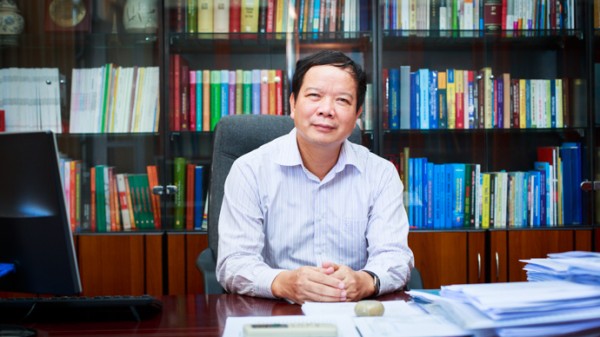
In the 2012-2013 academic year, the University of Social Sciences and Humanities achieved comprehensive results in many areas of activity. Assoc. Prof. Dr. Nguyen Van Kim (Vice Rector of the University) summarized the outstanding achievements and outlined the important directions of the University for the upcoming academic year.
- Could you please tell us about the important achievements that the University of Social Sciences and Humanities has accomplished in the field of education during the past academic year?
First and foremost, it must be said that, thanks to a clear understanding of its role and mission as a leading center for basic science training and research, the University of Social Sciences and Humanities has had a solid roadmap and steps towards integration and adaptation to the country's development realities and the current trend of internationalization in education and training. Based on this, in recent years, the spirit of continuous innovation and creativity has been the guiding principle throughout the University's activities and development orientation.
The most outstanding achievement in the field of training at the University is the successful transformation of 23 undergraduate and 54 postgraduate programs according to output standards. This has created high levels of interconnectedness between different disciplines and between undergraduate and postgraduate training. Prioritizing quality, the training programs are developed based on references from top-ranked universities in the region and the world, while maximizing the intellectual resources of the units, experts, and lecturers throughout the University. This transformation also demonstrates a clear and profound understanding and adaptability of a training center in the face of societal changes, demands, and the internal development needs of the academic disciplines at the University of Social Sciences and Humanities.
To continuously enhance students' knowledge, broaden their horizons, and create employment opportunities, the University has been actively promoting the development of dual degree programs, double majors, and major-minor programs. Following the successful development of the dual degree program in Tourism and Travel Service Management, dual degree programs in other socially attractive fields such as Management Science, Sociology, Journalism, International Studies, and Oriental Studies will soon be implemented. According to the plan, the successful development of these programs will increase the number of core programs offered by the University from 23 to 122. The University hopes this will be an effective and suitable training method and model to meet the current needs of students, while also leveraging the University's strengths in program articulation.
In addition, international collaborative training programs are being implemented successfully and will soon be expanded with 2+2 and 3+1 programs with partners. The university is also implementing two master's programs, "Public Policy and Enterprise Management" (MAPE) and "Child and Adolescent Developmental Psychology," in cooperation with the University of Toulouse le Mirail (France). The university is also developing a program on "Social Psychology in Labor, Career Guidance, and the Environment" with this university. Furthermore, the University of Social Sciences and Humanities has successfully established three Vietnamese Studies Centers in China and Taiwan in collaboration with partners. Last academic year, the University of Social Sciences and Humanities was assigned by the Central Organizing Committee and Office 165 to train the first cohort of Master's students in Science and Technology Management. Throughout the course, from the training program and organizational and management methods to knowledge transfer and technology adoption, everything was implemented on schedule and achieved good results. As a result, 36 out of 38 students successfully defended their Master's theses, and many achieved outstanding results. Based on this, the School is actively collaborating with Lund University, Sweden, to carry out the training mission for the second cohort assigned by the Central Organizing Committee, Office 165, and Vietnam National University, Hanoi.
It can be said that the quality of the training programs has built the reputation of the University and earned the trust of society and students. Over the years, the number of candidates applying to the University's training programs has remained stable. Besides traditional university entrance exam blocks like C and D, new blocks like A and B are increasingly attracting more applicants. The University's entrance exam cutoff scores are consistently among the highest.

Associate Professor Dr. Nguyen Van Kim giving an interview to the press during the 2013 university entrance exam.
- What are the key objectives the school is focusing on in its training activities for the upcoming academic year?
The training activities of the University of Social Sciences and Humanities will aim at four main objectives:
Firstly, we must continuously improve and ensure the quality of our training. The school always considers quality as its top priority because it is the brand, reputation, and honor of the entire school community.
Secondly, there needs to be a closer link between training and research. Currently and in the years to come, research must be given special importance to support undergraduate and postgraduate training. In fact, the latest research findings have been applied very effectively and dynamically in lecturers' presentations at universities.
Thirdly, internationalizing the training programs ensures that the University's training activities are always adaptable and keep pace with the development trends of the country, as well as the level of education, training, and scientific research development of the regional and global university community. Internationalizing the training program is not simply about teaching and learning in English, but must be reflected in the content, knowledge level, methods, research perspectives, and advanced approaches of each lecturer in each subject.
Fourth, we need to develop plans and roadmaps to continue expanding into new majors and specializations, constantly renewing ourselves and making our training programs more attractive to students. Diversifying majors and specializations aims to meet societal needs on one hand, and on the other hand, reflects the university's vision and thinking regarding the development trends of the country and the social sciences and humanities in the current context.
If the above four objectives are successfully achieved, I believe that the University of Social Sciences and Humanities will achieve even more accomplishments in the field of education.

An international scientific conference on the theme "The 1973 Paris Agreement: 40 Years Later" was organized by the University of Social Sciences and Humanities in collaboration with Vietnamese scientists and experts from the University of Paris I, the Military History Institute of the Ministry of National Defence, Monterllier University, Lyon University (France), Hawaii Pacific University (USA), and Greifswald University (Germany) on January 17, 2013.
- You mentioned the spirit of innovation and creativity as a guiding principle in the school's activities. How has that spirit been demonstrated in scientific research activities?
The past year has also been a particularly successful one for the University of Social Sciences and Humanities in its research activities. The University has been assigned to lead numerous state-level projects, ministerial-level projects, Nafosted projects, protocol projects, and research projects at the request of local authorities. In the past academic year, the University was assigned 11 state-level projects and 1 protocol project (equivalent to state level). Never before has the University achieved such great success in scientific research.
This success reflects innovations in leadership, guidance, work organization, and the effective utilization of intellectual resources from the faculty, researchers, and experts within the University. It can be said that the approach and mindset in organizing scientific research activities by the University's staff and scientists have become more practical, dynamic, and have enhanced the role of strong research groups and leading experts. The research groups and scientists within the University have consistently followed and aligned the scientific research directions of experts and units with the major research directions of the country, proactively engaging in discussions and working with the heads of research programs and relevant agencies to propose and develop research projects and topics.
From the University's perspective, thanks to mobilizing the intellectual resources of many experts and domestic and international cooperation, the University of Social Sciences and Humanities has strengthened and developed its research capacity, continuing to affirm its position as a research-oriented university. In the near future, according to the plan of the Ministry of Science and Technology and the Vietnam Historical Science Association, the University of Social Sciences and Humanities hopes that many of its scientists will have the opportunity to participate in a major scientific project, contributing to the compilation of the "National History" (History of Vietnam in the Ho Chi Minh Era), expected to consist of 3 main products, 24 volumes, to be implemented in 2013 and continuously for about 5 years.

One of the university's major scientific tasks is to research borders, maritime sovereignty, the impact of regional and international organizations, and the policies of major powers...
- One of the important directions approved by the Standing Committee of the University's Science and Technology Council in a recent meeting was "focusing on carrying out major scientific tasks." Could you elaborate on these points?
Currently, the School's research topics are quite diverse, spanning various fields: History, Culture, Society, Policy, Technology, etc. The basic orientations of these topics are defined as follows:
Firstly, the focus is on clarifying traditional values, fundamental changes in socio-economic life in Vietnam, changes in social relations, social stratification, social capital, the role and function of the family, urbanization, research on policies and the transfer of science and technology, etc. The goal of these research topics is to clarify the trends, advantages, difficulties, and challenges facing Vietnam's development today and propose solutions to overcome them.
Secondly, some research topics have focused on in-depth studies of social issues, the process of cultural and ideological exchange, integration and transformation, changes in religious and belief life, the role of traditional social organizations, customary laws, indigenous knowledge, and the promotion of the role of indigenous knowledge resources in economic development, environmental protection, ensuring social welfare, etc.
Thirdly, the research addresses pressing issues facing Vietnamese society in the context of integration, regionalization, and globalization, such as border issues, maritime sovereignty, the impact of regional and international organizations, and the policies of major powers. Some research projects also focus on strategic areas such as the Northwest, Central Highlands, and Southwest regions. The results of these studies will contribute to promoting the socio-economic development of these localities, while also preparing the scientific basis and arguments for formulating policies and affirming Vietnam's development model and philosophy.
From the implementation of research projects, it can be seen that while previously most projects were conducted in a specialized direction, now there is an increasing number of interdisciplinary projects, with the participation of many experts from different professional fields. In addition, the spirit of openness and cooperation in scientific research, especially international cooperation, is a key factor contributing to the success of the University. Because the development of a university today must always be placed within broad connections. Cooperation with universities in the region and around the world has been and continues to create momentum for new developments in the University's training and scientific research. In the future, the scientific research activities of the University of Social Sciences and Humanities will continue to be implemented in this direction.

President Truong Tan Sang attended the opening ceremony of the 2012-2013 academic year at the University of Social Sciences and Humanities on September 14, 2012.
- In the 2012-2013 academic year, the University of Social Sciences and Humanities had two major events: welcoming President Truong Tan Sang to the opening ceremony of the new academic year and the Minister of Education and Training Pham Vu Luan visiting and working with the university's scientists. Could you please explain the significance of these two events for the development of the University?
These are two very important events, demonstrating the attention of the Party and State leaders to a leading training and research center in social sciences and humanities like the University of Social Sciences and Humanities, Vietnam National University, Hanoi.
President Truong Tan Sang delivered an important speech, highly appreciating the rich tradition and immense contributions of the University and many generations of teachers and researchers to the country's science, education, and training. The President also emphasized that the social sciences and humanities bear a crucial responsibility in educating ideology, fostering patriotism and national pride, building social relations, and shaping the values, ethical standards, lifestyles, and character of Vietnamese people. Therefore, the University of Social Sciences and Humanities, Vietnam National University, Hanoi, has a great role and responsibility; it must be a leading unit, actively and effectively implementing the Party's resolutions, so that education and training truly become a top national priority and a driving force for the country's rapid and sustainable development.
During his visit in early 2013, Minister Pham Vu Luan also showed great interest in the innovations and outstanding achievements of the University in recent years. The Minister highly appreciated the prestige of the University's team of experts, with more than 20 scientific works and groups of works winning the Ho Chi Minh Prize and State Prizes. In addition, he noted the growth of the faculty and staff, with 94% currently holding postgraduate degrees…
It can be said that these visits are a great source of joy and motivation for the faculty, students, and trainees of the School in the coming period. The visits and working sessions of leaders of the Party, State, and relevant agencies help the School to be more confident in its development directions, and to better understand its role and responsibility towards the cause of education and training as well as the development of the country.

- What challenges and opportunities will a leading center for social sciences and humanities training, with a long tradition and memorable contributions to the development of national education in the past, face in the current context?
The path of the University of Social Sciences and Humanities is fraught with challenges but also many opportunities, requiring the University's leadership and the leadership of its units to have a correct understanding, accurate analysis and forecast of new development trends, and a clear definition of their mission and tasks. It is important to note that sometimes, it is precisely from within challenges and particularly difficult circumstances that we can find new insights for development.
Currently, the Party and the State are paying increasing attention to social sciences and humanities. However, more specific policies and guidelines are needed, along with fundamental surveys to scientifically and objectively assess the current state of the workforce and the actual capacity for training and research in social sciences and humanities. Changes in organizational and management methods are necessary, creating mechanisms for development. Furthermore, management at all levels needs to provide stronger support and investment in social sciences and humanities. Based on this, and with internal efforts, the University will have additional conditions and motivation for development.
Another visible challenge lies in the limitations of the school's facilities. Currently, the school has only a limited number of research rooms, documentation rooms, and classrooms that meet standards. The learning and research space for staff and students is limited and does not adequately meet the school's development goals and requirements. However, the school will always strive for innovation within its circumstances and conditions, overcoming some of the difficulties so that each step is a solid step towards its set goals.
Another challenge is the generational transition. This transition is taking place between the first generation of scientists who contributed to the establishment of the University of Social Sciences and Humanities and the current team of scientists and administrators. Although there are certain difficulties in organization and personnel in implementing training and research in some units, previous generations have left behind invaluable legacies for the development of the University and its units. The transmission of knowledge, the sense of responsibility between generations, and the enthusiasm and passion for science of the professors are sacred values that create the unique strength and internal power of the University. The current staff and faculty are all dedicated to their profession and always strive to preserve the valuable identity and traditions of the University. The University as a whole is striving to promote the values of a university community, continuing to build a university spirit where everyone works together to build the University of Social Sciences and Humanities. On the other hand, nowadays, faculty and staff at the University are not only actively absorbing the knowledge and experience of previous generations but also proactively expanding their horizons to receive scientific and technological achievements from abroad. In recent years, approximately one-third of the University's faculty and staff have regularly been sent abroad for exchange, research, and teaching. This shows that the flow of knowledge between domestic and international sources has created a countercurrent, forming the foundation and basis for the University's development and integration.