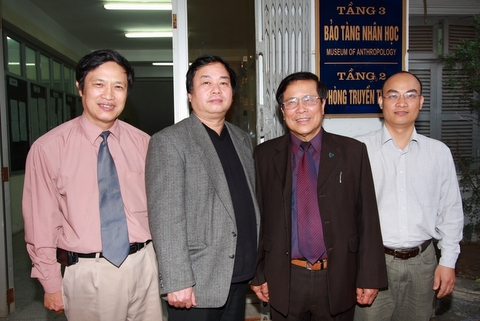
In 2009, among the 17 training programs at the University of Social Sciences and Humanities, Vietnam National University, Hanoi, Anthropology was a new major, attracting the attention of many candidates. The Department of Anthropology (Faculty of History - University of Social Sciences and Humanities - Vietnam National University, Hanoi) would like to provide a brief overview of the Anthropology program offered by the Department, hoping to help prospective students better understand this field of study.Internationally, Anthropology is an integrated science that combines knowledge from the natural sciences, social sciences, humanities, and arts to comprehensively study human beings. Originating in the 19th century, anthropology holds a particularly important academic position and possesses profound practical significance, and is currently taught in many universities worldwide.
| NAME OF THE ASSOCIATION |
NUMBER OF MEMBERS |
| American Anthropological Association |
11,000 |
| Japanese Cultural Anthropology Association |
2,060 |
| Russian Society of Ethnology and Anthropology |
1,500 |
| Brazilian Anthropological Society |
1,200 |
| European Association for Social Anthropology |
1,000 |
| Indian Anthropological Society |
750 |
| British Social Anthropology Society |
600 |
Source:Gustavo Lins Ribeiro 2006. 'World Anthropology: Cosmopolitics for a new global scenario in anthropology'. Critique of Anthropology, Vol. 26 (4), page 369.
After more than a century of development, most universities in the region and around the world offer anthropology programs at all three levels—bachelor's, master's, and doctoral—with varying scales. Many anthropology departments are invested in by the State to become reputable and high-quality research, training, and consulting centers, having a significant impact on society in general, and on the State's cultural, social, and development policies in particular. According to the common structure in many universities worldwide today, anthropology is a science encompassing many different sub-disciplines such as physical anthropology, socio-cultural anthropology, linguistic anthropology, and archaeology. Recently, a new sub-discipline, called applied anthropology, has emerged in many universities, primarily training personnel to work in research, development, and public health care. In Vietnam, as in China and many former Eastern European socialist countries, anthropology is not organized as a single discipline as is common in other European and American universities, but has developed into separate disciplines such as linguistics, archaeology, cultural studies, ethnology, etc. Recently, most of these countries have also shifted to a model of anthropological training and research that combines these sub-disciplines into a single science under the name Anthropology, or innovates and expands the research scope of traditional ethnology and calls it the science of Anthropology and Ethnology.

The Department of Anthropology (Faculty of Social Sciences and Humanities, Vietnam National University, Hanoi) is currently built upon the tradition of ethnology, which has been taught at Hanoi University since 1917 under French rule, combined with the absorption of the best aspects of modern European and American anthropology. In this direction, anthropology is fundamentally a science that uses ethnographic data to study and explore the diversity of cultures and the principles of human social organization, both historically and in the present. The establishment of an undergraduate program in anthropology is the result of nearly 10 years of preparation by the Department and the University, including curriculum development, staffing, and other necessary material conditions. This is part of the strategy to develop the Department of Anthropology into a leading research and training center for undergraduate and postgraduate studies in Vietnam, with the potential for collaboration and competitiveness with anthropology training centers in the region and around the world.

The Department's undergraduate anthropology program aims to provide students with fundamental and in-depth knowledge in various fields of anthropology, creating a foundation for anthropology graduates to work in research and training institutions in socio-cultural fields, domestic organizations, international organizations, non-governmental organizations, government agencies, and other organizations that require anthropological knowledge. Graduates from the Department of Anthropology will be equipped with a solid foundation of knowledge to teach socio-cultural subjects at universities and colleges, or to continue their studies in master's and doctoral programs at universities both domestically and internationally. [img class="caption" src="images/stories/2009/02/17/img_7264.jpg" border="0" alt="Assoc. Prof. Dr. Lam Ba Nam - Vice Rector of the university, former Head of the Department of Anthropology" title="Assoc. Prof. Dr. Lam Ba Nam - Vice Rector of the university, former Head of the Department of Anthropology" width="280" height="223" align="right" ] A highlight of the training program is that it will inherit a rich tradition and training experience of the Department from many decades. When building the training program, the Department pays special attention to the unity and harmony between theory and practice, between basic research and applied research, between disciplinary knowledge and interdisciplinary knowledge with other social sciences, humanities and arts, in order to train anthropologists who can effectively apply the knowledge gained during their studies to real work and life. With a faculty trained in Russia, the Netherlands, and Australia, including some who have taught in the United States, Singapore, and other countries, the Department selectively absorbs the best knowledge from developed anthropological systems in various countries, combining it with the foundation of Vietnamese ethnology training and research to build an anthropology program suitable to Vietnam's political, economic, cultural, and social conditions, while ensuring integration with anthropology in the region and the world. Thus, the Department's undergraduate anthropology program not only aims for high quality but also for integration, cooperation, and collaborative training with domestic and international educational institutions. [img class="caption" src="images/stories/2009/02/17/img_8676.jpg" border="0" alt="Meeting to assign tasks to the Council for compiling the Anthropology curriculum framework of the Ministry of Education and Training" title="Meeting to assign tasks to the Council for compiling the Anthropology curriculum framework of the Ministry of Education and Training" width="280" height="187" align="left" ] As mentioned, the Department of Anthropology (Faculty of Social Sciences and Humanities - Vietnam National University, Hanoi) is a successor to the tradition of the Department of Ethnology established in the 1960s of the last century at Hanoi University. After several decades of development, the Department has trained thousands of researchers in culture and achieved significant accomplishments in research, undergraduate and postgraduate training, and has made important contributions to advising on the planning and implementation of economic, political, cultural, and social policies of the Party and the State. The country's reform process has created demands for innovation in training and research on human beings and human culture and society to develop and integrate with the region and the world. Opening an anthropology training program allows for the expansion of research subjects and the training of a team of anthropologists capable of effectively meeting the demands of national reform, development, and integration.