
Journalism and AI: Behind the Hype
According to Professor Nguyen Duc An, Artificial Intelligence (AI) is gradually asserting its important role in journalism. Many major news organizations around the world have deeply applied artificial intelligence to their news production processes. The Associated Press reported that the use of AI has helped journalists save up to 20% of their time, freeing them from meticulous tasks such as reporting on financial reports, while also improving accuracy. Bloomberg shared that one-third of all their articles are published by a robot named Cyborg.
Automating the news reporting process from dynamic data sources not only saves journalists time but also scales up article production for smaller, niche markets. AI has the ability to analyze complex data sources, helping journalists uncover information they wouldn't be able to find themselves. Furthermore, AI plays a crucial role in detecting and preventing fake news, with support from organizations like Full Fact, BBC Verify, and Snopes.
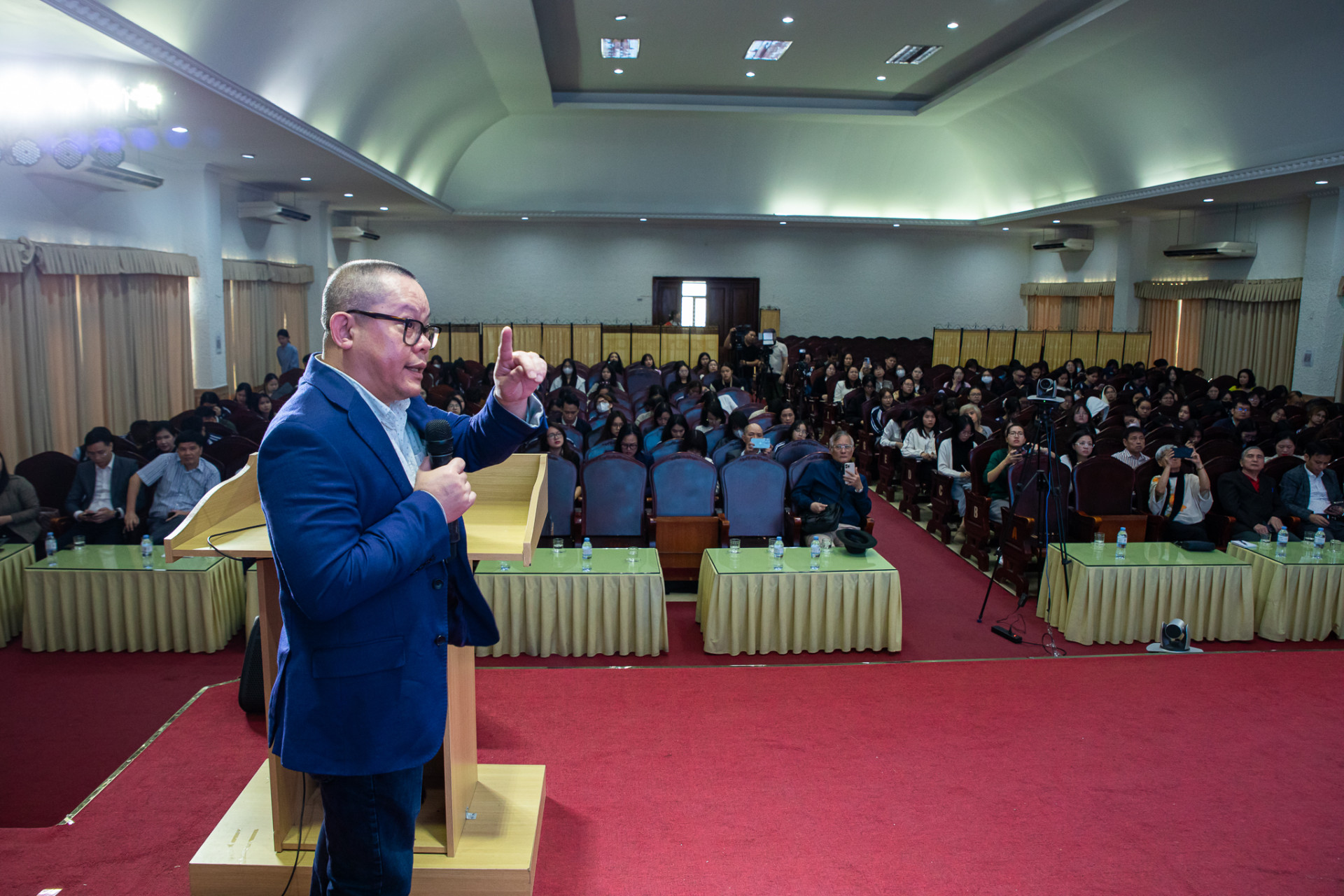
Overview of the panel discussion "Who are journalists? Where is journalism headed when AI is becoming increasingly skilled at content creation?".
However, Professor Nguyen Duc An emphasized that, despite the "buzz" surrounding AI, this technology still cannot completely replace the role of humans in journalism.
Professor Nguyen Duc An pointed out that current media coverage of AI is also "problematic." "We are exaggerating, creating a hype, and focusing on the benefits, forgetting the downsides. This creates a negative effect on how society receives technology," Professor An stated.

Professor Nguyen Duc An argues that the current media coverage of AI is exaggerating, creating a hype, and focusing only on the benefits while ignoring the downsides of this technology.
The professor referred to Moravec's Paradox, according to which conscious tasks such as high-level reasoning, playing chess, or choosing stocks are relatively easy to program. Conversely, unconscious tasks such as walking, running, looking, and recognizing are very difficult to program. This suggests that, although AI can process large amounts of data at breakneck speed, it still lacks the contextual thinking and emotional intelligence necessary to tell stories in a nuanced way.
Professor Nguyen Duc An pointed out that AI cannot be present at the scene of an accident, in a courtroom, or at a board meeting. It cannot feel the pain of a family or look into someone's eyes to discern the truth. All AI does is "free up" reporters so they can do more of those things.
While AI offers many benefits, it also carries significant risks. AI can reinforce existing social biases, be prone to illusions, and provide misinformation. Therefore, the use of AI in journalism needs to be approached with caution.
The professor recommended that journalists approach this technology with an open mind but also with a sense of responsibility. To effectively utilize AI, journalists need to be properly trained in this technology while maintaining professional ethics and responsibility to the community. "Sanctifying" AI is not advisable; instead, human oversight and transparency with users are necessary.
Journalists need to view AI as a tool.
During the panel discussion, the extremes of artificial intelligence continued to be discussed and explained by the speakers.

The panel discussion at the seminar featured four speakers (from right to left): Dr. Phan Van Kien, Director of the Institute of Journalism and Communication Training; Dr. Nguyen Quang Dong, Director of the Institute for Communication Policy and Development Research; Prof. Nguyen Duc An; and journalist Le Tho Binh, Vice President of the Digital Communication Association.
Dr. Nguyen Quang Dong shared: "Vietnamese journalism currently lacks two things. Firstly, it lacks data about its readers; we don't know who our readers are. Secondly, it lacks understanding of its readers."
The Director of the Institute for Media Policy and Development Research further analyzed: “Last year, we conducted a survey of 170 newsrooms in Vietnam to understand the technologies used to understand readers. The results showed that about 85% of newsroom leaders had started using technologies like Google Analytics to gather information about their readers. However, only about 34% of reporters used this technology.”
This disparity reflects a significant gap in technology adoption across different levels within the newsroom, indicating that while leadership recognizes the importance of technology, its practical implementation and application remain challenging.
According to Professor Nguyen Duc An, the "difficulties of the economics of journalism" for both the world and Vietnamese journalism today stem from the readership. We are losing readers, not because of technology. Technology only exacerbates this issue.
The crisis in the relationship between humans and AI was also a topic of discussion at the seminar. According to Dr. Phan Van Kien, many people insist that AI must replace humans or vice versa, but reality shows that both can coexist.
"The human element within us is something AI certainly cannot replace," said Dr. Phan Van Kien. He emphasized that emotions, creativity, and the ability to deeply understand society are aspects that AI has yet to achieve.
The Director of the Institute of Broadcasting and Communication Technology further shared: "Journalists must find another job that AI cannot replace them in, because if they just stand still, they will certainly be replaced."

Dr. Phan Van Kien shared that journalists will be replaced if they only stand still.
At the seminar, many questions were answered, providing an opportunity for everyone to better understand the relationship between humans and technology in journalism. The speakers all agreed that AI cannot replace humans in crucial aspects such as emotions, creativity, and deep social understanding. Instead, AI should be considered a supporting tool, helping journalists improve their work efficiency and content quality.

Experts and speakers took a commemorative photo with lecturers and students from the Institute of Journalism and Communication Training.
ButNewspaper Journalists and Public Opinion
ButVietTimes Magazine
ButApplied Electronics Magazine
ButBusiness section, Vietnam Law Newspaper
Author:Text: Phuong Anh / Photos: Viet Ha - Hoang Giang
Newer news
Older news

