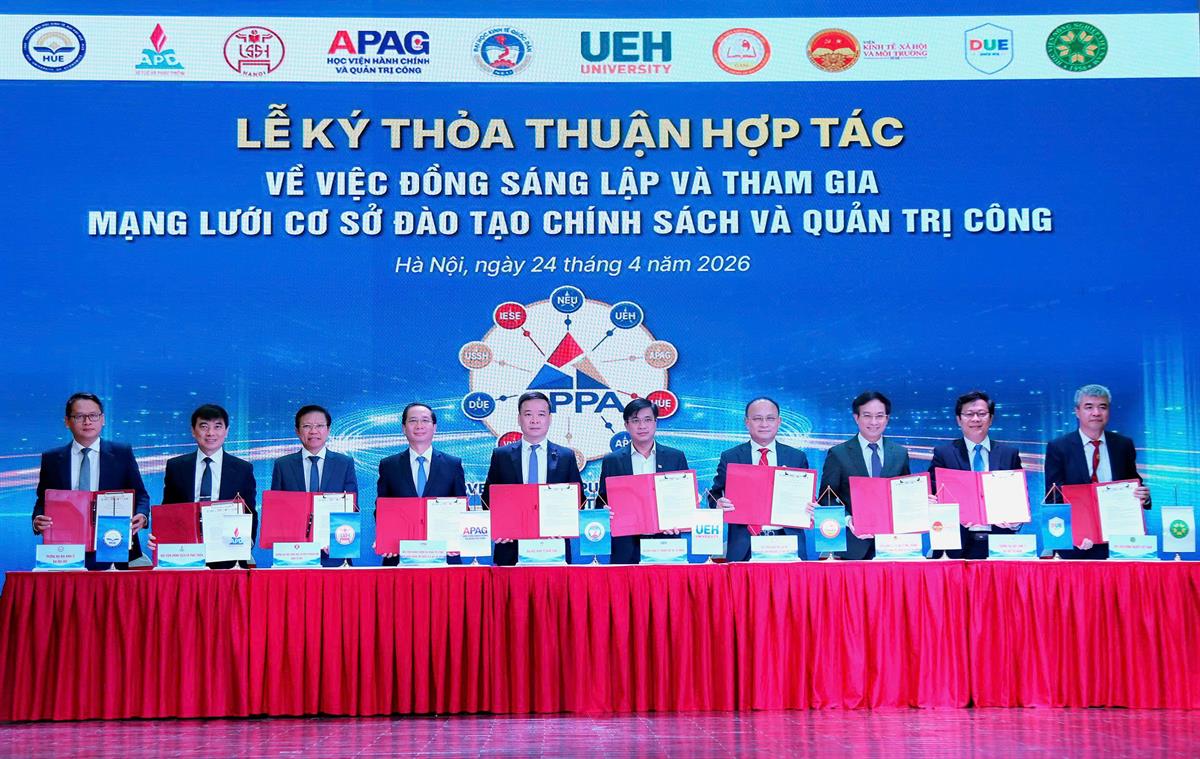
Leaders of policy and public administration training institutions signed a cooperation agreement to co-found and participate in the GPPA.
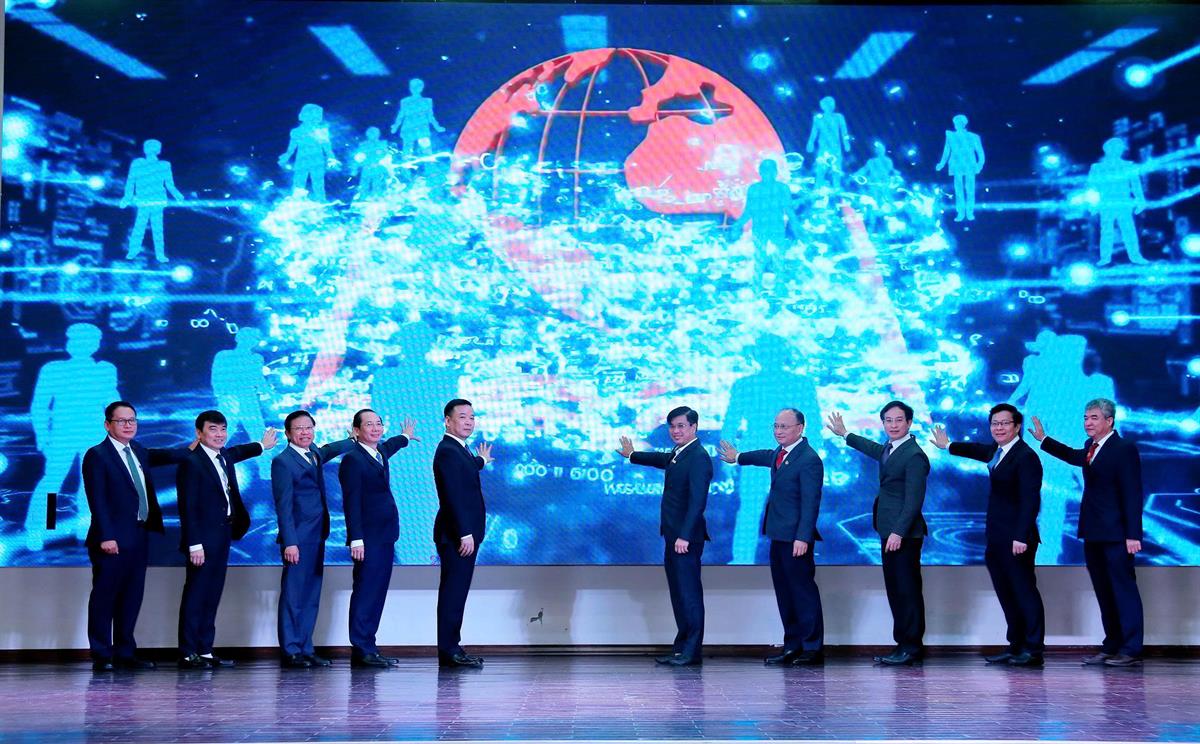
Leaders of institutions providing training in public policy and administration jointly performed the ceremony to launch the GPPA.
Attending the ceremony, on behalf of the Ho Chi Minh National Academy of Politics were Associate Professor, Dr. Tran Thanh Giang, Chief of the Academy's Office; Associate Professor, Dr. Bui Van Huyen, Director of the Institute of Economics, Society and Environment; Dr. Tran Van Thang, Chief Inspector of the Academy; Associate Professor, Dr. Dau Huong Nam, Director of the International Cooperation Department; Associate Professor, Dr. Nguyen Ba Chien, Director of the Academy of Public Administration and Management; Associate Professor, Dr. Dinh Thi Nga, Deputy Director of the Institute of Economics, Society and Environment; Dr. Bui Phuong Dinh, Deputy Director of the Academy of Public Administration and Management; Associate Professor, Dr. Hoang Van Hoan, Deputy Director of the Department of Political Schools; and staff and lecturers from the Institute of Economics, Society and Environment and the Academy of Public Administration and Management.
On the part of the policy and public administration training institutions participating in GPPA were Assoc. Prof. Dr. Bui Duc Tho, Secretary of the Party Committee of the National Economics University; Assoc. Prof. Dr. Bui Huy Nhuong, Director of the National Economics University; Prof. Dr. Hoang Anh Tuan, Rector of the University of Social Sciences and Humanities, Vietnam National University, Hanoi; Assoc. Prof. Dr. Tran Trong Nguyen, Director of the Academy of Policy and Development; Assoc. Prof. Dr. Nguyen Huy Hoang, Director of the Academy of Social Sciences, Vietnam Academy of Social Sciences; Assoc. Prof. Dr. Le Van Huy, Rector of the University of Economics, Da Nang University; Prof. Dr. Pham Van Cuong, Deputy Director of the Vietnam Academy of Agriculture; Assoc. Prof. Dr. Bui Quang Hung, Deputy Director in charge of the University of Economics, Ho Chi Minh City; Assoc. Prof. Dr. Bui Duc Tinh, Vice Rector of the University of Economics, Hue University; along with representatives from policy and public administration research units at the central level and in Hanoi. Faculty members, lecturers, experts, scientists, students, and researchers from GPPA member countries.
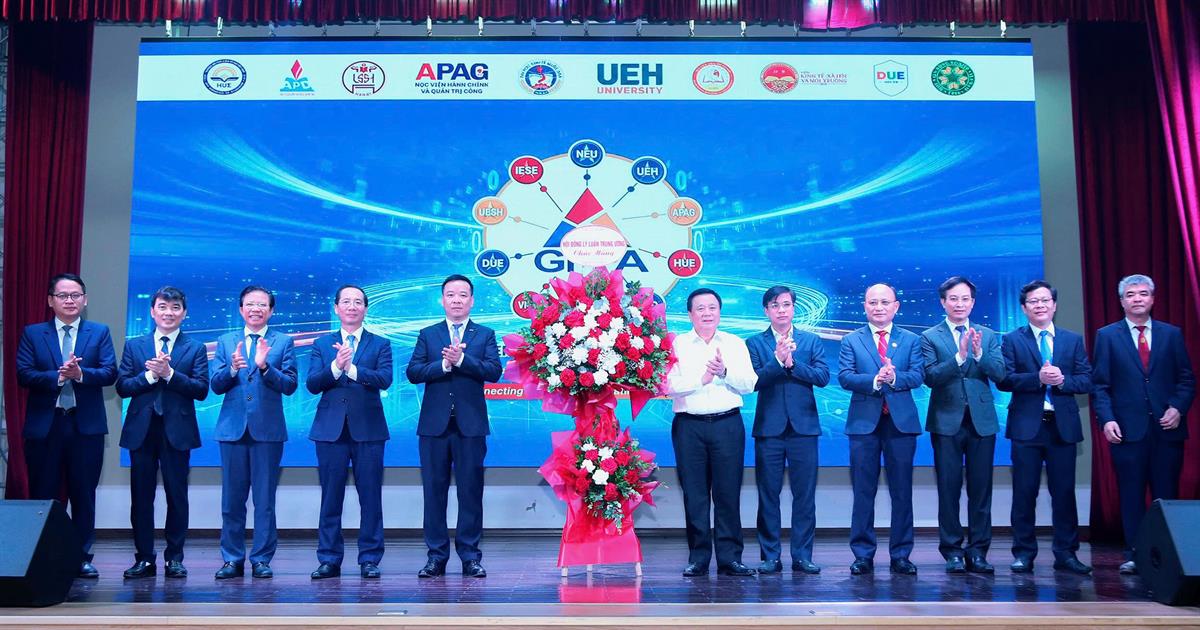
Professor, Doctor Nguyen Xuan Thang, Member of the Politburo of the 13th Party Congress, Chairman of the Central Theoretical Council, presented flowers to offer congratulations.
Based on the need to strengthen academic linkages, share knowledge, develop the scientific community, and improve the quality of training, research, and evidence-based policy consulting in the field of public policy and governance, the GPPA Network was officially established and launched at the ceremony with the participation of 10 public policy and governance training institutions nationwide, including: National Economics University; Ho Chi Minh City University of Economics; Academy of Policy and Development; Academy of Public Administration and Governance under the Ho Chi Minh National Academy of Politics; Academy of Social Sciences under the Vietnam Academy of Social Sciences; Vietnam Academy of Agriculture; University of Social Sciences and Humanities under Hanoi National University; University of Economics under Da Nang University; University of Economics under Hue University; Institute of Economics, Society and Environment under the Ho Chi Minh National Academy of Politics.
Speaking at the first annual Scientific Forum and Ceremony themed "National Governance and Management Human Resource Training in the New Era," Professor Nguyen Xuan Thang, Member of the Politburo of the 13th Party Congress and Chairman of the Central Theoretical Council, acknowledged and highly appreciated the initiative to establish GPPA – a strategic network connecting training institutions and scientists to share knowledge, build a scientific community on public policy and governance, coordinate the organization of forums, workshops, seminars, and scientific conferences; promote academic publications and communication, cooperate in research and provide advice and policy critique based on evidence, meeting current practical needs. Professor Nguyen Xuan Thang expressed his hope that GPPA will become a model network serving the cause of national construction and development.
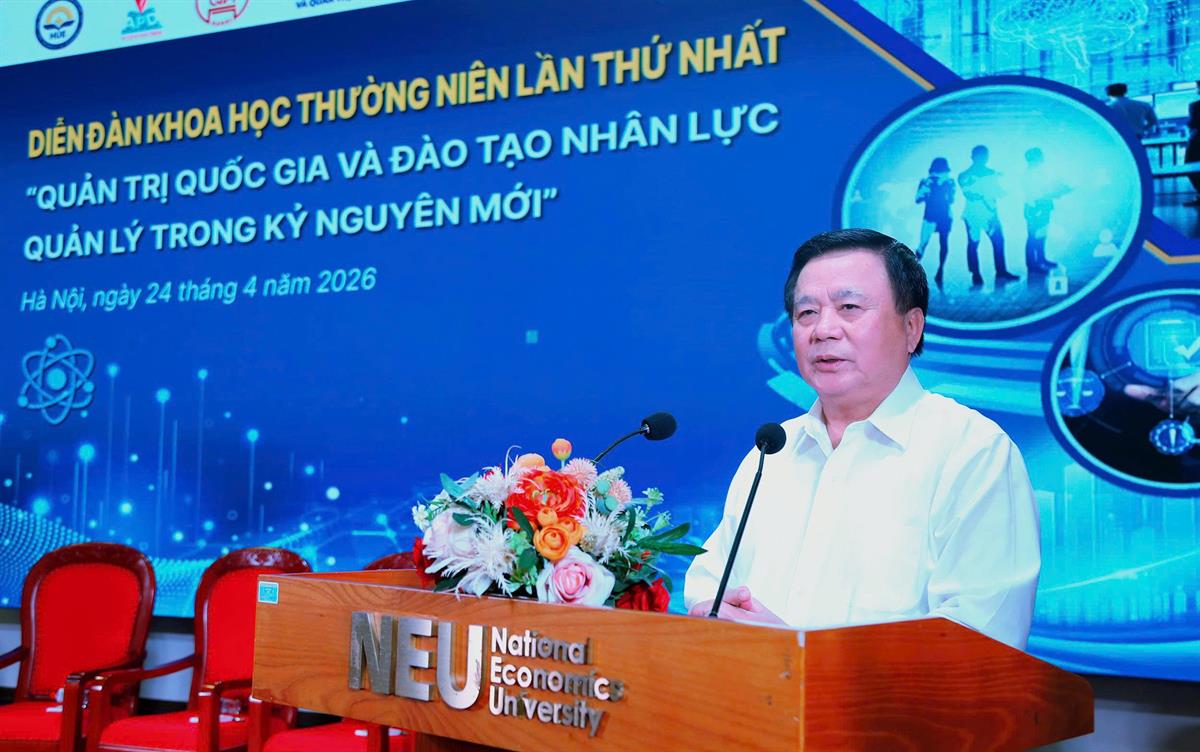
Professor, Doctor Nguyen Xuan Thang, Member of the Politburo of the 13th Party Congress, Chairman of the Central Theoretical Council, delivered a speech at the ceremony.
Regarding the first annual scientific forum of the GPPA, "National Governance and Management Human Resource Training in the New Era," the member of the Politburo of the 13th Party Congress and Chairman of the Central Theoretical Council expressed his hope that the forum would not only focus on training and developing management human resources in the new era but also expand to include exchanges and discussions on collaborative research activities, jointly addressing the country's pressing issues, linking practical experience and research with policy planning and implementation, and making positive contributions to the implementation of the contents summarizing 100 years of the Party's leadership of the Vietnamese revolution (1930-2030) and 40 years of implementing the Platform for building the country during the transitional period to socialism.
Speaking at the ceremony, Associate Professor Bui Huy Nhuong, Director of the National Economics University and Chairman of GPPA 2026, representing the host institution, emphasized that many training and research institutions in Vietnam are currently implementing training and research programs related to public administration and policy. However, these programs are fragmented and carried out separately according to the individual orientations of each educational institution. Therefore, the establishment and launch of GPPA with the participation of 10 member institutions will open a new phase of development for training and research in policy and public administration, marking the beginning of a journey of substantive, effective, and sustainable cooperation. Based on respecting and leveraging the strengths and unique identities of each member, the members participating in the Network will operate in a spirit of connection, sharing, cooperation, and jointly creating common values for a modern, effective, and highly accountable public administration.
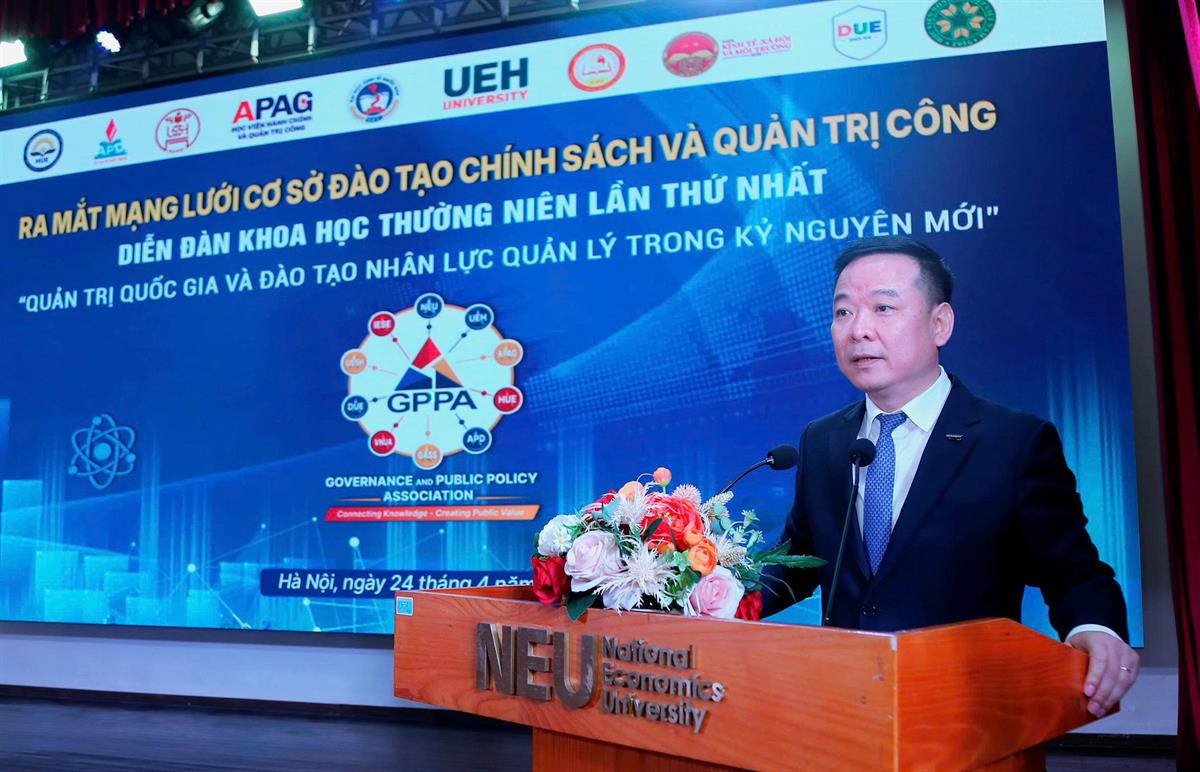
Associate Professor Bui Huy Nhuong, Director of the National Economics University and Chairman of GPPA in 2026, delivered a welcoming speech.
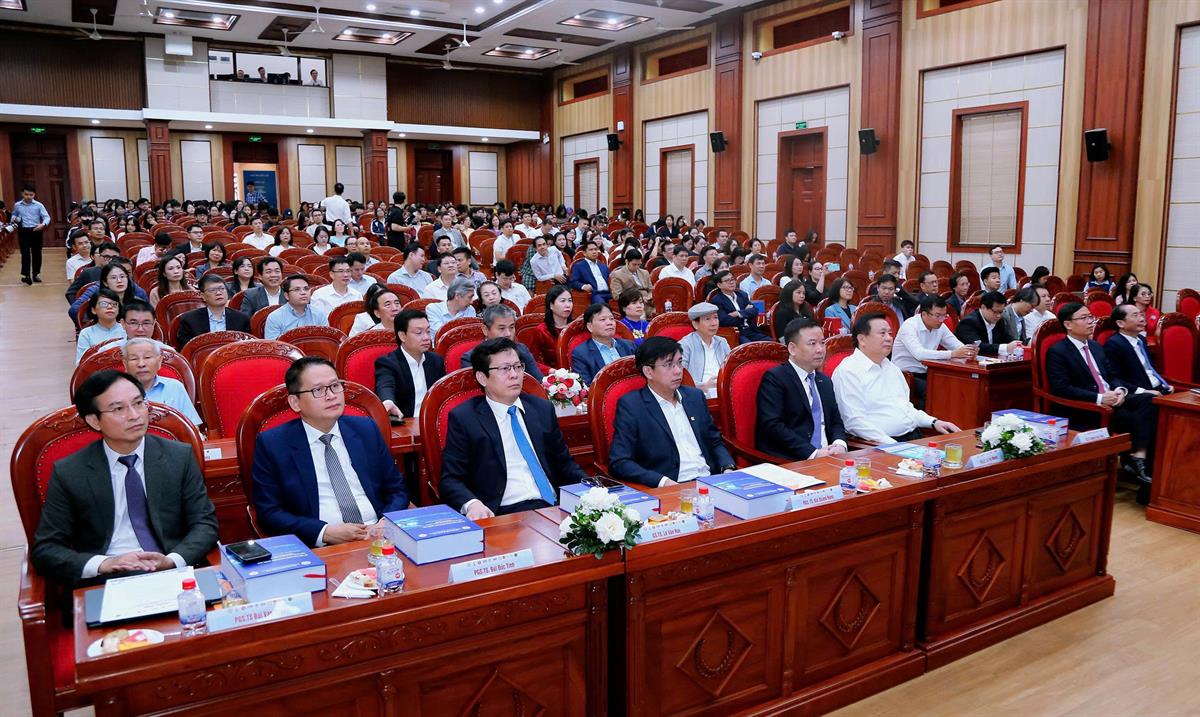
Delegates attending the ceremony
With that in mind, Associate Professor Bui Huy Nhuong suggested that the delegates focus their discussions on clarifying the following three main points: Firstly, in the era of national development, what trend should the national governance model in Vietnam follow? What demands does effective, transparent, and highly accountable national governance in the digital age place on the current public administration workforce? What needs to be done to meet those demands? Secondly, what demands does the current process of streamlining the administrative apparatus and implementing a two-tiered local government model place on the current management workforce? What needs to be done to meet those demands? Thirdly, what can and should educational and research institutions specializing in public policy and management do to contribute to building effective, transparent, and highly accountable national governance in the digital age?
Associate Professor Bui Huy Nhuong affirmed that the issues discussed at the Forum will be compiled by the Organizing Committee into a policy advisory report to be submitted to Party and State agencies, as well as relevant stakeholders, in order to refine the national governance model for sustainable development in Vietnam.
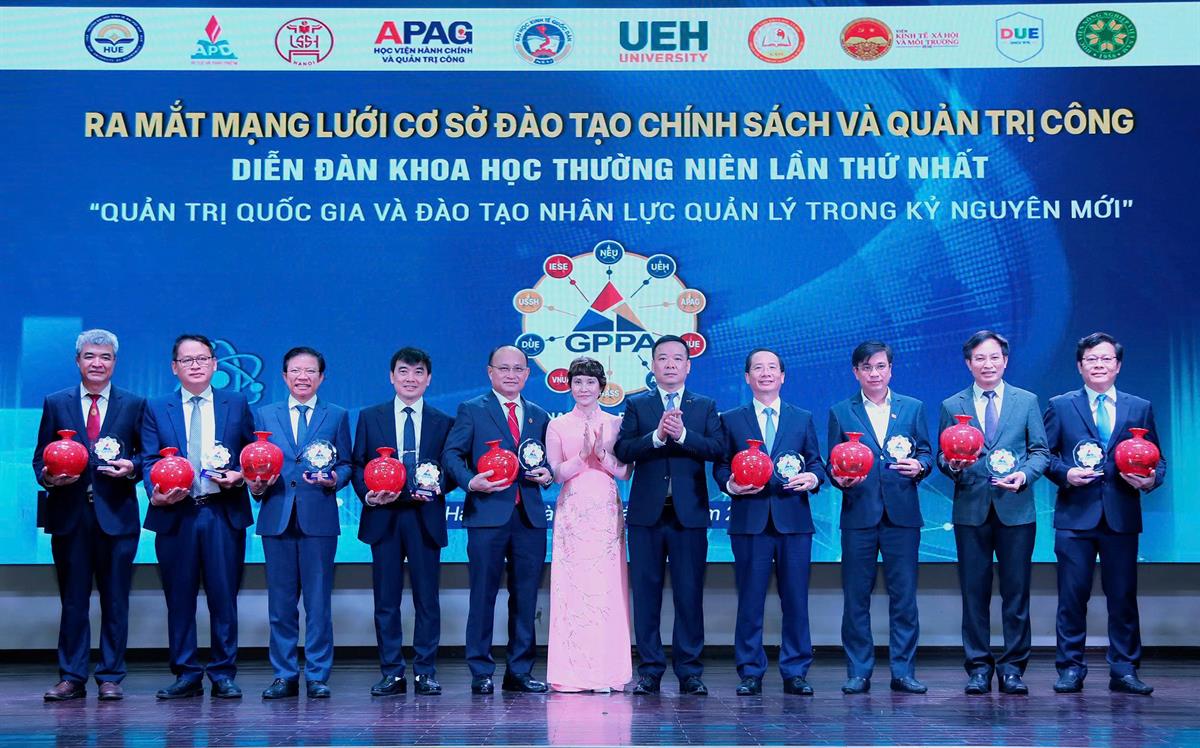
Representatives of the National Economics University leadership, the GPPA Chairman for 2026, presented the Network's emblem to the participating units.
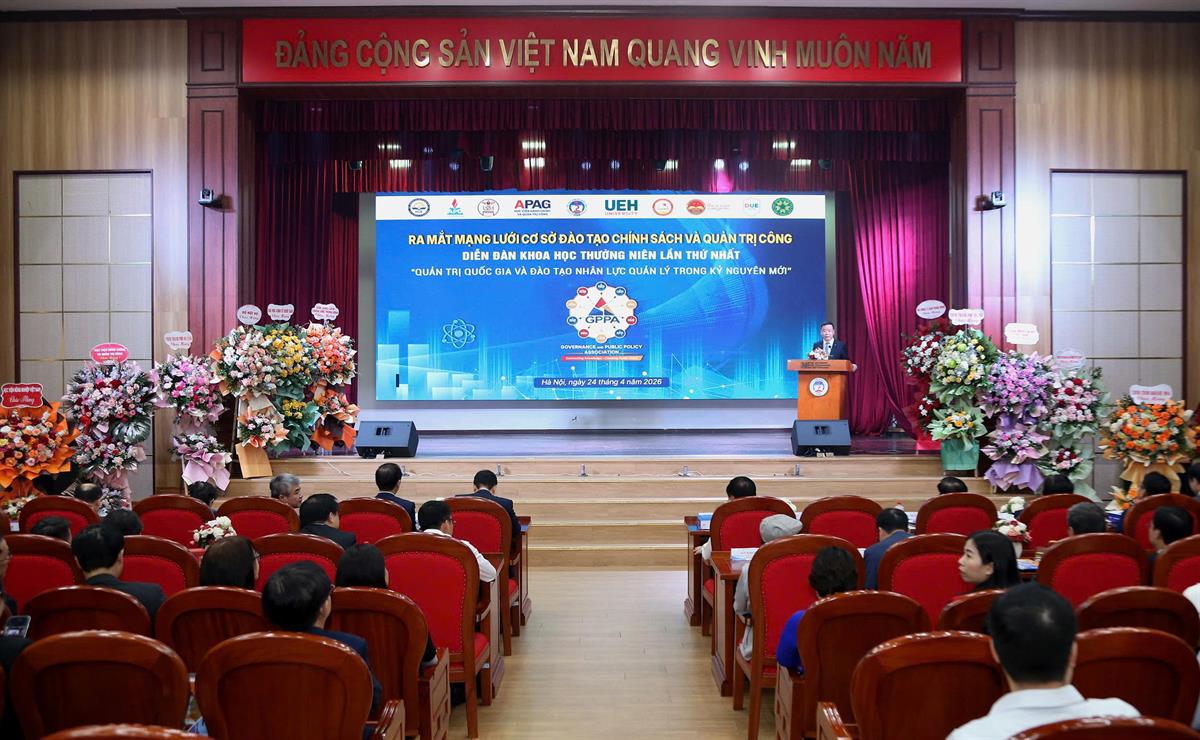
Scenes from the Ceremony
At the conference, delegates affirmed that in the new era, when the digital economy and data-driven governance are profoundly changing the structure and operation of the world economy, national governance has become a decisive factor in the competitiveness and sustainable development of each nation. Recognizing the need to innovate the national governance model in the new era, the 14th National Congress of the Party set forth the requirement to "Enhance national governance capacity towards modernity and efficiency; build a streamlined state administrative apparatus that operates effectively and efficiently to serve the people and socio-economic development." In particular, the Resolution also considers digital transformation as a key tool for modernizing national governance and affirms that "Promoting national digital transformation, developing a digital government, digital economy, and digital society is one of the strategic breakthroughs, creating a favorable legal environment for new business models, the digital economy, and the green economy."
Delegates argued that the content of the document reflected the Party's thinking in shifting from an administrative-command management model to a modern public governance model based on the principles of efficiency, transparency, and accountability. Accordingly, national governance in Vietnam in the new era needs to focus on streamlining the administrative apparatus, clearly defining the authority between the central and local levels, improving the coordination mechanism for policy implementation, and enhancing the capacity, professionalism, and accountability of cadres, civil servants, and public employees to meet the requirements of the growth model reform, digital transformation, and deep international integration.
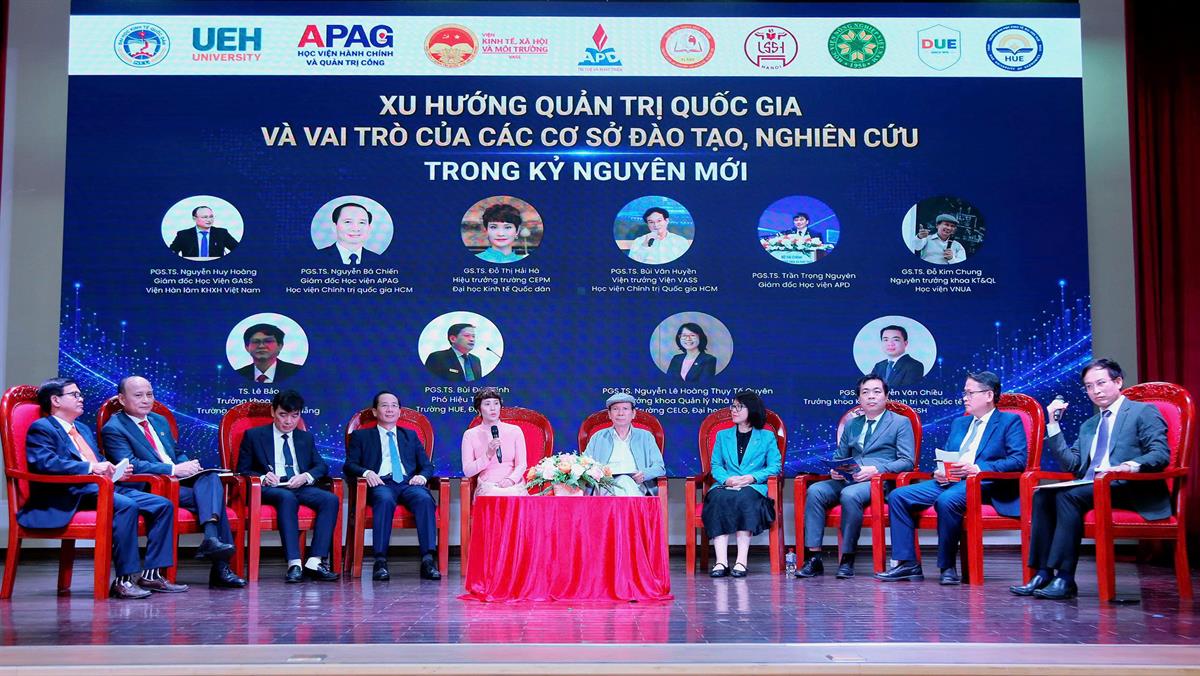
Experts and scientists participated in a roundtable discussion at the Forum.
The workshop affirmed that the implementation of the Party's policies in recent years has brought about significant changes in national governance in Vietnam. Vietnam's public administration has been reorganized towards streamlining; decentralization and delegation of power have been expanded, with the two-tiered government model gradually being perfected, contributing to reducing intermediate levels and improving the efficiency of socio-economic management. However, institutional reform and national governance still face some limitations, such as the lack of truly flexible coordination between the central and local governments; expanded decentralization and delegation of power but insufficient accountability; and a shortage of data-driven analytical and decision-making skills among civil servants, as well as limited strategic thinking and digital capabilities that do not meet the requirements of the new national governance system. These limitations have created an urgent need for innovation in the content, programs, and methods of education, training, and scientific research in a modern direction to improve the quality of human resources for management and public policy, meeting the requirements of institutional reform and modernization of public administration in Vietnam.
In a roundtable discussion on national governance trends and the role of higher education institutions in the new era, participating experts and scientists delved into and clarified the content, models, and factors influencing national governance in the new era; the relationship between the quality of state governance and human development in Vietnam; the data economy and the transformation of the role of state governance; institutional reform in public governance associated with decentralization and delegation of power; opportunities and challenges for Vietnam; and the issue of training managerial human resources in the new context of Vietnam's digital economy. From this, they proposed solutions to improve the effectiveness of national governance in the digital era in Vietnam today, shifting from administrative management to development governance, and training and developing managerial human resources to meet the requirements of national governance in the new era.
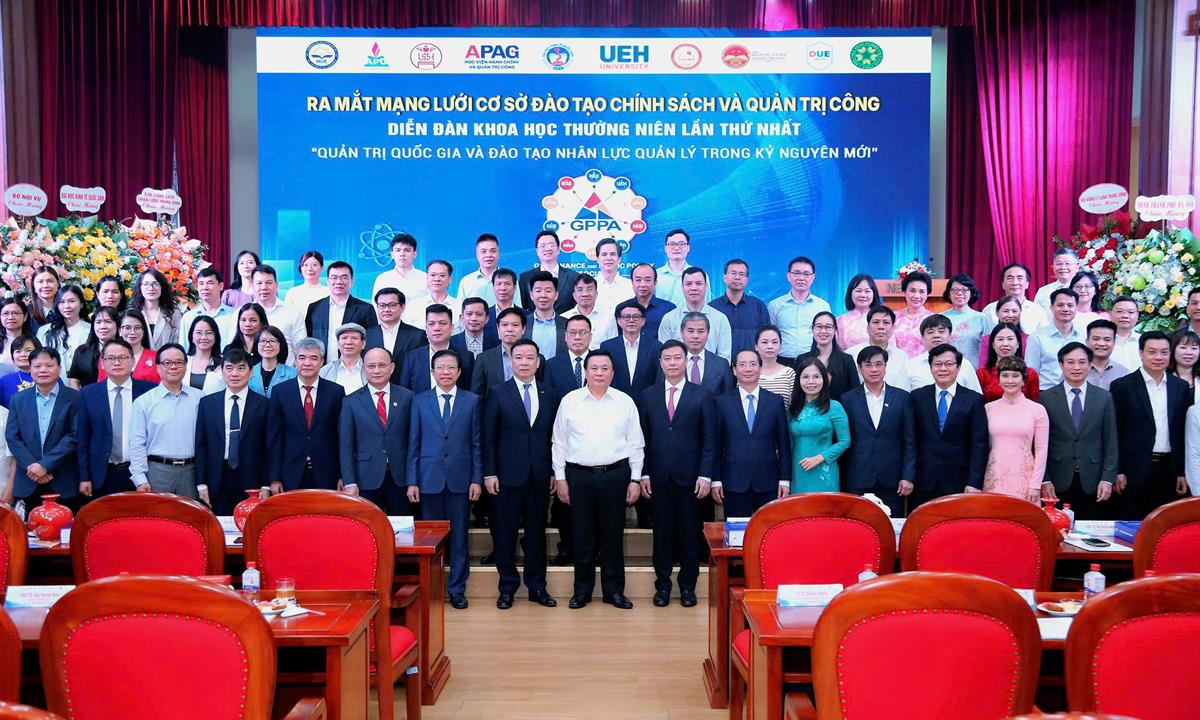
The delegates attending the event took a commemorative photo.
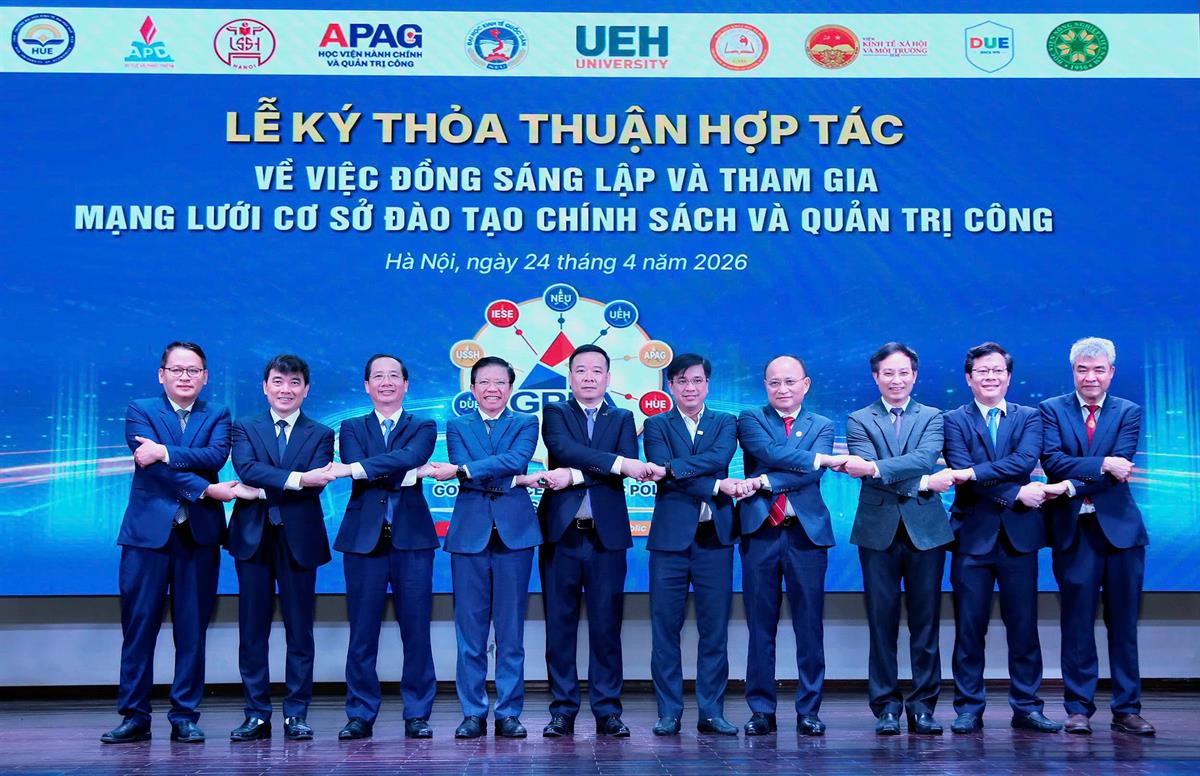
Representatives from the member units of the Network took a commemorative photo.
Author:According to the Ho Chi Minh National Academy of Politics
Newer news
Older news

