Following Resolution No. 71-NQ/TW dated August 22, 2025, on breakthroughs in education and training development, policies for developing high-quality human resources, attracting talent, and postgraduate training continue to receive attention. Resources are also prioritized for scientific research, including basic research linked to postgraduate training.
Decree No. 179/2026/ND-CP stipulates scholarship policies for doctoral students in basic science, key engineering fields, and strategic technologies. Several localities and higher education institutions have also implemented support policies for doctoral students, including programs providing support up to hundreds of millions of VND.
However, the level of investment still varies across fields. In the social sciences and humanities, support policies specifically for doctoral students are not yet widespread, mainly consisting of tuition fee waivers or reductions, or support through research projects.
In this context, direct investment in future research and teaching human resources, starting from the postgraduate stage, is being implemented by some higher education institutions as a proactive approach to creating a high-quality scientific workforce.
At the University of Social Sciences and Humanities, Vietnam National University, Hanoi, the policy for doctoral students under the "talent pool" program is designed to consider them as the next generation of research and teaching staff for the university.
Accordingly, doctoral students receive 100% tuition fee support for the duration of their training, equivalent to approximately 50 million VND per year, and also receive support for living expenses, research, international publications, and academic activities.
Associate Professor Dang Hong Son, Vice Rector of the University of Social Sciences and Humanities, believes that building a successor team must begin early. If universities only start searching and recruiting when a position needs someone, they will find it difficult to proactively manage the quality and supply of human resources.
"Talent development," therefore, is not simply about granting scholarships to students. More importantly, the school identifies promising young people early on, creating conditions for them to receive systematic training, participate in research, and gradually develop the capabilities of a scientist.
According to this model, the central task of a doctoral student is to complete their dissertation and develop their research capabilities. For those who already have a master's degree, the standard training time is 3 years; for those with a bachelor's degree, it is 4 years.
During their training period, doctoral students are not required to perform administrative duties; teaching support activities are also limited to an appropriate level, approximately 20 hours per year. Each doctoral student is supervised and supported by experienced faculty members throughout their research.
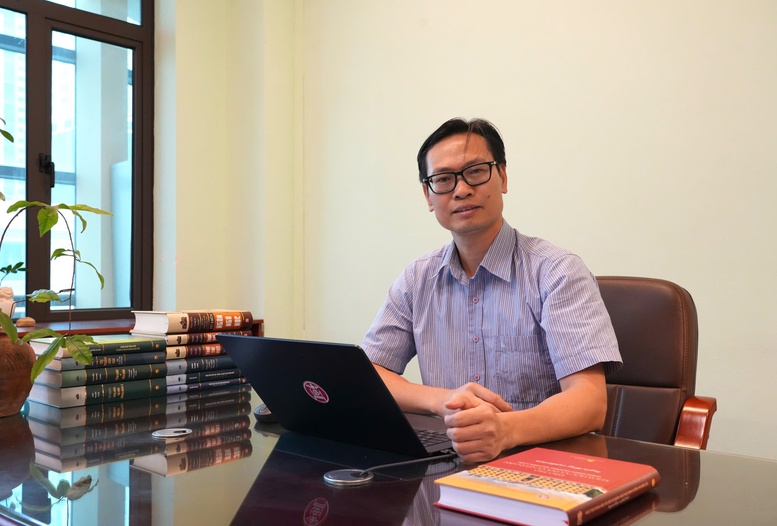
Assoc. Prof. Dr. Dang Hong Son: To have scientists, we must invest in them from the time they are still postgraduate students - Photo: chinhphu.vn/Thu Trang
According to Associate Professor Dr. Dang Hong Son, this approach stems from the reality that if young people have to simultaneously worry about jobs, income, and non-specialized work, it is difficult to expect them to dedicate all their time and effort to scientific research.
Therefore, investing in postgraduate students should not only focus on tuition fees but also create conditions for them to truly "make a living from research." In addition to tuition fees, policies should include support for living expenses, social insurance, health insurance, funding for attending academic activities abroad, international publications, and participation in research projects.
Some grants can amount to up to 25 million VND for academic activities abroad; doctoral students who defend their dissertations early, on time, and meet the requirements may even receive a bonus of up to 50 million VND.
In general, the total amount of support can reach approximately 580-750 million VND for a doctoral student over a period of 3-4 years.
This is a significant investment. However, when considered within the long-term development of the scientific workforce, the value of this investment lies not just in a PhD degree, but in the formation of a capable researcher with scientific output and the potential for continued development within a university environment.
However, Associate Professor Dr. Dang Hong Son also emphasized that a large-scale investment policy requires commensurate commitments to output quality.
"Supported doctoral students must complete the program on time, meet language requirements, perform research tasks, and publish international scientific papers as required, including at least one publication in the WoS or Scopus systems."
"Along with that, there is a requirement to participate in research activities, seminars, projects, and contribute to the school's academic environment," said Associate Professor Dr. Dang Hong Son.
Thus, the relationship between the university and graduate students is based on the principle of investment coupled with responsibility, and support coupled with selection based on results. Those who receive investment not only receive financial support but must also demonstrate their competence and research output.
This approach both motivates graduate students to focus on their scientific work and helps the university avoid spreading resources too thinly, directing them towards those who are truly capable and promising.
However, creating a new pool of talent is only the first step. The more important challenge is how to ensure that young people, after receiving their PhDs, continue to pursue careers in science.
A young PhD holder has many career options. If the university environment lacks suitable job opportunities, research groups, research funding, and career development opportunities, the investment in training during those years will be difficult to translate into a long-term scientific workforce.
Therefore, the talent recruitment policy needs to be followed by a clear career path: from graduate student to lecturer and researcher; from joining a research group to gradually forming their own research group; from conducting research projects to leading scientific tasks and developing into capable independent scientists.
This is also a crucial factor in retaining young people in the academic environment.
The ultimate goal of talent development policy should therefore not only be to increase the number of people with PhDs, but also to cultivate a generation of young scientists who possess research capabilities, teaching abilities, scientific output, and long-term development prospects.
To achieve this, the investment process must begin early enough, focus on the right people, be linked to results, and be sustained by a clear career path.
In other words, according to Associate Professor Dr. Dang Hong Son, to have scientists of the future, we cannot simply "recruit people" when positions are vacant. We need to cultivate talent while young people are still studying, invest in them when they begin their scientific work, and create an environment for them to grow into independent scientists.
Related articles:
Government Electronic Newspaper: To cultivate scientists, investment must begin when they are still graduate students.
Education and Times Newspaper:A breakthrough in doctoral scholarship policy in the Social Sciences and Humanities.
Life and Law Newspaper: The university invests up to 750 million VND per doctoral student, creating a pool of future lecturers.
Author:According to the Government Electronic Newspaper
Older news

