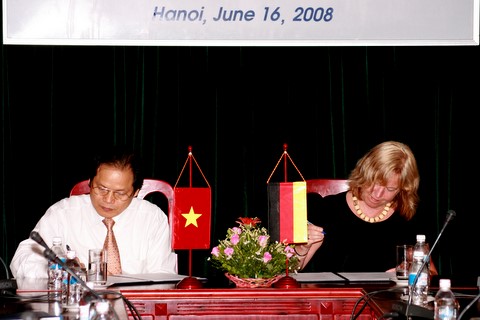
On the occasion of the 10th anniversary of the cooperation and development between the Rosa Luxemburg Institute and the University of Social Sciences and Humanities, Hanoi Television conducted an interview with Professor Dr. Nguyen Van Khanh - Rector of the University. USSH is pleased to present the content of this interview.
1. Could you please explain the process of establishing the relationship between the University of Social Sciences and Humanities and the Rosa Luxemburg Institute?The Rosa Luxemburg Foundation (RLS) is the representative organization of the Social Democratic Party (PDS), whose views are closely aligned with the current Left Party of the Federal Republic of Germany. It is named after the outstanding German politician and heroine, Rosa Luxemburg. The University of Social Sciences and Humanities in Hanoi was the first Vietnamese institution to establish a collaborative relationship with the RLS Institute, beginning in 2001 with a visit by Mr. Jorg Schultz. In 2002, the RLS Institute officially signed a cooperation agreement with the University of Social Sciences and Humanities, Vietnam National University, Hanoi, for a three-year funding program on policy research. In 2008, the Institute further expanded its cooperation with the university by signing a cooperation agreement for three projects: 1/ Policy research to enhance the capacity of policymakers and socio-political organizations; 2/ Innovation in education policy; 3/ Choosing left-wing theories in a changing world. To date, the University of Social Sciences and Humanities has had a cooperative relationship with the Institute of RLS for over 10 years. After 10 years of cooperation and development, from its initial partner, the University of Social Sciences and Humanities, the Institute of RLS now has nearly 20 partners with dozens of collaborative projects in Vietnam.
 2. Could you please assess the impact and effectiveness of the RLS Institute's collaboration with the University?
Over the past 10 years of cooperation with the RLS Institute, through various collaborative projects, the University has achieved many important results. a. Regarding research: The two sides have conducted research and organized 13 seminars and workshops in Vietnam and the Federal Republic of Germany. In addition, several delegations have been sent to conduct research and exchange experiences on policy analysis research in Vietnam, Germany, China, Singapore, etc., helping Vietnamese researchers and lecturers accumulate more knowledge and experience in the field of research, planning, and implementation of policies, especially in the field of Science and Education. Simultaneously, many documents on policy science have been translated and compiled, including a policy science textbook used in undergraduate management science programs; and the book "Policy Analysis and Planning Skills" has been published to serve training courses on policy analysis and planning skills for Vietnamese National Assembly delegates from the 2011-2015 term. b. Regarding training: - Develop and teach three undergraduate courses in Policy Science for students in the Faculty of Management Science. - Provide training in soft skills for students, enhance the role of businesses and the labor market, and strengthen the connection between employers and the university's training programs. - Organize over 20 training courses on policy analysis and planning skills for policy officers in provinces and cities both domestically and internationally. c. International cooperation: - Establish cooperative relationships with several universities in Germany, China, Singapore, Italy, etc., to develop the field of policy science, primarily public policy. - Conduct faculty exchanges and coordinate the organization of seminars and scientific conferences on policy science with several research institutes and universities in Asia and Europe. d. Establish a Center for Policy Research and Analysis (CEPSTA) and build a policy research network in Vietnam. To implement collaborative projects with the RLS Institute and build a network for policy research, the university established the Center for Policy Research and Analysis (CEPSTA) in 2007. Through CEPSTA, the university has strengthened its partnership activities to build a network for policy research with hundreds of policy-making and implementation officials, including members of Parliament, working in various universities, research institutions, or in ministries, provinces, and cities nationwide.
 3. How would you assess the activities and role of CEPSTA?
Established in 2007, the center has successfully fulfilled its functions of research, professional training, and consulting on policy planning and implementation issues. As the focal point for receiving and implementing collaborative projects with the RLS Institute, the Center (CEPSTA) of the University has built and developed a network (comprising dozens of research institutions and universities) on Policy Science in Vietnam. The center has also conducted training courses on research and policy planning skills for hundreds of officials from the National Assembly, central and local levels, contributing to the innovation and improvement of analytical and policy planning skills, and socio-economic development in localities.
4. Can you suggest some ideas to foster future collaboration with the RLS Institute?- Regarding organization, the University hopes to continue receiving support in terms of experience and resources from the RLS Institute for development. Based on this, in the near future, it is hoped that the CEPSTA Center will develop into a Policy Institute, playing a leading role in Vietnam, similar to the Lee Kuan Yew Policy Institute in Singapore in this field. - Regarding policy research: + The Institute will continue to support the University in implementing training courses and workshops to enhance skills in research, planning, and policy implementation for local officials, especially those in remote, mountainous areas – regions with limited opportunities for training and learning in this field. + Support in establishing the Policy Science major, primarily public policy, as an independent academic discipline within the University of Social Sciences and Humanities at all three levels: bachelor's, master's, and doctoral. + Support projects on environmental policy, climate change adaptation, and sustainable development, especially in the areas of science and education policy. In short, after 10 years of cooperation with the RLS Institute, the University of Social Sciences and Humanities in particular, and Vietnam in general, have undergone significant changes from awareness to policy planning and implementation, contributing to the formation and development of Policy Science in Vietnam. On the occasion of the 10th anniversary of our cooperation with Vietnam, on behalf of the University of Social Sciences and Humanities, Vietnam National University, Hanoi – the Institute's first partner in Vietnam – I would like to express my sincere gratitude to the generations of leaders of the RLS Institute, the heads of representative offices, and all members of the Institute in Hanoi for their enthusiastic and effective support and assistance to the University and Vietnam, making important contributions to the development of higher education and the country of Vietnam over the past decade. We wish for the cooperative relationship between the RLS Institute and Vietnam to continue to develop, and for the Institute's position and prestige to be further enhanced in Vietnam and worldwide, worthy of the great name and ideals of the heroine Rosa Luxemburg.
Thank you very much, sir.