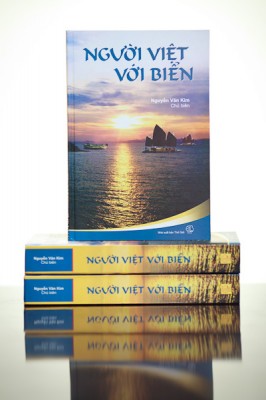
Professor Vu Duong Ninh introduces the book "Vietnamese People and the Sea," edited by Associate Professor Nguyen Van Kim, published by The Gioi Publishing House, 2011.
For generations, humankind has lived on
Blue PlanetWith its vast expanse of green mountains and forests, the green of rice paddies, and the boundless blue of the sea, the Earth, a blend of continents and oceans, forms an ecological environment for humanity that is both tranquil and peaceful, yet also fraught with storms and harsh challenges. In this natural environment, over generations, people have adapted, overcome obstacles, and utilized favorable conditions to survive, develop, and create a diverse and rich life, yet one marked by countless changes. Vietnam and its people, from their very beginnings, have converged and flourished in such an environment of mountains, forests, plains, and seas. The process of nation-building, protecting the land, and expanding the territory by our ancestors has bequeathed to succeeding generations the S-shaped Vietnam we see today. The Vietnamese homeland sits in a strategically advantageous position with an ideal "three-dimensional spatial coordinate." From a geographical, cultural, and historical perspective, and considering its strategic position, Vietnam is both a Southeast Asian and an East Asian country, situated on the western edge of the Pacific Rim. Therefore, it has formed a cultural environment rooted in rice-growing valleys and deltas, absorbing influences from Chinese civilization from the Northeast and Indian civilization from the Southeast, while also opening its doors to the East Sea to receive the influx of Western civilization.

This three-dimensional spatial position naturally fostered in the Vietnamese people a harmonious consciousness between land and ocean, between land and sea, beginning with the immortal legend of Lac Long Quan and Au Co, who took 50 children to the mountains and 50 children to the sea, building the beautiful land of Vietnam. Generation after generation, communities living on Vietnamese territory have reclaimed land, conquered the seas, established sovereignty, expanded trade, and continued to write the glorious history left by their ancestors. Along with the process of "opening up the country" to the South came voyages to the open sea, taking control of many archipelagos and sea regions. The doors of foreign trade opened wide with numerous seaports and port cities welcoming merchant ships from neighboring countries, and facilitating contact with merchants and missionaries from many Western countries. In modern times, during the arduous struggle for national liberation, alongside the Ho Chi Minh Trail on land along the Truong Son Mountains, there was the Ho Chi Minh Trail at sea, with its "ships without numbers" braving the waves of the East Sea to reach the battlefield. And in today's development, the maritime economy occupies an extremely important position in the national economy. Oil is exploited, seafood is exported, industrial zones are established, coastal tourism is expanded… all contributing to a breakthrough in integration with the world. Cultural heritage, legendary routes, and economic achievements once again demonstrate the Vietnamese people's mindset of always connecting land and sea, an eternal identity originating from ancient times, from thousands of years of history to the present and forever after. From a historical research perspective, this work...
Vietnamese people and the seaIt has focused on exploring and explaining the relationship between Vietnam, the Vietnamese people, and the outside world via maritime routes.
Maritime cultural strataBuilt upon legends about the nation's founding, spiritual beliefs, everyday folk tales, and records accumulated over many ages, the awareness of the sea has gradually become increasingly vast and profound. Archaeological excavations have unearthed prehistoric and early historical artifacts from coastal areas and islands along the length of the country from North to South, extending into the East Sea.
Trade relationsMaritime activity was a prominent, fairly continuous, and effective aspect of the country's maritime activities. Early trade relations between Dai Viet and Northeast and Southeast Asian countries, and subsequent interactions with the Western East India Companies, significantly boosted the country's economy. Many traces remain of once-vibrant trading ports such as Van Don, Hoi An, Thi Nai - Nuoc Man, and even island ports like Con Lon and Phu Quoc. Numerous records of merchants from China, Japan, India, Siam, Java, Portugal, Spain, the Netherlands, France, and England are still preserved in documents, architectural works, commercial products, and discovered shipwrecks. These documents reveal the landscape of maritime trade, the rise and fall of trading ports and cities, the bustling shipping routes, and the extensive international exchanges. Overarching all of this is the maritime consciousness, the maritime policies of various dynasties, and maritime trade activities throughout different periods, amidst the vicissitudes of time.
Maritime sovereignty and securityThis is a topic of continuous interest throughout the course of the country's history. Vietnam's sovereignty over the Hoang Sa and Truong Sa archipelagos and many other islands is mentioned through documents recorded in Chinese historical records and through observations by Western merchants and missionaries. These foreigners themselves, along with their sources, objectively and realistically stated Vietnam's sovereign rights over the archipelagos in the East Sea, and today, protecting sovereignty, maintaining security, and developing the maritime economy are long-term strategic tasks. The three main contents of the book presented above are components of a research project undertaken by the authors who voluntarily participated and worked closely together.
Asian Trade Research GroupFounded and directly led by Assoc. Prof. Dr. Nguyen Van Kim, the group was established in 1999 with key members from the Department of World History - Faculty of History (University of Social Sciences and Humanities, Vietnam National University, Hanoi) and also includes many lecturers from universities and research institutes who studied and worked at the Department of World History - Faculty of History and the University of Social Sciences and Humanities, Vietnam National University, Hanoi. Over the years, in its research, teaching, and international cooperation activities,
Asian Trade Research GroupThe focus has been on the following key areas: 1. The traditional maritime exploitation practices of the Vietnamese people and regional communities; 2. The maritime mindset and thinking of the Vietnamese people; 3. Maritime cultures and cultural spaces; 4. The formation, operation, and role of trading ports and port cities; 5.
Marine bodyand their relationship
Agricultural institutions,
Forestry institutions6. The relationship between
Seawith
Continent6. The formation of trade routes and sources of goods; 7. Maritime trade activities of the Vietnamese people and the relationship between the Vietnamese and Asian and European merchant communities; 8. The process of exchange, dissemination, and response of ideas and culture; 9. Awareness of sovereignty, the process of establishing and protecting the sovereignty of our nation's seas and islands throughout history; 10. Building sources of documents, databases, and information on seas and islands and research serving the Vietnam Maritime Strategy... From these orientations, research activities have been contributing towards a more comprehensive and profound understanding of the position and importance of the sea, its rich and diverse potential, while also contributing to building scientific arguments for formulating policies on exploiting marine resources, developing the marine economy, and protecting Vietnam's sovereignty over its seas and islands. (The work)
Vietnamese people and the seaThe work, edited by Associate Professor Dr. Nguyen Van Kim, is one of the new achievements in implementing the aforementioned research orientation. The project is the result of the scientific passion and serious research style of its members.
Asian Trade Research Groupsimultaneously
This promises many more follow-up works in the future. I feel honored to introduce this scientific work to a wide audience.
Vietnamese people and the seaand expressed confidence in receiving further works and articles within the established program of the Research Group as well as members of the Department of World History.
Hanoi, September 15, 2011