I remember almost fifty years ago, when I was in third grade in Nguyen Binh district, Cao Bang province, I once heard my eldest brother – a young teacher who had left the lowlands to teach secondary school literature there – while tearing off a page from a block calendar (the only type of calendar commonly available at that time, printed on thin, poor-quality paper) to roll cigarettes, humming a poem that included these lines:
Tonight,
The Earth hasn't completed one full rotation yet.
The plan is now one year old.
Skilled hands, overflowing with confidence and love.
Things fall, and time passes.
The peaches haven't arrived at the factory yet, and spring has already come.
The sound of firecrackers, the calendar on the wall looking bewildered...Among the many things that my young, inquisitive mind absorbed from books and observations around me, these verses made a particularly strong impression because of my brother's explanation of the "absurdity" in the situation.
overtakeof spring and the "surprised mood" of the wall calendar. Then this "event" was overshadowed by many other interesting new things, until I entered the 14th cohort of the Literature Department at Hanoi University and learned about the author of the poem.
The peaches haven't arrived at the factory yet, and spring has already come.The above lines were written by a professor in the department. The poem has been printed in
Anthology of Vietnamese poetry 1945 – 1960.

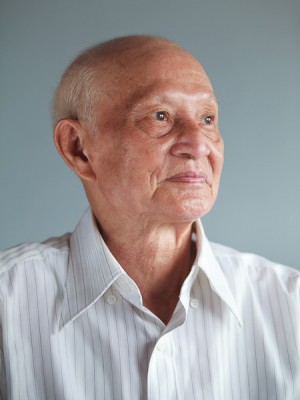
But I only truly had the opportunity to study with Professor Nguyen Kim Dinh for the first time after the liberation of South Vietnam, when I returned to the lecture hall for the 18th course. At that time, he was about 40 years old, rather thin (that was his physique, although in those years, almost everyone was thin!). But beneath the brim of his felt casquette hat (as I later learned, having followed him for many years, since our days in Moscow), his bright eyes were always fixed on the person he was speaking to, both encouraging and anticipating something. Especially, whenever he lifted his hat, his broad forehead created not only an outward impression of strength.
overtakeTime seemed to brighten his kind face, adding to his intellectual radiance. Indeed, Professor's lectures on M. Gorky, V. Mayakovsky, and others transcended the limitations of the few textbooks available at the time (there were only about two main ones in the library: one by V. Nubarov – a visiting professor at Hanoi University in the late 1950s – and another by Professor Hoang Xuan Nhi). In his lectures, we not only discovered new knowledge but also felt the fervent desire to "bring sparks of sunlight into the human bloodstream" and the enthusiasm to "implement the resolutions of the heart," declaring war on "Soviet vulgarity" of those writers. Later, when I had the opportunity to be close to him, to continue studying and teaching with him in the same subject, I gradually understood the source of the voice that was both passionate and enthusiastic, yet firm and concise, in his lectures and research. Anyone who has read all, or most, of the research works by Professor or those he has led – about thirty articles, books, and scientific research projects (a number that isn't particularly "impressive" to those who like statistics) – will likely share my initial impression of a consistently bold writing style.
overtakeand encouraged colleagues and students to "dive into" topical academic issues in literary research such as typology, poetics, semiotics, narrative studies, and cultural studies. This was only evident through the works published in the Literary Journal.
Some poetic issues of verbal art(1985)
Regarding the research trend in liberal literature(1993)
Russian philologists and the semiotic tendency in literature(1995), in the proceedings of the national conference on New Poetry –
Experiencing the artistic space in Modern Poetry(in the book)
Looking back at a revolution in poetry,1993), or through ministerial-level research projects.
Narrative language problems(1998), for me, the image of the Professor, if "seen from the side," is already very sharp. In the chronology of the Faculty of Literature, Hanoi University, it can be said without exaggeration that the scientific events in which the Professor actively participated related to the above issues were not limited to the scope of influence of a single academic unit. For example, at the 1980 scientific conference (held at 19 Le Thanh Tong, I don't remember the exact name) on theoretical and practical issues in literary research, which included scholars from the Institute of Literature and Hanoi Pedagogical University, the paper presented...
Some issues regarding the methodology of typological research.The professor's work convinced the audience not only because of the clarity of his theoretical conclusions on a relatively new issue at the time, but also because of his careful, selective attitude and respectful acknowledgment of the practical research results of his colleagues, even those who had not yet consciously applied this method. I am referring to Volume II of his work on literary history.
Vietnamese literature of the 10th century and the first half of the 18th century(University and Vocational High School Publishing House, 1979) compiled by Professor Bui Duy Tan (in the two-volume textbook series by authors Dinh Gia Khanh, Mai Cao Chuong, and Bui Duy Tan), was mentioned by the Professor in his paper. According to the Professor, the author of the book also based his classification of trends and genres from the 16th century to the first half of the 18th century on the principle of "typological community." I was also very impressed by the mutual respect among the professors in the department when, on the sidelines of that conference, in response to my greeting, Professor of Linguistics Nguyen Tai Can said he attended the conference "primarily to hear Mr. Dinh's paper." Later, the Professor developed that paper into a teaching topic for many years at the postgraduate level. Looking at the "paradigm" of literary theory and criticism research in the years that followed, I kept thinking it was no coincidence that after the summarizing and thought-provoking articles by Professor Do Duc Hieu, along with the works of professors of the same generation as Professor Do Duc Hieu and Professor Tran Dinh Huou, a number of noteworthy articles/books by his close students appeared, for example, on typology by Lai Nguyen An.
Try to find out what types of Thematic motifs in modern Vietnamese literature.Literature Magazine, 1987, issue 6) and Tran Ngoc Vuong (
The talented Confucian scholar and Vietnamese literature(Education Publishing House, 1995), on the poetics of Nguyen Xuan Kinh (
Poetics of folk songs,(National University of Hanoi Publishing House, 2004),…

In Professor Hoang Xuan Nhi's book, *M. Gorky – Life and Work*, written 22 years earlier (1959), this monograph provides a deeper and more vivid understanding of Gorky – the "harbinger of storms" of the revolution, the "apostle" of socialism, the creator of the "myth of the man with the wings of Icarus." In this book about M. Gorky, readers can find traces of Gorky's own influence – a master of literary portraiture. Naturally, time has allowed those who succeeded him in teaching and researching Russian literature to introduce another facet of Gorky – one of the great and complex phenomena of world literature, a man of skepticism, who once disagreed with the Soviet government on cultural and intellectual issues. Nevertheless, I still think that if the curriculum for literature students included a subject...
Research and critical writing skills(If this type of course had already been implemented in practice), then the professor's book would surely be used as a practice object for genre analysis.
Creative portraiture criticism.Like most people who studied literature in Soviet Russia, Professor's connection to Russia was not only based on beautiful impressions and memories of the country's nature and people, but also on the lofty humanistic ideals, full of vitality, embodied in the immortal literary images of classical Russian writers.

As the son of a renowned teacher from Thanh Hoa province, originally from Nghe An, Mr. Nguyen Kim Dinh himself studied Chinese characters from a young age, receiving a Diplôme from Dao Duy Tu school, at the same time as his senior, Professor Tran Dinh Huou. He also taught high school (mathematics!) for four years in Quang Xuong before enrolling in the first cohort at Hanoi University. This brief overview helps to understand the "level of acceptance" of Russian literature and culture held by the reader, Nguyen Kim Dinh. And only with such a "level of acceptance" can one possess the ability to adapt to the changing times while remaining loyal to Russian studies. It's worth remembering that in the early 1990s, after the collapse of the Soviet Union, several "Russian scholars" quickly changed their decades-long beliefs in the (true) values of Soviet literature, becoming, or struggling to become, a different kind of "scholar." For the loyal reader Nguyen Kim Dinh, reading is not just about acquiring knowledge, but also, and inevitably must be, accompanied by creativity—creativity in its own unique sense, in a particular aspect. Perhaps that's why, recently, during meetings among Russian studies scholars, when participating in expert committees evaluating doctoral dissertations or considering state awards, Professor Dinh often said, "We learn a lot, but we don't do much." That's a reality. But there's another reality, mentioned by Associate Professor Dao Tuan Anh, a close colleague of ours: "We may be sad that we haven't done much, but we can rest assured that what we create isn't 'mass-produced'!" As for me, in those words of Professor Dinh, I read not only a touch of regret but also a yearning to reach new goals in the relay race of generations of Russian studies scholars in our country.

Among the many things Professor shared with me throughout our years of working together, there are two things I often share with my students whenever I mention him as a revered mentor. The first is the requirement for a solid foundation of professional knowledge. He told me during our first meeting, when I became his colleague: "To teach and research well, you must first be proficient in foreign languages and have a firm grasp of literary theory." Perhaps among my fellow students and colleagues, I was fortunate to have someone who guided me and was willing to share his expertise from the moment I became a lecturer (he often jokingly said, "Feel free to exploit" him as much as you can). The second is the ethical responsibility of a teacher, which he spoke of in a way typical of a "literary person." Nearly 20 years ago, during a discussion about some "deviant" phenomena in teacher-student relationships, he recalled two lines of poetry by the Soviet poet Nikolai Sidorenko that he greatly admired:
Sing whatever you want, do whatever you want.But don't soil the first snowflakes of the season.Recently, I asked my friend Viktorya Musyuchuk in Kyiv to help me find the original printed version of the poem from 1945, after searching the internet without success. The full text of the poem can be translated as follows.
| More informationПервый снег |
|
Sidorenko Nikolai NikolaevichFirst snowfall of the season |
|
|
|
| Он первый, самый первый, ранний Емс не знал свиданий С полями, рощами, рекой. |
|
Snow was the first, the earliest. Accustomed only to tranquility, Snow had never once encountered forests, fields, or rivers. |
|
|
|
| Ведь он земли едва коснулся – И всюду радостно ему. More often than not, more often than not |
|
The snow has only just touched the ground – it's already everywhere, bustling with activity. High above, the snow, which had been sleeping, is now awakened… The snow is still the first, fresh and new because… |
|
|
|
| Что принял утром, на морозе, Не танковые колеи, А мирный ровный бег полозьев, Шаги мои, шаги твои. |
|
In the freezing morning, we receive not the tracks of tanks on the road, but the hurried footsteps of you and me, steady and peaceful. |
|
|
|
| При нем деревья будто выше, При нем воздушнее мосты, Синей дымок над дальней крыей, Моложе и красивей ты. |
|
Thanks to the snow, the trees seem taller, thanks to the snowballs appear more precarious, the smoke is bluer on the distant rooftops, and you look younger and more beautiful. |
|
|
|
| More information наши взоры – Все это первый ранний снег. |
|
The patches of forest, the early morning, the mountain slopes, the clear stream, the smiles, the small paths, the serenity, and our vision—all are reflected in the first snow of the season. |
|
|
|
| Идем, а он кружится, белый, Легчайшей из земных утех. More often than not, more often than not. |
|
We walk, the white snow swirling around us, a simple, earthly joy. Sing whatever you want, do whatever you please, but don't soil the first snowfall of the season. |
| 1945 |
|
|
First snowfall of the seasonEach person's first love – a symbol of purity and sacredness: "the first kiss, the first battle" (E. Evtusshenko), the first blank page in the book of life… The teacher always believed that the purpose of teaching was to help each person preserve these noble values throughout their lives. His life of "learning without weariness, teaching without fatigue" was intertwined with words. On his seventy-fifth birthday, my friends and I presented him with a calligraphy piece bearing four characters.
Don Hau Bac VanIn two days, Professor will turn eighty-one. Our Russian Studies group is working on a research project about Russian literature abroad, which will also be a gift to celebrate his birthday.
Linh Xuan Truong Mau.
Hanoi, September 16, 2011