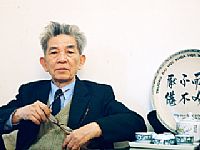
USSH — An article by Professor Dinh Van Duc (published in "100 Portraits of a Century of the National University" - 2006) about Professor Nguyen Tai Can - the person who illuminated the origins of the Vietnamese language.
My teacher, Professor Nguyen Tai Can, was a very special and remarkable teacher. According to stories, he was very mischievous but intelligent and had an excellent memory when he was in school. Once, during a class competition to recite folk poems, he managed to read 500 lines straight.
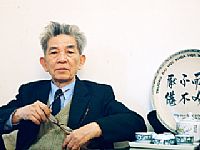
When he joined the resistance war, he had just finished his high school education. Following the advice of his older brother (Dr. Nguyen Tai Chat), he returned to Nghe An to participate in the resistance. After enduring many hardships and poverty in youth work, peasant associations, and then the Propaganda Department of the Zone IV Party Committee, in 1949, he joined the Party in Thanh Chuong district. Those who came before him recognized his professional competence and decided to bring him into the education sector, where he was directly mentored by Mr. Dang Thai Mai. From then on, he dedicated himself to education for 42 years until his retirement. His life was full of ups and downs, but his unwavering will and principled nature helped him remain steadfast through all difficulties. He lived a simple, frugal life, despite not lacking anything. He always maintained the style of a Nghe An native and a scientific cadre of a still poor country. However, in his daily life, he was extremely cheerful; wherever he went, there was the hearty laughter of everyone, especially the students. Now I recall... Ten years ago, when he was 70, I wrote the first short piece. We told him:
Let's have a memorable time today.
"Let's toast on the day you turn eighty, teacher."Then that day arrived very quickly. As fast as time accelerated. He was now exactly 80 years old. His physique was still agile, though his back was more hunched and his hair more gray, but in science, his thinking remained youthful, passionate, and creative. His body of work was truly immense. He received the Ho Chi Minh Prize, rising to the same level of honor as his predecessors: Dao Duy Anh, Hoang Xuan Han, Tran Duc Thao, Dang Thai Mai, Tran Van Giau... It all began with a literary suggestion from scholar Hoang Xuan Han more than 10 years earlier: could one perhaps rely on the taboo words in texts?
"The Tale of Kieu"He sought to understand the origins of the original Tale of Kieu through its various stages. He pondered, toiled, and decided to tackle a problem no one had yet addressed: using the methods of historical linguistics to study the text. He began with the Duy Minh Thi version of the Tale of Kieu (1872). A massive body of research was published. This was followed by a large book researching the Nôm versions of the Tale of Kieu. By continuing his research on taboo words in the work, he was the first to propose a new timeframe for Nguyen Du's composition.
"The Tale of Kieu"When the poet was over 30 years old (1787-1790), his recent groundbreaking writings caused a stir among classical scholars due to their bold and scientifically grounded new ideas. His continuous academic success stemmed from his very modern and sound thinking methods. He had a firm grasp of linguistic theories in various historical contexts. Bold yet cautious, he successfully applied linguistic theories to native-language materials, both modern and historical, opening up very new ideas. I recall events from over 40 years ago. In 1961, he returned to Vietnam after years of teaching Vietnamese language and culture at the Department of Sinology, Leningrad University. He actively participated in the founding of the Department of Vietnamese Studies there, and the university considered him one of the founders of the Vietnamese language discipline. He defended the first doctoral thesis in Literature from our country in the Soviet Union (1960).
The noun word class in Vietnamese"This is a linguistic treatise written during the heyday of Structuralism, but it was discouraged due to the Cold War. Although written in Europe, the author was not swept up in the "Eurocentric" perspective of "classical morphology," which was very much in line with the tradition of inflectional languages. He sought to start from the native language, skillfully combining it with the distributional methods of Descriptive Theory and even the tradition of Chinese linguistics to propose the concept of Noun Phrase and a structural model of it, as has been included in textbooks for decades. He only published this treatise (1975) when its ideas had been established through the ups and downs of reality. Professor A. Sapchenko, my dissertation supervisor, in a seminar on Word Categories (1976), told the graduate students:
At the beginning of the 1960s, when Nguyen Tai Can wrote "Vietnamese Grammar under the Influence of Structuralism," it was a very new and bold idea in Oriental studies."Returning to the university lecture halls in Vietnam (1961), he persistently and gradually disseminated the advanced ideas of Oriental studies. Our class of students at that time first learned the names of Meillet, Bodouin De Courtenay, Sherba, Polivanov, Dragunov Kholodovich... through his grammar lectures. He suggested and spread very important academic ideas related to the Vietnamese language, but not in the classical way of purely theoretical lectures; instead, he did very concrete things. I remember... In the autumn of 1962, my class was supposed to study Vietnamese grammar, but he didn't come to class immediately, nor did he introduce what he had researched, including his dissertation. As the Head of the Department, he asked us to study Vietnamese Phonetics first. He assigned Mr. Nguyen Phan Canh, a young, quick-witted lecturer with good pedagogical methods, to give us a series of lectures, only later did we learn that it was the content of Gordina's research, a subject..." He was a student of Soviet Oriental studies. We understood how important syllables are in Vietnamese, their structure, the opposition between initials and finals, the theory of tones... He also introduced other solutions, such as those of Andreev, Haudricourt, Le Van Li... Learning went hand in hand with practice; he trained us in the skills of recording phonetics and phonology. The second one was very difficult because it required a keen ear, and I didn't have that. After finishing this course, one day he called a few of us up and gave us a responsibility: The Ministry of Education had just asked him and Professor Hoang Tue to compile a set of textbooks.
"Vietnamese Grammar"We were given the books to teach on a trial basis in Hanoi and would later be taught at Trung Vuong High School and a few other schools. We had to go home and carefully read these books, then we would accompany the teachers on their practical training. Those books were truly excellent. To this day, I haven't seen anything better because the concepts in these books are very new, very Vietnamese, highly pedagogical, and especially contain many good and practical exercises. Unfortunately, at that time, the Ministry of Education refused to widely distribute the books and did not allow their widespread use. Back then, printing was very difficult, so the teacher often gave us valuable materials to copy by hand. I remember he gave me a typed copy of a Russian book, "..."
Chinese grammar" by A. Dragunov (1941). The professor spent a large sum of money hiring a typist to bring it back to the country because this book contains very important ideas about Oriental studies, including the evaluation of "
pattern"(Morphosyllabema) is a type of..."
quality unit"of the grammar of an isolating language. After copying it by hand, I practiced translating it into Vietnamese, learning both the knowledge and the foreign language at the same time. Thanks to that, I still remember it to this day. During the difficult years of war, when the school was evacuated to Dai Tu district, Bac Thai province (now Thai Nguyen), the teacher was 40 years old. Nowadays, anyone who is 40 years old looks very young, but back then, the teacher looked old and haggard. He had many wrinkles on his forehead from thinking. In Dai Tu, he continued to develop the ideas he had formed: An article about
from section(Slovomorphema) has been published, affirming the intermediate nature of Vietnamese syllables in the relationship between words and traditional morphemes. A separate article is dedicated to its use.
short phrase,as a standard for classification, to "improve the work" of classifying Vietnamese word classes. I still remember those two reports being presented by the professor in the bamboo hut of the kindergarten class in Hung Dao hamlet, Van Tho commune, at the Faculty's scientific conference in the summer of 1966. The book "
Vietnamese grammar"
The famous (compound words - phrases) (1975) was drafted by the professor in 1967 in Dai Tu and completed when he returned to Hanoi after the evacuation (1969). However, he pondered over it for a long time, giving the handwritten draft to us to read, and using it in seminars for students of many courses. He was meticulous about every detail and word. I remember most vividly his hesitation when proposing the solution of "one center, two positions (T.1, T.2)" for the noun phrase structure. Only when he was completely at ease did he allow it to be printed. Professor V. Solsev once said:
Nguyen Tai Can truly created a school of thought in Vietnamese linguistics."We wanted you to continue writing about Vietnamese syntax, but you said:
Teaching is fine. I still teach, but research takes time, and international theory is changing very rapidly. Even N. Chomsky (1957-1965) had already changed. Perhaps we should leave it to the next generation, who are more perceptive!"In fact, he discovered a stronger skill that few of his contemporaries or even those who came after him could have achieved without it:
"Historical Vietnamese Linguistics Research".My teacher had three research areas being pursued simultaneously: Sino-Vietnamese studies, historical Vietnamese phonetics, and historical Vietnamese grammar. He advocated for both students and colleagues to work together. Half of his Ho Chi Minh Prizes were in this field. During the scorching summer of 1972, my students and I evacuated to escape American bombs. At the beginning of summer, we followed him to teach a university class in Information and Culture evacuated to Dan Phuong, Ha Tay. At noon, everyone would play chess or take a nap to rest at a villager's house, while my teacher would take his books and pens to a teahouse at the edge of the village to work. The teahouse was next to an old temple, and seeing Chinese characters, he climbed a ladder to get close to the roof and found wooden planks with ancient characters. As a seasoned scientist, he quickly discovered a valuable treasure trove of woodblock prints from the early Le Dynasty, which the history of printing only knew about later. These were the woodblock prints of the "
Supreme Jade Emperor's Original Conduct Collection of Sutras"It's very valuable. The professor devoted considerable effort to researching this work and wrote a series of contributing articles that drew the attention of historians and classical scholars. I know he shifted his focus to the field of Sinology. The late 1970s were a difficult period for our country in foreign relations. With his insight and understanding of the situation, he decided to publish it."
:"
The origins of the formation of Sino-Vietnamese pronunciation."
(1979).
Everyone felt hesitant in that sensitive and very complex context. This book, with its rich and scientific content, quickly received high praise both domestically and internationally. To this day, it remains the best book in this field. The book "
Some issues concerning the Nôm script."(1983) showed a new approach by the professor compared to the existing traditional analysis. Through historical phonology and diachronic comparisons, he further clarified the origins and writing styles of Nôm script, as well as determining the center and boundaries of Nôm script. He also compared Nôm and Quốc ngữ after he and his wife (Professor Nona Stankevich, formerly a staff member of the Linguistics Department) hand-copied Alexandre De Rhodes' dictionary. Ten years later, he published another book."
Classical Chinese literature of the Ly and Tran dynasties (through the poetry of Nguyen Trung Ngan)"
,It introduced a method of studying ancient and medieval Vietnamese literature using a textual approach from linguistics. The book was warmly received by the literary community. In the late 1980s and early 1990s, he began preparing to write a textbook.
Historical Phonetics of the Vietnamese Language"After a long period of accumulating materials in this field, the professor had very fruitful scientific exchanges with renowned scientists such as Haudricourt, Diffloth, Ferlus... on the Vietnamese-Muong, Mon-Khmer, South Asian, and Hmong-Dao currencies, during his teaching and research trips to France and the United States. He also had a group of students who were interested in and studied with him: Sokolovskaja, Nguyen Van Loi, Tran Tri Doi, Barbara..."
Historical Phonetics of the Vietnamese Language"(1995) is a textbook"
History of the Vietnamese language"This was a very profound and serious introduction to this subject at Hanoi National University. He retired in 1992, but he didn't rest. The number of pages he wrote in the past 10 years is even longer than when he was working. He remained diligent, creative, and thorough in his studies, but very gentle in his dealings with others. He still advised us to be honest and humble. He was unhappy when he heard that his students were overconfident and hadn't studied properly. I remember his words: "
We must always innovate, but we must be truly open to learning. Debate is for learning from each other and developing. Don't be blindly competitive or chase after empty fame. Even if others disagree with you, you can always learn something."Teacher, we understand that there are times when we haven't pleased you, but we always feel secure knowing you're there to guide us. We often say to each other: you are a gentleman; throughout your life, you've always been at the back when queuing, but in reality, you're at the front. Now you're in your eighties, and you still look strong and sharp-minded. We feel warmhearted."