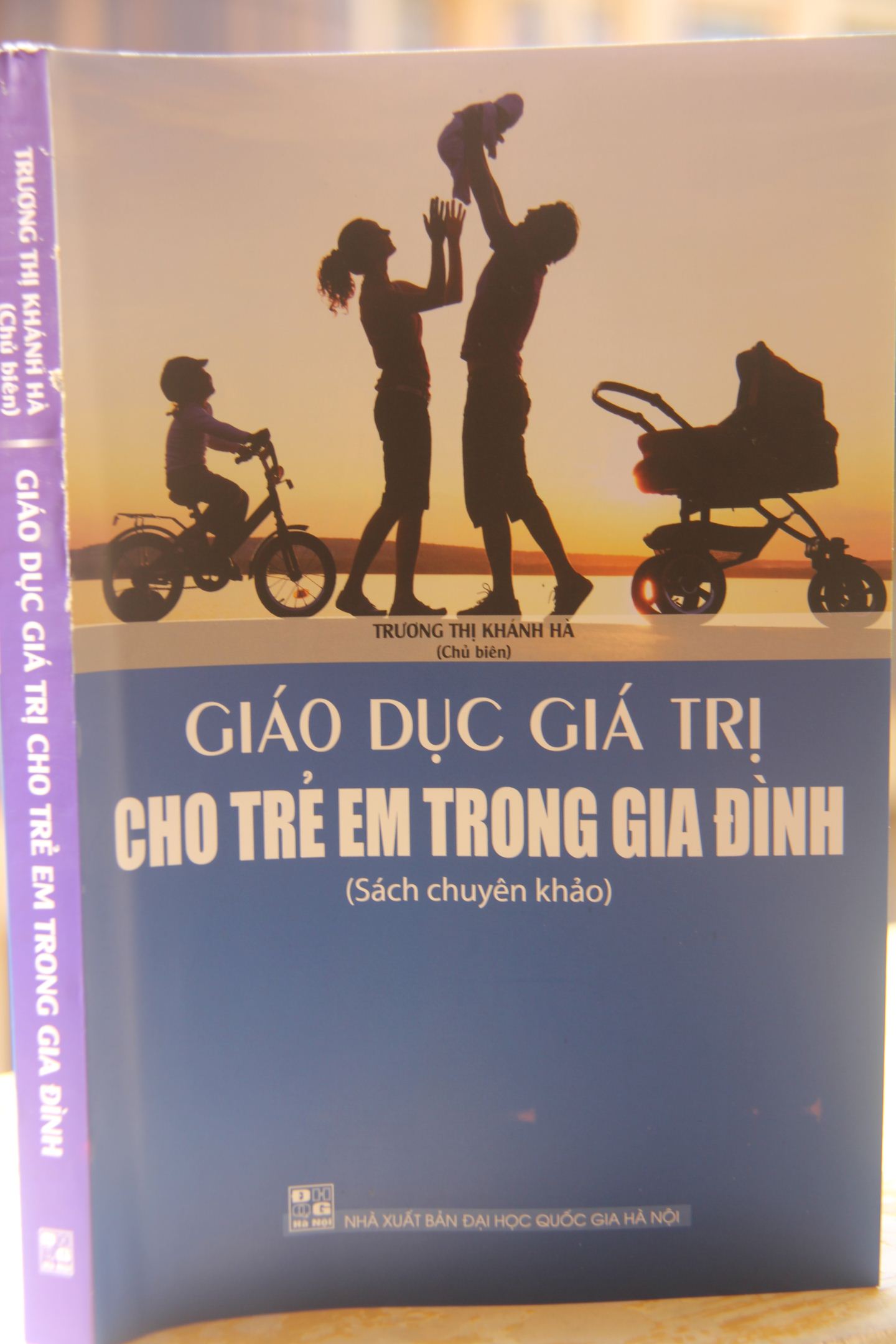
Currently, many value education programs have been invested in and implemented in schools, from preschool to high school and university. However, family education seems to still be based on experience passed down from previous generations, revealing many shortcomings. Within the scope of this book, we will delve into analyzing some issues of value education for children in the family.
We all know that the family is the first place that witnesses each person's first steps and also the last place that welcomes them in their twilight years. With such a special and close bond, it can be said that the family is a favorable environment and has a strong influence on the formation of each person's character. Our ancestors had sayings like, "Like father, like son," and "Children of the same family will resemble each other in some way," to describe the influence of parents on their children, not only in appearance but also in character. School education and social education play a crucial role, but their role is only effectively realized when family education is the foundation. Therefore, understanding what kind of people parents today want to raise their children, where they want to guide them, and what methods they use is what we are interested in researching.
Value education for children within the family is not a new issue. Although not explicitly called values education, in every family, grandparents and parents always guide and instruct their children on what is right and good, what is considered important, correct, and beautiful. The admonitions and examples of parents are true lessons, deeply ingrained in the soul and accompanying each person throughout their life. The beautiful traditional values of the nation, such as patriotism, compassion, a thirst for knowledge, hard work, filial piety, humility, and respect for one's roots, are always nurtured and passed down from grandparents and parents to future generations. However, in the last 20 years, especially since Vietnam joined the WTO (January 11, 2007), the issue of values education for children has faced many difficulties. Many families have yet to identify the goals and methods for educating the younger generation about values in the context of rapid economic, cultural, and social changes, leading to a shift in value systems.
In reality, the authoritarian, patriarchal methods of parental education and traditional values are no longer entirely suitable for modern society, while children are rapidly adopting and spreading new values to their peers. Generational conflict and discord are increasing, children are disobedient to their parents, and the growing pressure of work leaves some parents struggling to instill values in their children, leaving the responsibility of educating them to schools and society. As a result, many parents fail to control the formation of their children's values, failing to understand them until regrettable incidents occur.
Globalization and international integration present us with many challenges, including the challenge of establishing new value systems and new educational methods within the family, which both inherit and promote the traditional values of the nation while being in line with the development trends of modern society.
During the compilation process, the authors made every effort, but undoubtedly there are still many shortcomings. We sincerely hope to receive feedback from researchers and readers so that the book can be improved.
Hanoi, 2016
Author:Authors.
Newer news
Older news

