
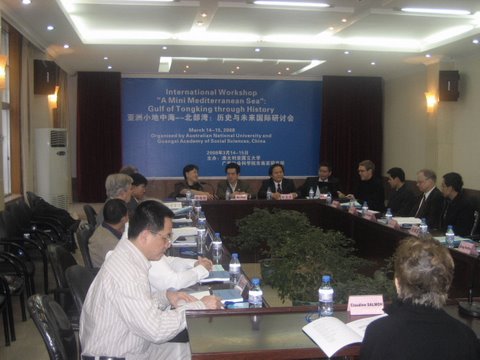
On March 14th and 15th, 2008, over 30 scientists from eight countries (China, Vietnam, Australia, Taiwan, Thailand, Germany, France, and the United States) participated in the International Conference “Little Mediterranean: The Gulf of Tonkin Through Historical Periods” at the Guangxi Academy of Social Sciences, Nanning City, Guangxi Province, China. Among the foreign scientists participating in the conference were several experts on Vietnam, such as Professor John Withmore (University of Michigan, USA), Professor Brantly Womack (University of Virginia), Professor Claudine Salmon (University of Paris, France), Professor Li Tana (Australian National University), etc. 22 papers were presented in 10 subcommittees: Opening Session; Overview of the “Two Belt and Road Initiative”; Little Mediterranean?; New Discoveries in Archaeology; Regional Political Context (10th-13th Centuries); Ports, trade networks and commercial systems; Trade and merchants in the Gulf of Tonkin; Piracy in the Gulf of Tonkin (17th-19th centuries); Cultural exchange; Closing session.
From the late 20th century, Denys Lombard published his comparative studies on the history of two regions that were relatively geographically distant but shared similarities in their historical development: the Mediterranean in Western Europe and the South China Sea (with a focus on the Gulf of Tonkin) in East Asia. In particular, Lombard's treatise "Another 'Mediterranean' in South East Asia" truly inspired many researchers to engage in lively debates on this issue. Therefore, the 22 papers presented at this Gulf of Tonkin Conference are also in line with this spirit.
The reports focus on various aspects of the Gulf of Tonkin region throughout history, particularly aiming to clarify the similarities and differences between the two aforementioned sea regions. Besides some similarities, the differences are very clear, especially in terms of natural geography: monsoons, ocean currents, tidal regimes, etc. The Mediterranean Sea is sheltered from many directions and lies in a temperate climate zone, so the sea is relatively calm, largely unaffected by monsoons and strong ocean currents. Meanwhile, the Gulf of Tonkin region in particular and the South China Sea region in general are strongly influenced by monsoons and many strong ocean currents; therefore, transportation is greatly affected, especially during the period when sailing ships were still used. While in the Mediterranean, merchants could essentially travel south to North Africa and north to Southern Europe relatively freely, in the South China Sea, merchants could only travel according to the monsoon regime. Therefore, each two-way trade trip required at least two wind seasons (one year), not to mention that if the wind was unfavorable, merchant ships had to wait for almost a year before they could set sail again... The differences in natural conditions led to differences in a series of other aspects between the historical development of the two regions, including technical, cultural, and ethnic issues...
Vietnam possesses a large portion of the Gulf of Tonkin, so all presentations at the conference were directly or indirectly related to Vietnam. In his presentation, "Vietnam in the Commercial Networks of East Asia," delivered at the Opening Session, Professor Nguyen Van Khanh, Rector of the University of Social Sciences and Humanities, Vietnam National University, Hanoi, affirmed, "As a country with a history closely linked to the Gulf of Tonkin region, and possessing a coastline of over 3,000 km connecting southern China with the Malay Peninsula and the Polynesian world, Vietnam's history has developed in close connection with the history of the region in general and the commercial history of the region in particular." After reviewing the key periods of Vietnam's historical development in relation to the Gulf of Tonkin and the South China Sea, the report affirms: "Today, with the principles of sustainable cooperation, adherence to common principles, mutual respect, and mutual benefit, Vietnam is striving to implement multilateral and multi-sectoral cooperation strategies with many countries in the region. This will contribute to peaceful and prosperous development in the Gulf of Tonkin region in particular and East Asia in general in the future..."
After two days of lively discussions, the conference concluded with a tour of several locations in the Gulf of Tonkin region: Mong Cai border gate (Vietnam), Dongxing city, Fangcheng port... (China). The main organizers (Professor Li Tana from the Australian National University and Professor Gu Xiaotung from the Guangxi Academy of Social Sciences) hope to hold a follow-up conference on the same topic to further discuss aspects that were not thoroughly addressed in the conference, such as cultural exchange, trade, shipping routes and commerce... in the Gulf of Tonkin region in particular and the South China Sea in general throughout history.
•Hoang Le Phong
(Department of History, University of Social Sciences and Humanities)
Author:no1knows
Newer news

