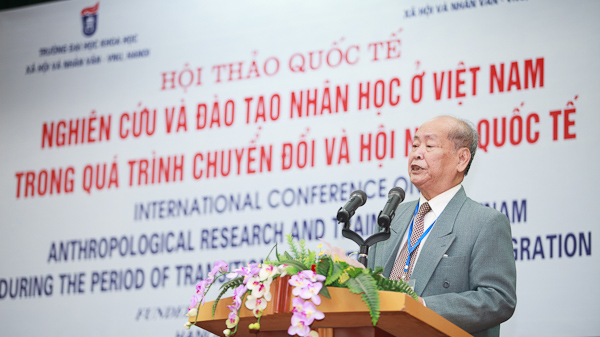
On October 20th, the University of Social Sciences and Humanities (VNU Hanoi) collaborated with the University of Social Sciences and Humanities (VNU Ho Chi Minh City) to organize the international conference "Anthropology Research and Training in Vietnam in the Process of Transition and International Integration".In his opening remarks at the conference, Professor Nguyen Van Khanh (Rector of the University of Social Sciences and Humanities - Vietnam National University, Hanoi) reviewed the development of Ethnology in Vietnam and the emergence of the current field of Anthropology. Since 2009, the University of Social Sciences and Humanities - Vietnam National University, Hanoi has been enrolling and training undergraduate students in Anthropology and is currently preparing to launch master's degree programs. In his presentation at the opening session, Professor Phan Huu Dat (Vietnam Association of Ethnology and Anthropology) emphasized: In the process of reform and international integration, Vietnamese Ethnology research must undergo a transformation from Ethnology to Anthropology. At the same time, Vietnamese Anthropology needs to actively learn from countries with developed anthropological sciences. However, this learning should not be a mere copying but a proactive process of selection aimed at building a Vietnamese anthropology foundation.

Following the opening session, the conference proceeded with discussions on 35 reports in 3 subcommittees: Training and Research in Ethnology and Anthropology in Vietnam; Ethnic Issues; and Urban Issues. Discussing research and training in Anthropology in Vietnam during the transition and international integration process, Associate Professor Dr. Luong Van Manh stated that: The transition from traditional Ethnology to scientific Anthropology is an inevitable development; it is not the "death" of Ethnology but rather an enhanced combination of traditional Ethnology and Anthropology. This allows the science to both inherit the achievements of Ethnology and absorb global anthropological knowledge, meeting the needs and demands of the country's current industrialization and modernization process. Also discussing the research and training in Anthropology, the presentation by Assoc. Prof. Dr. Nguyen Van Tiep (Head of the Department of Anthropology, Faculty of Social Sciences and Humanities – Vietnam National University Ho Chi Minh City) offered several recommendations and solutions for modernizing the field of Anthropology. According to him, it is necessary to quickly develop a strategy for the development of Anthropology with the participation of training, research, and management agencies; along with reorganizing the structure, building an information system, curricula, reference materials, unifying training programs, and linking research and training units and agencies… Regarding ethnic issues, the presentations and discussions mainly focused on economic, social, and cultural issues among ethnic groups, especially minority groups in Vietnam. Among these, the policies and their impact on the Party and State during the period of industrialization and modernization received much discussion. Le Duy Dai (Vietnam Museum of Ethnology) suggested that policies should pay attention to the characteristics of each region and ethnic group, promote the self-reliance of ethnic minorities, and contribute to raising the intellectual level of the population. Regarding urban issues, the presentations highlighted factors influencing current urban development, trends in urban life, and the urbanization process in some suburban areas, leading to changes in spatial layout, social relations, and employment structure. In summary, the opinions and discussions at the conference affirmed that after 10 years of transition, the training and research in anthropology in Vietnam has achieved fundamental successes, creating a foundation for further development. However, limitations, difficulties, and challenges remain, requiring more in-depth research and cooperation to develop anthropology with a distinct Vietnamese identity.