Discussions surrounding the issue of verifying sources were one of the two main topics of the final session in the series of professional journalism seminars at the University of Social Sciences and Humanities, on April 1, 2010.
Verification to ensure objective information
“For journalists, any information received needs careful verification to ensure it is up-to-date but from an official source.” This was the opening statement of journalism expert Vu Minh Thuy. The best way to verify the accuracy of information is to go to the scene of the incident or event that is of public interest. If far from the scene, journalists can call relevant authorities or those responsible for providing official information. For example, the story of a fisherman who went missing during Typhoon Chanchu and then returned home was very appealing to reporters and the public. Reporters investigated and verified the information directly from the person involved to produce moving articles about him. However, not long after, it turned out that the story was fabricated by the fisherman to avoid having to reclaim the compensation he received as a victim of the typhoon. Therefore, rushing to verify the accuracy of information can have serious consequences. In modern journalism, foreign countries have departments that thoroughly verify data and information before publishing articles, and "it's necessary to hear the voice of the person involved, whether right or wrong; that's how journalists protect themselves."
1001 sources of information
Journalist Pham Thi Thanh Long, a Master's degree holder, further emphasized the importance of verifying sources and its significant impact on the reputation of the newspaper and the honor of the journalist themselves. According to journalist Thanh Long, "reputation" must be built through the quality of the journalist's work. And to become a well-known journalist, verifying sources is extremely important. Sources for reporters are abundant. Journalists should have relationships with many people in different localities so that when events occur, having the voice of someone who has lived there and knows the place will give the article more substance, and the information will be more relatable and appealing to readers. Journalist Thanh Long stressed that maintaining relationships is not simply about work, but also about interpersonal relationships. We need to build trust so that when events occur, they are willing to provide us with the fastest and most accurate information. This relationship needs to be built over a considerable period of time. Another important source of information, according to journalist Thanh Long, is from specialized journals. Currently, there are approximately 900 published publications in Vietnam. Among them are specialized journals dedicated to researchers, which are extremely important sources for journalists. Official reports are documents that journalists can use to gather information for their articles. However, in reality, there are events where relying solely on those around them is insufficient for journalists to obtain complete information, especially objective information on a broad scale. In such cases, we can utilize information from online forums. Some argue that information on forums is not official because people sometimes exchange random opinions. Such unofficial information can damage the credibility of the newspaper as well as the self-respect of journalists. That is true, but we should also consider the reality that many social issues are discussed on forums in a very insightful, frank, and profound way. Journalists must be cautious about information on online forums. Such information only becomes valuable if it is verified and linked to the actual source of the statements. The next crucial aspect is the method of presenting and using that information, which must be rigorously verified. The speaker then consciously defends the opinions they express to the public.
Differences from quotations
"Quoting information effectively differentiates articles on the same topic and creates a unique identity for each journalist. The effectiveness of a well-quoted piece depends on how the reporter questions the subject. Reporters need to be careful not to make the major mistake of assuming they already know everything. Even if they already know the information, reporters should ask questions to confirm that it was provided by the subject themselves." This is the advice from Master's degree holder Tran Le Thuy regarding quoting information in journalism. It's important not to include background, general, or supplementary information in quotations. Choose quotes that express personal feelings or showcase the subject's personality. Journalist Le Thuy also shared a concise approach to modern writing: Think of it as telling a story. After all, a journalist is an intermediary, asking those who know and telling those who don't. Therefore, tell the story concisely, clearly, and engagingly. The second part of the seminar was the certificate awarding ceremony and the closing ceremony. However, the discussion continued with interesting sharing of issues related to journalism.
Summary and certificate awarding for journalism students.

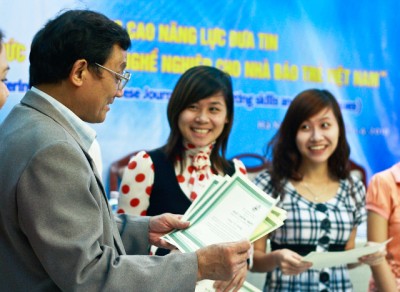
The program "Enhancing Reporting Skills and Professional Ethics Knowledge for Young Journalists" concluded with a closing ceremony and certificate awarding for participants on the afternoon of April 1, 2010, at the auditorium on the 4th floor of building H. Associate Professor Dr. Dinh Van Huong, representing the Faculty of Journalism and Communication, highly praised the quality of the seminars and expressed sincere gratitude to the U.S. Embassy in Vietnam and the journalists and young journalism masters who sponsored and organized this beneficial program for journalism students at the University of Social Sciences and Humanities, Vietnam National University, Hanoi. Mr. David Moyer, Acting Cultural and Information Counselor of the U.S. Embassy, acknowledged and appreciated the success of the seminars and expressed his desire for further cooperation with the Faculty of Journalism and Communication in the future. Mr. David Moyer, Associate Professor Dinh Van Huong, and Associate Professor Duong Xuan Son presented certificates to the participating students.
•Tien Thanh