

Why "summer semester"?
The school administration's decision to open a summer semester is to give students even more opportunities to complete their courses as early and as successfully as possible.
Many students have seized this opportunity, sacrificing their leisure time to stay in school and with their teachers. Trung (K56 Tourism Studies) shared his reason for attending summer school: “I’m in my final year and haven’t yet passed the foreign language proficiency requirement, so I’m taking advantage of this summer semester hoping to graduate in early September. However, choosing summer school means putting aside all work and plans to schedule time for classes, reviewing lessons, doing assignments, and preparing for exams.”
For students in cohorts K57 and K58 who are no longer under pressure to graduate, the reason they choose summer courses is: "Summer semesters give us more free time. We can study ahead and improve our grades in some general subjects to reduce the burden on the two main semesters," said Hong (K58 Vietnamese Studies). Similarly, Tuyet (K58 Archival Studies) confided: "My home is far away, so I want to stay in Hanoi this summer to manage my summer studies and find part-time work."
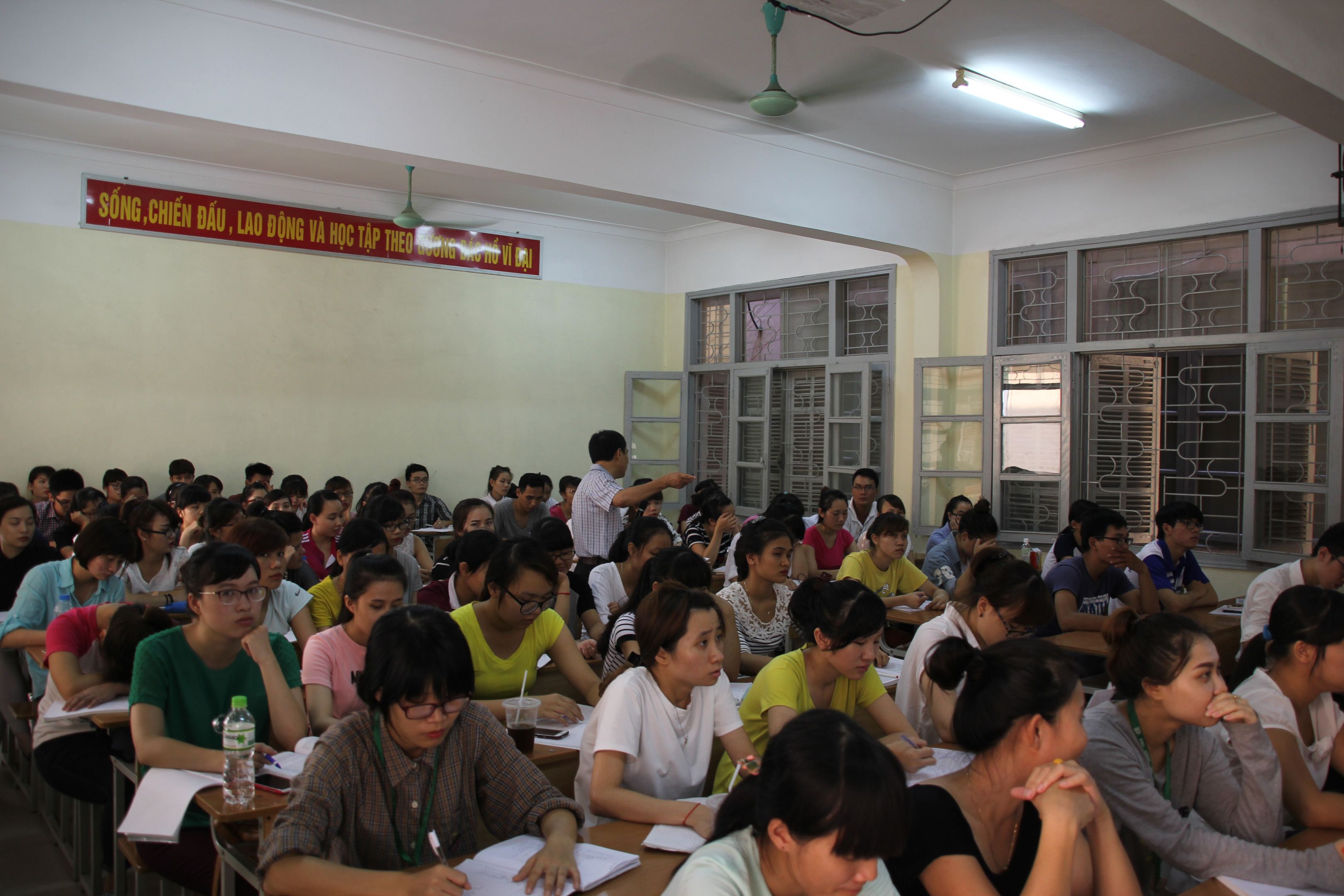
One hour of class time in Marxism-Leninism II
Summer semester: Hot, cold, and stressful
These are the difficulties that both teachers and students are facing and overcoming this summer semester. Teacher Tien (Fundamentals of Vietnamese Culture class – History Faculty), who was so engrossed in his lectures that he forgot about break time, was enthusiastic and dedicated to his lessons and his students. When asked about the difficulties, he only complained about one thing: “The weather is so hot, even turning on the fan doesn’t relieve the heat. That’s an unavoidable limitation during the summer semester.” The summer semester, held from the beginning of July to the end of August, coincides with the intense heatwave in Hanoi, especially this summer, with temperatures reaching 38-39 degrees Celsius during prolonged heatwaves. This is truly a challenge for both teachers and students in the classroom.
Ms. Huong (English B1 class – English Department) was surprised by the number of students in her class, as this was her first summer teaching term: "I was a little surprised by the number of students. I thought they were out having fun and didn't want to come to class so early. But when I entered the classroom, I saw that almost every English class was 'full' (20-30 students/class)."
With a large number of students and only 7 weeks of study time, yet still needing to cover the full curriculum, students face immense pressure. Extended class times, increased class periods, and the hot weather easily lead to fatigue and a subdued classroom atmosphere, says Duong (K58).According to CLC Literature: “Hot weather significantly affects health, but the heat also makes students lethargic, reducing learning effectiveness in class. Along with that, the pressure of homework and exams piling up makes this summer semester even more intense.”
Besides being enthusiastic and witty to attract students' attention, the teachers also create many engaging activities such as group discussions, games related to the lesson, and videos and images. Therefore, if you take a stroll around the summer classes, you'll hear laughter coming from the English classes in building C, and even hear singing from the "summer choir" of the psychology class in room G103.


The dedication of the teachers
Summer semester: "Easy questions, high scores"
This is something many students participating in summer semesters hear or hear whispered among senior students. According to Mr. Dinh Quang Hung from the Training Department: “It’s the same lectures, the same teachers, the same curriculum, the same teaching methods, and the same assessment requirements as the main semester, so there can’t be any ‘easier, higher grades.’ You need to evaluate more objectively.” Mr. Tien added: “We still teach the correct curriculum, the exam questions are selected from the question bank, and we grade according to the standard answer key, so there can be no favoritism in the summer semester compared to the main semester.”
This serves as both a confirmation and a warning to all students who still hope to exploit the illusion of high grades when registering for summer courses. To get high grades, you still have to put in your best effort for all seven weeks of study.


K57 Discussion Session – Social Work
This summer, K59 is at a disadvantage.
This year, the K59 cohort began their intensive National Defense and Security Education program at the Hoa Lac campus for one month. This coincided with the summer semester (August 2nd - August 28th). Therefore, K59 students couldn't register for the program this summer, meaning they missed an opportunity to improve their skills or advance their studies. However, Professor Hung offered reassurance: "While it's regrettable for K59, not studying this summer means there are still opportunities in subsequent summers. Furthermore, students who don't want to study National Defense and Security this year can still register in later semesters if they wish. All rights and benefits for the students are still guaranteed."
In conclusion
Choosing a summer semester offers students the opportunity to get ahead of the curve or improve their grades, but it also means sacrificing rest time in the face of hot weather, course pressure, and tight deadlines. However, with proper time management and organization, students can still achieve high efficiency. The time pressure, combined with the enthusiasm of the teachers, will motivate students to overcome the major obstacles during the summer semester.
|
The summer semester (also known as the supplementary semester) was approved by the Board of Directors from the very first years of credit-based training. Courses offered during the summer semester are organized over a 7-week period, from the beginning of July to the end of August. On average, including practical courses, the university organizes approximately 40 courses each summer semester. The number of students registering for the summer semester is around 1000. |
Author:Thanh Tung
Newer news
Older news

