I remember him, short and stocky, with a pensive, quiet face. He spoke softly, as if he were listening to himself. He rarely smiled, but when he did, it was a bright smile, his eyes distant and sparkling… Following my friends, I occasionally visited him and quietly observed. Before, I didn't know, but since knowing him – both during my student years and later as a lecturer – I noticed that the people surrounding him weren't the beautiful girls or pretty young women from the female students, but rather a group of eccentric orangutans from the department, with their peculiarities in clothing, mannerisms, and even their “statements.” He welcomed them openly and intimately, and they spoke to him enthusiastically, passionately, and “very democratically.” They recited poetry, sometimes with their eyes half-closed and lost in thought, sometimes whispering, and sometimes shouting, gesticulating wildly like actors on stage. He listened attentively and endured it all with amusement.
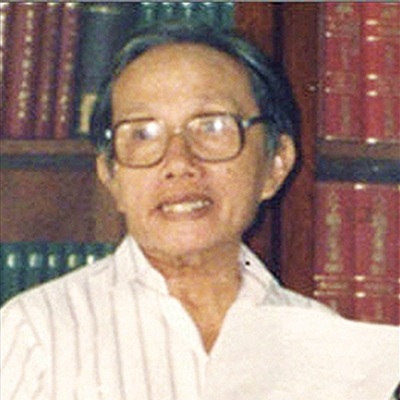
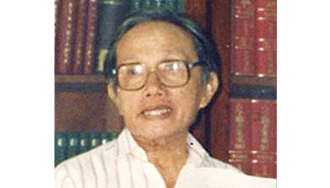
Professor, People's Teacher Le Dinh Ky (1923-2009) - Head of the Department of Literary Theory and Vietnamese Literature, Faculty of Linguistics and Literature (1971-1976).
I remember we didn't get to study the specialized subject until our fourth year.The Tale of Kieu and Nguyen Du's Realism– a book on a particular topic, very engaging, simply put, you can read it over and over again without getting bored. That's the general feeling of many people, not just those in the literary field. Ms. Sinh – a graduate of the University of Economics and Planning, wife of Professor Le Chi Dung – who at that time was a young lecturer in the Faculty of Literature, in the same generation as Professors Le Chi Que, Nguyen Thien Giap, and Dinh Xuan Dung… was such a fan. Because Professor Dung was my homeroom teacher and also from Quang Binh, I occasionally visited his house. Once, I saw Ms. Sinh holding a copy in her hand.The Tale of Kieu and Nguyen Du's RealismAs she read, she praised effusively, "Thu, how wonderfully Mr. Ky writes! I've read it many times, and the more I read, the more I like it!" Suddenly, her enthusiasm faded, and her voice became pensive, "Mr. Ky's salary now is enough to buy a chicken every week to improve our diet, isn't it?"...
Besides that once-famous treatise, he also wrote textbooks on literary theory:Artistic method –1962,Theoretical foundations of literature– 1971; wrote critical essays and literary research papers:The path to poetry- 1969,Poetry with Xuân Diệu, Hoài Thanh, Chế Lan Viên -1988,Modern poetry – its ups and downs –1989 etc… His forte and strength was researching and criticizing poetry. He wrote about any author, whether old or young, whether established or just starting out; from To Huu to Pham Tien Duat, from Che Lan Vien to Thai Giang, from Te Hanh to Luu Quang Vu…The path to poetryHe devoted himself wholeheartedly to writing, pouring all his thoughts and feelings into his work, with both the clarity of his intellect and the sensitivity of his intuition. His works are always groundbreaking, characterized by his masterful, subtle, and profoundly insightful writing style. In particular, through his portrayals of prominent figures such as Thế Lữ, Lưu Trọng Lư, Xuân Diệu, Huy Cận, Hàn Mặc Tử, Nguyễn Bính, Chế Lan Viên, Vũ Hoàng Chương, Bích Khê…Modern poetry – Ups and downs)Professor Le Dinh Ky has revived a brilliant and unique era of poetry in the flow of 20th-century Vietnamese poetry.
Perhaps because he is an introspective person, his lectures are "intense rather than passionate," or perhaps he tries to guide the audience—the students—into the depth of the subject matter, paying less attention to the excitement or something more focused on the formalities of the "young and immature" student audience, who often pay more attention to the teacher's clothing and mannerisms than to the lecture itself. Studying Professor Ky's course, if you concentrate and broaden your "expectations," you will gain many useful and novel insights. For example, when he lectures...The Tale of Kieu...to the point where Nguyen Du describes the meeting and intimate encounter between the "national beauty and genius" couple, Kim Trong and Thuy Kieu, and the line: "One looks directly at the other's face, yet bows their head in fear.",My teacher paused for a long time to explain and elaborate on the brilliance and skill of Nguyen Du in portraying a pair of lovers deeply infatuated with each other (with the sign of "flirtatiousness in their affection"). According to him, a virtuous woman, when sitting opposite a man who is infatuated with her, should "shyly lower her head" when the man "looks directly into her face," because staring up at him at that moment would be inappropriate! To this day, I haven't forgotten his humorous, gentle, yet profound analysis. And I realized that Nguyen Du had indeed chosen for the character Thuy Kieu, in those moments and in that intimate setting, a very graceful posture, very distinctly East Asian in character.
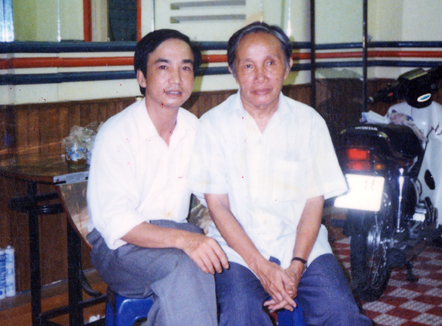
Professor Le Dinh Ky with his students at his home.
In December 1976, thanks to the arrangements of Professor Nguyen Lai, a linguistics professor who was then teaching at a university in the German Democratic Republic, my teacher had a trip abroad for less than a month. At that time, I had just gotten married and was having trouble finding accommodation. He called me over and said, “This is a once-in-a-lifetime opportunity. Come stay at my place; it’s bright and spacious. I’m going to Germany for about three weeks. During that time, the dormitory and administrative offices will surely arrange housing for you.” I was extremely surprised and could only bow my head in gratitude to hide the tears welling up in my eyes… Upon returning from Germany, he told me that he had bought dozens of bicycle spokes, and was very happy because this item was very scarce in Vietnam. He was surprised to find that they were spokes for children’s bicycles (I think they weren’t called mini-bikes back then), and we didn’t have that type of bicycle. Then, the teacher took a rosy, fragrant apple, carefully sliced it into many pieces, and placed them on a plate with a poetic and charming invitation: "Here you go, a little taste from faraway Siberia…". It was the finest fruit I had ever tasted at that time. And even now, I haven't tasted an apple as delicious as that!
I remember Professor Le Dinh Ky was very genuine, simple, and averse to formality, pretense, and superficiality. Although brief, my time at the Faculty of Literature, University of Hanoi, was filled with his dedicated guidance, allowing me to take my first tentative steps into a profession I now love but which I once feared. My first observation session, where he provided feedback on my lecture, was attended by prominent figures: Professor Hoang Nhu Mai, Professor Le Dinh Ky, Professor Phan Cu De, Professor Ha Minh Duc… Looking down from the podium, my heart pounded and my legs trembled; I spoke hesitantly and stammered. After the lecture, Professor Hoang Nhu Mai whispered to Professor Ky, "He lectured as if he were a student talking to his teacher!" I secretly admired Professor Hoang Nhu Mai's keen insight. Indeed, at that moment, I forgot the lecture content, the sequence of my intended presentation, and even the dozens of students sitting in front of me (including quite a few older men who had returned from the battlefield and whom I usually held in high regard). I only saw the towering figures of my professors… But my beloved professors were all “noble hearts,” giving me sincere and valuable feedback, helping me to be more confident on the long and arduous road ahead. Professor Ky encouraged and advised me a great deal. He showed me how to read and take notes on materials, how to “walk on two legs”—teaching and research, specifically, how to invest in classroom lectures while simultaneously writing critical research papers. My professor particularly emphasized and repeatedly reminded me: "You must remember that writing poetry criticism is very difficult, but the hardest thing is to hide the theory, letting it dissolve into the analytical feeling," and added: "Nothing is more awkward than writing poetry criticism where the theory is completely exposed, dry, rigid..." Everything I gained in my later research works and critical essays stemmed from those valuable introductory lessons, from the profound experiences and "philosophy" of my professor. His care and guidance were often not "overly dramatic," yet contained both theoretical and practical significance. And most importantly, it helped researchers make appropriate choices. More profoundly, it was the aesthetics of poetry criticism research and a cultured way of behaving, a way of "playing fair" towards poetry in particular and literature in general.
Because he was so engrossed in his work, and it seemed that every time I went to his house I would find him diligently working at a desk cluttered with books and reference materials (yet still scientific and with its own "logic," as he explained when anyone questioned the mess), he was always very busy. The time he had to prepare meals was also his only free time for "relaxation" (as he jokingly put it). Even so, he never begrudged the time to discuss professional matters and the authors and works he was interested in. At those times, he seemed much more lively and enthusiastic, his pensive, thoughtful demeanor replaced by relaxed smiles. During one such conversation, I mentioned his scientific paper titled...Youth, revolution, and poetryMy teacher wrote a passage that included a vivid, colorful description of the Trường Sơn artistic landscape – the cradle of a generation of poets who fought against the US and saved the country – which I knew very well: “Trường Sơn in the torrential rains and floods, in the scorching sun and the Laotian winds, in the roaring bombs and bullets…” After hearing it, he calmly replied: “Ah, I ‘stole’ it from a student who was a police officer in his final year in that department, how could I possibly write something like that… You have to live and die with Trường Sơn to be able to write like that.” I understood that it was just a figure of speech, and it was his genuine sincerity that made the conversation increasingly interesting and heartfelt. Not only me, but many people shared the same feeling that talking to Professor Lê Đình Kỵ didn't require any pretense or careful consideration of every word. Over time, those conversations always evoke a warm, carefree period of my life. Those are memories I will never forget.
I remember, when I received my doctoral research topic on "Xuan Dieu's Poetry Before the August 1945 Revolution," throughPoetryandSending fragrance on the wind"From far-off Saigon, my teacher sent me a few books, (including...")Modern poetry – its ups and downsandPoetry with Xuân Diệu, Hoài Thanh, Chế Lan Viên(It became an essential tool for me to read and ponder) and he reminded me to think deeply, not to repeat others, to find the unique color of "Xuan Dieu's self" and the difference between nature and soul in New Poetry and nature and country in revolutionary poetry after 1945. Knowing that Professor Ha Minh Duc had accepted me as his thesis supervisor, he shared: "That's excellent. Professor Duc is very knowledgeable in this field. The topic is good but not easy to write; you have to try very hard." Before the official defense, I sent him a summary of my thesis for him to read and anxiously awaited the weighty evaluations from a leading expert on New Poetry. And unexpectedly, he read it very quickly and sent me a review via fax with very kind and encouraging words of praise. That exceeded all expectations because, for me, having him read it was already precious; I never dared to think that he would even write a review for me. I called him and choked up with gratitude. My professor seemed very pleased with the initial achievements of his former student. Then he asked me how many journal articles I had published, suggesting I gradually publish excerpts from my dissertation before printing it as a monograph. He also said I needed to write much more because, whether I liked it or not, once I was in a teaching position at the university, completing my doctoral dissertation (back then it wasn't called a PhD) meant preparing for the associate professor application… Now, reading the review dated October 24, 1995, with its tiny, slanted handwriting that I've cherished and preserved for decades as a precious memento, and remembering his guidance, my eyes well up with tears. I am so indebted to him, yet I have never been able to repay him…
In my mind, Professor Le Dinh Ky was an exemplary scientist: combining the erudition and elegance of intellect with the depth and subtlety of emotion, sharp thinking with keen intuition. In my heart, he was a mentor with a big heart, kind, generous, and forgiving. Every time I remember him, I feel as if I am reliving the noble, warm, and gentle teacher-student relationship. It was a tranquil space, full of life and human connection, an indelible memory that keeps returning and radiating warmth within me.
Hanoi, April 11, 2014
|
PROFESSOR, PEOPLE'S TEACHER LE DINH KY
+ Workplace: Faculty of Literature, Hanoi University. + Management position: Head of the Department of Literary Theory and Vietnamese Literature (1971-1976).
Artistic method.Education Publishing House, Hanoi, 1962. The path to poetry Literature Publishing House, Hanoi, 1969 The Tale of Kieu and realism.Social Sciences Publishing House, Hanoi, 1970 Theoretical foundations of literature- Volume 4. Education Publishing House, Hanoi, 1971. Poetry by To Huu.Literature Publishing House, Hanoi, 1979 Learn about literature.Literature Publishing House, Ho Chi Minh City, 1984 Modern poetry: its ups and downs..Ho Chi Minh City Publishing House, 1988 Poetry with Xuân Diệu, Chế Lan Viên, Hoài ThanhCuu Long Publishing House, 1988. The issue of Romanticism in modern Vietnamese literature.Education Publishing House, Hanoi, 1998.
+ State Award for Literature and Arts in 2001. |
Author:Assoc. Prof. Dr. Ly Hoai Thu

