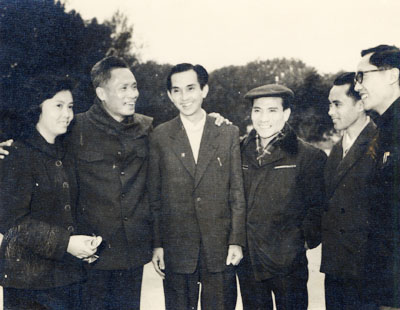
1. In 1962, after graduating with a degree in Literature from Lomonosov Moscow State University (Soviet Union), Ms. Hoang Thi Chau returned to Vietnam to teach at the Faculty of Literature – Hanoi University. There, she established her position as a linguistic researcher with an article in the field of Toponymy, which, even after half a century, remains a valuable work that has almost become legendary.The relationshiplanguageancient times in Southeast Asiasomeriver name(1964/1966). By reconstructing the ancient form “*khloong” of the word “river” in modern Vietnamese, the author affirmed the role of rivers as a constituent element in many river names in Vietnam. The connection between these river names even extended beyond the administrative borders of Vietnam, encompassing a vast cultural region between the Yangtze River in China and the Saluen River in Myanmar. However, the article did not simply limit the scope of its survey of river names in Southeast Asia to its title, but also presented some fundamental issues in toponymy research. From a very early stage, she attempted to break away from the tendency to explain place names using local history and folk etymology, approaching toponymy from a historical linguistic perspective. Perhaps these theoretical and methodological issues formed the basis for her subsequent research in a diachronic direction, such as exploring the study of toponymy.Etymology of the name of the Bach Dang River(1995)Learn the etymology of words referring to water transport vehicles.(2013). Song Hoang Thi Chau is not a scientist who prefers to use academic terminology. After outlining important directions for research in toponymy, she focused on a pressing research issue in modern life – Standardization of place names. This is an article that provides a brief overview of the issue, such asForeign place names on world maps: concepts, terminology, and methods of incorporating place names.(2007); review article to establish solutions such asTowards standardizing the writing of place names in ethnic minority areas in Vietnam.(2004) up to the “technical” article on spelling such as explaining the limitations of the national alphabet on the richness of place namesCentral Highlands place names on the map: A bridge connecting Vietnamese place names with the world.(1994), from which to determineThe role of F, J, W, and Z in transliterating foreign place names.(2007). It seems that the view of preserving the original language is consistent and becomes the overarching theme in her writings related to the standardization of place names in our country. However, this does not mean that the writings are boring repetitions; each article is actually a place of brilliant discoveries. In the articleCharacteristics of how place names in the Central Highlands region are recorded on some topographic maps.(1992), she helped us understand clearly that the place names of the Central Highlands on French maps were not French characters as previously mistakenly believed by scholars, but rather the scripts of the ethnic groups in the Central Highlands (a script established in the late 19th - early 20th centuries based on the Vietnamese national script with additions and improvements). And that script was more thoroughly identified as part of the process of encoding place names in Vietnam, as she presented in her article.The process of encoding ancient place names and standardizing the writing of place names in ethnic minority languages today.(2002/2003). All those reflections, from long articles presenting rigorous scientific arguments to short articles that were even just a "call to action" to use the original names of the two famous rivers, Donau and Don, correctly.Let's give the rivers back their names.(2006), we can all see a persistent effort to apply linguistic knowledge to serve life, specifically and first of all in mapmaking, and then towards unification throughout society.
2. If Toponymy is the starting point for a career in linguistic research, then Dialectology is the research direction that has made Hoang Thi Chau known as a leading expert in our country for many years. Before her, research on the spoken language of different regions on this small strip of land had been done by L. Cardière, H. Maspéro, M.V. Gordina, and L.S. Bystrov, as well as Phan Ke Binh, Nguyen Bat Tuy, and later Hoang Phe. But it wasn't until 1989, whenVietnamese language across the country(Social Sciences Publishing House, 1989, 284 pages) by Hoang Thi Chau marked the official and widespread recognition of the subfield of Dialectology within Vietnamese linguistics. The book transcended the limitations of an introductory textbook on a subfield of modern linguistics that focuses on the study of regional dialects—by defining the research object, outlining its nature, introducing methods and techniques, and providing basic concepts of the subfield, etc.—to become a comprehensive monograph on the dialects of Vietnamese. It is not difficult to recognize that the book is the culmination of over 30 years of reflection and concern for this research area, starting from introductory articles on dialects through the most readily apparent aspect: local vocabulary.Some observations on the standardization process of the Vietnamese language as reflected in the use of regional words in books and newspapers before and after the August Revolution.(1970), to more specialized articles aimed at introducing concepts such asVietnamese dialects and villages(1978) or defining, distinguishing concepts such asRe-examining our understanding of certain linguistic concepts.(1979), up to research papers on the characteristics of some dialects such asSome aspects of phonetic changes in Vietnamese in rural areas today (based on the results of dialect surveys in Vinh Linh and Thai Binh provinces)(1972)Regarding the remaining four palatalized consonants in the Vietnamese dialect of northern Binh Tri Thien region.(1988). As the title of the book in its first edition suggests, the Vietnamese language across all regions of the country is described systematically and accurately. But Hoang Thi Chau did not describe it merely for the sake of description. She was very scientific in dividing the three dialects into North, Central, and South, with two transitional buffer zones in Thanh Hoa and Thua Thien Hue, and then concluding that the Central dialect is the oldest, the Northern dialect is a modernization of the Central dialect, and finally the Southern dialect is built on the foundation of the Northern dialect with a mixture of Chinese, Khmer, and Cham languages. She was truly insightful in observing the differences in Vietnamese across geographical regions to see the changes in the Vietnamese language over time. With this broad and deep vision, she contributed a new direction to Vietnamese linguistics that had not been established before her, and perhaps no one after her will. One might have thought that after decades of dedicated and passionate work, laying the first foundations of a new subfield, she could finally rest. However, her love for the Vietnamese language seemed to compel her sharp mind to never rest. Following the "birth" of dialectology, she continued her work providing general knowledge about this subfield through comprehensive articles. She presented...Vietnamese Dialectology: Yesterday and Today(1991) to summarize the Vietnamese Dialect Conference held in June 1989 at the Faculty of Literature - Hanoi University and to introduce the work "Vietnamese Language in the Country Regions" which had just been published - two events that hold special significance in the development of dialectology in our country. She wrote50 years of integrating dialects and vernaculars into the national language.(1995) to contribute a professional voice to the standardization of the Vietnamese language. And somewhere, articles about the characteristics of the spoken language of a particular locality were researched and published by her.Regarding a hybrid language (lingua-franca) in Hoi An - Da Nang in the 18th century(1991) has helped us to better understand a linguistic characteristic of the port area, which was a place of interaction between Vietnamese and many foreign languages in the past.The formation of a dialect outside of national territory.(2000) again introduces a very special phenomenon of the Kinh ethnic people in Dongxing (Guangxi, China) who have preserved and developed the language of their Vietnamese ancestors after nearly five centuries of exile. In particular, with regard to her homeland of Hue, she devoted much effort to the report.To which dialect region does the Hue dialect belong?In the scientific conference "Hue Language - Hue People - Hue Culture" (held during the Hue Festival 2004), this article, in just about 6 pages, attempts to identify the basic characteristics of the Hue dialect through sketches of its historical development. This demonstrates the conclusion about its transitional position between the Central and Southern dialects, a point previously discussed 15 years earlier in Vietnamese language studies across the country. The book is not simply a compilation of the author's in-depth research over more than 30 years. Many regions of the country still preserve unique linguistic characteristics, and beneath the pristine white pages of these reprints lie insights and hopes for future generations.
3. Looking at the publication dates of her scientific works, one might think that Professor Hoang Thi Chau's research on the languages of ethnic minorities was a secondary pursuit, a sudden development during her research on place names and fieldwork exploring dialects. In reality, things are sometimes different from what we perceive and might assume. Who would have imagined that a young girl from Dong Khanh High School would be such a staunch revolutionary fighter that, before her third arrest, the Organization hastily transferred her to the North and sent her to study in the Soviet Union? Her months studying at the prestigious Lomonosov University were filled with much reflection. Her Russian friends would one day become teachers of Russian language and literature in secondary schools. And what would she do? Vietnam is a multi-ethnic country, and there are countless ethnic minorities yet to be discovered. She understood her responsibility was to study the languages of ethnic minorities in Vietnam to help them preserve their own cultures. Perhaps it was this initial goal that later led her to gradually concretize each step, ultimately aiming to build a useful writing system for ethnic minorities in our country. Having determined her research direction, she immersed herself in a vibrant academic environment, in the atmosphere of fundamental yet in-depth research at one of the world's leading scientific institutions at the time. She attentively listened to lectures on ancient Greek, ancient Latin, ancient Slavic, and their intricate family relationships, then diligently transcribed unfamiliar languages belonging to the Eastern, Western, and Southern branches of Slavic. Regularly, week after week, the figure of an Asian female student could be seen striding across the spacious grounds to the Institute of Oriental Studies to attend classes on Thai and Burmese languages. Even lacking sufficient time to attend classes, she had a Russian friend, Professor Lekomtsev, who later became a respected Vietnamese linguist, attend Indonesian language classes on her behalf and then lecture on each lesson. These lectures on languages from East to West prepared her with the theoretical and methodological foundation for her later research into the languages of Vietnam's ethnic minorities. Unlike her colleagues, who focused solely on fieldwork to obtain descriptive results for each individual ethnic minority language, Hoang Thi Chau had a more comprehensive perspective. Starting from an analysis of approximately 40 phonetic systems of ethnic minority languages that had been surveyed and described (by linguists both domestically and internationally), Hoang Thi Chau compared and classified them.Phonetic types of languages in Vietnam(1997). Based on the phonetic system with suprasegmental units (tones), segmental units (vowels, semi-vowels, initial consonants, final consonants), she classified the languages of ethnic minorities into distinct systems: tone/tonal evolution, basic vowels/dichotomous vowels (the author uses "dichotomous," but I think "dichotomous" is more appropriate), basic initial consonants/complex initial consonants, final consonants consisting of two sequences/final consonants consisting of one system/final consonants with only one or two units. It can be said that the classification of languages based on phonetics has provided us with a concise guide to the languages of ethnic minorities in Vietnam. Because ultimately, the most important thing in studying the languages of ethnic minorities is description, but it must be description in the context of the interrelation between languages to see the distinctions and use them. The distinctions in the context of interrelation are shown in Professor's classification. Hoang Thi Chau is remarkably economical. She has connected all the languages of Vietnam within a large framework, assigning fixed positions to each language. If linguistic typology defines the task of classifying different languages according to their nature, then this article has excellently accomplished the primary task of this subfield. However, Hoang Thi Chau is a person who always wants to erase the gray areas so that theory remains ever vibrant. She classifies the linguistic typologies in Vietnam with the aim of building writing systems for ethnic minority languages. From around the late 1980s, she thought extensively about the language policy in Vietnam at that time, analyzing its effectiveness and what needed to be improved from the perspective of a linguistic researcher.Some thoughts on language policy in Vietnam and its implementation.(1988). She was troubled.Why do many ethnic groups still lack a written language today?(1992), in order to analyze the role of writing in the social life of the inhabitants.Regarding the establishment and integration of ethnic minority writing systems into the lives of mountainous communities in our country.(1993). And she embarked on research to build a writing system for Vietnam's ethnic minorities, affirming her approach to solving this problem.It is possible to create a common writing system for many ethnic groups.(1993). Perhaps sharing the viewpoint of a modern Western philosopher who advocated "Small is beautiful," Hoang Thi Chau also gravitated towards the simplest things possible - a simple, economical common script that perhaps goes hand in hand with science. Based on research to classify the types of languages in Vietnam, she published a substantial work entitledDeveloping a phonetic alphabet for ethnic minorities in Vietnam.(National Culture Publishing House, 2001, 233 pages). This monograph can be seen as the author's important summary of phonetic characteristics aimed at popularizing the phonetic alphabet for ethnic minorities in our country. She advocated for the establishment of a supplementary system of symbols to complement the basic letters, creating a rich writing system capable of meeting the phonetic transcription needs of many different languages. The importance of this alphabet for the preservation and promotion of the cultural values of ethnic groups is undeniable, but bringing it into practice is a long story, prompting someone as deeply committed as her to submit a paper to the 6th Pan-Asian Linguistics Conference in 2004.Current situation and policies on developing and popularizing written languages among ethnic minorities.(2005). This article provides a generalized summary of the writing system situation for ethnic minorities, as well as macro-level recommendations for language policy solutions. It seems that this woman always possesses a perspective that transcends the narrow confines of "splitting hairs" thinking, instead embracing a broad and open-minded approach to all issues and fields. However, this does not mean that Professor Hoang Thi Chau rejects research into the specific characteristics of ethnic minority languages. For example, with the Cham language, she devoted considerable effort to understanding the formation of the Cham tonal system. The result is the report...The process of monosyllabic lysis and tone formation in the Cham language.(1976, in Russian) which she presented at the international scientific conference on tonal languages in Leipzig, and which Vietnamese Studies translated and reprinted more than 10 years later (1989). She observed and analyzed the Cham language in comparison with Vietnamese. The process of forming Vietnamese tones was demonstrated by A.G. Haudricourt in 1954, but that demonstration was entirely theoretical because the development of Vietnamese tones is a story of the past. Cham tones, however, are currently forming before our eyes. In the 20th century, Cham transformed from a polysyllabic, untoned language into a monosyllabic, tonal language. After many years of reflection and collecting additional linguistic data, she wroteThe Cham tonal system and its notation(1986) not only affirmed the existence of the tonal system, but also proposed a way to represent those tones in texts. And recently, as the first decade of the 21st century has passed, she is again enthusiastic to share her thoughts with a student who is using experimental phonology to study the Cham language. It seems that the research orientation towards minority languages of the Lomonosov University student from years ago, which had been quietly and persistently present, is now even more abundant in her role as a source of inspiration.
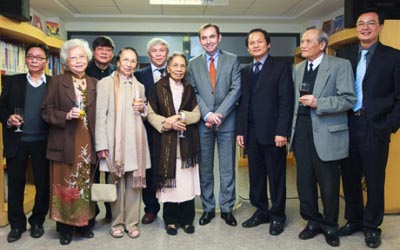
Professor Hoang Thi Chau and her colleagues at the University of Social Sciences and Humanities.
4. Indeed, for decades, countless students from the Faculty of Linguistics and Literature at the former Hanoi University (now the Faculty of Linguistics and Literature at the University of Social Sciences and Humanities) have grown, established themselves, and built their careers thanks to Professor Hoang Thi Chau's lectures. Throughout her life, she remains the beloved Ms. Chau of generations of students, even those who are not Vietnamese. Recently, on an anniversary, Professor Shimizu of Osaka University (Japan) shared beautiful memories of his teacher, Ms. Hoang Thi Chau: "...Actually, at that time, I felt like I was being held in the warm embrace of a mother...". With her profound knowledge of linguistics and the Vietnamese language, Professor Hoang Thi Chau became one of the first experts in Vietnam to teach Vietnamese abroad. Was this luck or the result of her tireless efforts? The scientific reports published after months of teaching abroad are perhaps the most complete answer. During my years as a specialist in Germany, in addition to successfully defending my doctoral thesis at Humboldt University on the topic...Phonetic systems in Vietnamese dialectsShe also wrote a basic Vietnamese language textbook in German.Vietnamese Grundkurs(1982, reprinted 1990; 212 pages). And also...Linguistics in the German Democratic Republic(1983) a general scientific report introducing the achievements of linguistic research in this country. A summary is a genre that requires prioritizing the collection and careful study of materials. Perhaps she read extensively, and with her practical scientific research skills, which she proudly acknowledged she learned from her German colleagues, the knowledge of linguistic research in the homeland of K. Marx was presented richly but clearly, outlining each stage with specific research trends and areas. Following the same line of thought, after six months of teaching Vietnamese language and literature at Peking University, she wrote...Vietnamese Studies in China(1998) aimed to introduce teaching and research institutions on Vietnam throughout this vast country. However, it seems to have gone beyond mere introduction, although the list of works related to Vietnam by Chinese Vietnamologists in the bibliography and footnotes at the end of the article is already a rich source of information, not to mention the main text. The article also shares experiences in teaching Vietnamese to Chinese people. Regarding learning Vietnamese in Japan, given the large number of Japanese people investing in Vietnam and engaging in cultural exchange in the 1990s, she compiled materials to write this article.Learning Vietnamese is currently very fashionable in Japan.(1998) served as a prediction for a cultural movement that deserves attention and plays a role in promoting friendship between the two countries. With the passage of more than 15 years, we understand even more the value of that article. Besides articles that introduce and provide information, Professor Hoang Thi Chau is, after all, an educator. With her experience in teaching Vietnamese as a foreign language, she has presented in-depth academic research papers at conferences on Vietnamese language teaching.The issue of correct pronunciation and dialectal pronunciation in teaching Vietnamese to foreigners.(1996) is a report that provides an overview of the Vietnamese pronunciation situation, which she argues is a challenge for teaching Vietnamese to foreigners, as everyone is using their native dialect for social communication. Based on identifying standard pronunciation using linguistic knowledge, she proposed specific solutions to overcome these difficulties in two directions: standardization of level and standardization of operation. Still deeply concerned about teaching Vietnamese pronunciation, after 15 years, she wrote...Applying Phonetics to teach pronunciation and spelling (to students and foreigners)(2011). In this article, she used phonetic knowledge such as the vowel trapezoid with the distinction of 3 jaw elevations and 3 tongue positions to teach vowels; or distinguishing consonants into opposing pairs so that practicing syllable blending does not cause confusion. For teaching tones, she provided "tips" to help young children and foreigners understand and use the 6 tones of Vietnamese correctly. Pronunciation is one of the prerequisites when wanting to learn and become proficient in any foreign language. With just two articles based on phonetics, Professor Hoang Thi Chau has made contributions, though simple, that are accurate, meticulous, and very useful regarding methods of teaching Vietnamese.
5. Social sciences and humanities, more than any other discipline, require erudition as a mandatory prerequisite. Erudition is both deep and broad. Broadness reflects a broad range of knowledge encompassing many related fields, while depth refers to a thorough understanding of the root of every issue discussed. In modern academia, we discuss interdisciplinary approaches extensively. However, without discussing overly complex or academic approaches, nearly half a century ago, Hoang Thi Chau wrote articles connecting linguistics with history. First and foremost is an article published in the Journal of Historical Research, serving as an outline of a direction that sparked many noteworthy ideas –Regarding the search for historical sources in ethnic languages.(1967). The Vietnamese corpus contains many elements preserving ancient features, and these elements constitute an extremely rich source of historical data. Although historians have paid much attention to and made full use of linguistic materials extracted from ancient texts, according to Professor Hoang Thi Chau, there are two particularly important sources of linguistic data that can become historical sources: dialects and place names. Following that guiding article, she compiled linguistic data to write a series of articles related to the early historical period to help dispel the myths surrounding the first Van Lang state in the nation's history. Professor of history Tran Quoc Vuong agreed and quoted her explanation of the word "phu do" (tutoring/guidance).[1]Using techniques from comparative linguistics and historical phonology, Professor Hoang Thi ChauUnderstanding the meaning of the word "tutoring" in the legend of Hung Vuong(1967) to prove that "phụ đạo" is not a Chinese word as previously believed, but an ancient Vietnamese word transliterated with a corresponding relationship to pơ tao, mơ tao, pa tao, bơ tao, pa đao, tạo, đạo of the languages of Vietnamese ethnic minorities today in terms of phonetics and sharing the same meaning of chieftain, supreme leader. Following this are analyses of the ethnic name "Lang", and the names of villages beginning with "Kẻ, Cổ" to determineThe country of Văn Lang and its territory as seen through linguistic documents.(1968) included part of present-day Liangguang and Northern Vietnam. The article also participated in the Hung Vuong Historical Period Research Conference that year –Some aspects of the social organization of the Van Lang Kingdom based on linguistic documents.(1968) again provides a systematic view of a completely isolated and somewhat "fragmented" Asian-style commune among the settlements in Northern Vietnam, provided by the Kẻ naming system and dense network of dialects, along with a clearly stratified society characterized by the titles and positions in legends that still exist today among ethnic groups close to the Vietnamese language family. After reflections on the Hung King era as a verification process for applying linguistics to explain a specific historical problem, Professor Hoang Thi Chau made general summaries about the essential and close relationship betweenLinguistics and History(1971).
If history gives us insight into the past, present, and future, then geographical space provides a comprehensive view, or in other words, a broad perspective on the interaction between its elements. After contributing documentary materials to historiography, Professor Hoang Thi Chau returns to the issues of the Vietnamese language itself in relation to language families and linguistic domains from the perspective of different dimensions – historical and geographical.A brief overview of geography and linguistics in Indochina.(1985) can be seen as her declaration of the close relationship between language and geographical regions throughout history. The survey of languages in Indochina shows two distinct areas: some phenomena are found only in the north (in Lao, Northwest Thai, Tay-Nung, Muong, and Northern dialects), while others appear only in the south (Thai and Southern dialects). The article concludes with the suggestion, "That difference may stem from the underlying structure," which guided the task of exploring the origins of the languages present in the region in terms of their kinship and contact. At the Soviet-Vietnamese Linguistics Conference, Professor Hoang Thi Chau wrote about...A common denotation used in many Southeast Asian languages.(1983) to determine the origin of the demonstrative word "ni" in many languages in the region. Using the same method, with analytical linguistic techniques, she pointed outThe kinship of Indochinese languages through grammatical and word formation characteristics.(1983, in German). Then she continued.Re-examining the relationship between the Vietnamese language and the Thai language through some ethnophones.(1998). Based on the similarities between Vietnamese and some languages belonging to the Tai family regarding word groups, which are related both semantically and phonetically, the author presented her own view on the typology of Vietnamese. She argued that the long-term contact in the Red River and Ma River deltas with Tai languages and later with Chinese changed the typology of Vietnamese from a Mon-Khmer base to a Sino-Tai language. This idea of hers seems to share the classification of H. Maspéro. And recently, on her never-ending quest for knowledge, she discovered an extremely rich source of linguistic data: the number systems of languages. In 2009, at the age of 75, Professor Hoang Thi Chau still presented a report.Word formation of the number system in various languages(2009) at the plenary session of the International Conference on Research and Teaching of Vietnamese-Chinese Language and Culture. The article is a decoding of the number system in languages spanning different language families from east to west to explore the universal way of thinking of all humanity as well as the national characteristics of the owners of each number system reflected through language. And the number system once again provides linguistic data to solve a long-debated topic.Attempt to explain the classification of South Asian languages based on numerical systems.(2011). Although modestly titled "A Trial," the article actually clarified the living areas of population groups belonging to the South Asian language family. The "familiar" area that she outlined in her first article researching river names about 50 years ago. Hoang Thi Chau has always been a scientist with "insight." She consistently summarizes broad issues from simple yet unique data, often surprising the academic community.
6. The five research directions in Professor Hoang Thi Chau's scientific career (Toponymy, Dialectology, Minority Languages, Teaching Vietnamese as a Foreign Language, and Historical and Geographical Linguistics) seem like disparate pieces, parallel lines that could never meet, but in reality, they are harmoniously connected by Phonetics. Phonetics acts as a key, helping her discover new issues and examine old problems throughout her long journey of study and research. Phonetics provides the basis for deciphering place names in Vietnam and the region. Dialectology is also concretized from phonetic distinctions. Without a basis for describing the phonetics of minority languages, it would be impossible to generalize phonetic types and even more impossible to build a suitable phonetic writing system. For the field of teaching Vietnamese as a foreign language, pronunciation instruction is even more important but has long received little due attention, making her guidance on applying phonetics to teaching all the more valuable. In particular, phonetics and its research methods have opened up interdisciplinary research between linguistics, history, and geography. Phonetic rules help reconstruct the ancient forms of Vietnamese words that have been transcribed, and some historical issues from ancient times have been explained. It is also through phonetic similarity analyses that the distribution areas of related languages can be seen. One might think that phonetics, with its demands for accuracy and meticulousness, would influence the style of linguists who use phonetics as a method of approach, but Professor Hoang Thi Chau is perhaps a special case. She always overcomes the limitations of fragmented analysis and focuses on general issues, reflecting the spirit of a pioneer. Indeed, throughout her life, she persevered like a ship carrying a heavy load of linguistic knowledge to the world.
And perhaps, from now on, "Ms. Chau" will no longer be a lonely boat amidst the stormy seas. Friends and colleagues cherish her work, her true students will forever hold in their hearts the image of their respected teacher, and society has also found its own way to honor her: the title of Professor, the Doctor of Philosophy degree, the title of People's Teacher, the State Award for Science and Technology. But it seems all those titles pale in comparison to the one thing she left behind: her reflections on linguistics, on the Vietnamese language, and on its application to life.
In this life, each person chooses their own path. Some paths strive to showcase their exceptional talents and shine brightly in the sunlight, while others are gentle exceptions, remaining hidden beneath the surface like underground streams, settling and silently nurturing tender young saplings. Hoang Thi Chau is one of those pure underground streams.
[1]The article "On the title 'Hung Vuong'" by Professor Tran Quoc Vuong is published in Hung Vuong Founding the Nation - Volume 3, Social Sciences Publishing House, 1973, pp. 353-355.
Author:Duong Xuan Quang

