What does journalism entail? How does propaganda, mobilization, and mass organization differ today? How can journalism be practiced to build lives, to make revolutions – to create progressive changes for society?
Perhaps every revolution begins within itself. In agriculture, a revolution might start with a single straw, while for journalism, perhaps it should begin with the simplest questions.
1.
When I was in second grade, I rummaged through my dad's bookshelf and found a poetry book with a very cheerful picture: a person wearing a hat holding a trumpet aloft. Looking closely, I realized it was a picture made up of letters – the phrase "Vietnam Independent." The accompanying verses read: "Vietnam Independent, blowing the trumpet. Calling on our people, young and old, to unite as steadfast as iron, to save our country." This cheerful image stuck in my mind as a child, both endearing and intriguing. Where did this image come from, and what was its purpose?
Later, I was delighted to find this small painting in the Independent Vietnam newspaper, the organ of the Cao Bang Provincial Committee of the Viet Minh. Why was such a serious topic, from such a serious organ, depicted through such a humorous painting? Going back to the time when the newspaper was founded after President Ho Chi Minh returned to the country to directly lead the revolution in 1941, he decided that a newspaper was necessary to propagate, encourage, organize, and lead the masses in the Revolution. At that time, the people in Cao Bang and the mountainous provinces of Viet Bac were illiterate and impoverished, unable to read long theoretical articles. It turned out that the painting and the easily memorized poem were the most effective method, perfectly suited to that target audience. Such relatable poems quickly spread and inspired the revolutionary movement, spreading from Cao Bang throughout the country.
So it's true that Uncle Ho's work in journalism was a form of revolution, which is why he chose such an accessible writing style. His concise writing also reveals his purpose: what journalism is for. The method always goes hand in hand with and reflects the purpose.
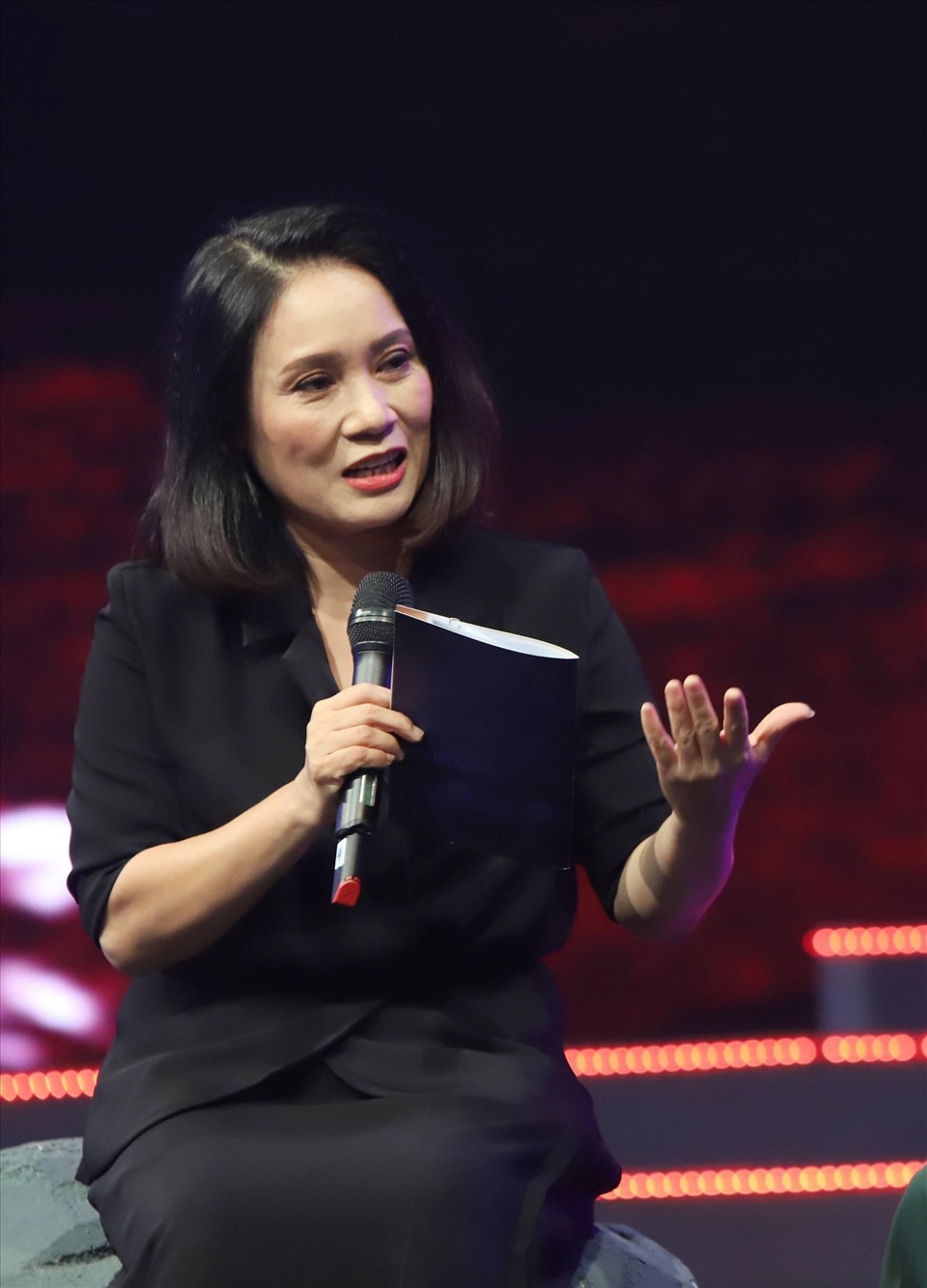
Journalist Ta Bich Loan
Today, the way news outlets report the news raises the question: What is the purpose of journalism?
Journalism can also be seen as a form of sales if we look at PR and advertising pages, or television channels that sell products.
Journalism is entertainment if we watch all kinds of entertainment programs and read entertaining articles on television channels and online newspapers.
Journalism is like building a networking club if we look at the interactive sections on the internet.
What does journalism mean if it no longer involves participating in revolutions like in certain years of Vietnamese history?
Let's look back at the history of world journalism when it first emerged. What did journalism entail back then?
A rather interesting story about the birth of the first French periodical is that in 1631, the editor Renaudot of the Gazette obtained a license from Cardinal Richard, granting him the privilege: "to print and sell to anyone he wished, newspapers reporting on everything happening in and outside the kingdom, on conferences, prices of goods, and other publications of the offices of communication, forever and only he had this right" (History of Journalism by Pierre Albert, World Publishing House, 1999).
From the text above, it can be seen that the first newspaper did two things simultaneously: reporting important events and commodity prices. Alongside this were debates on various topics in which the editor participated with a sharp and insightful style. According to Pierre Albert, from its very beginnings at the end of the 15th century, publications clearly demonstrated three main functions of journalism: reporting major current events, reporting daily anecdotes, and providing a forum for expressing opinions. This is not just an observation about French journalism. The purpose of journalism is not always to make revolution, but journalism has always been a tool for revolution: the English Revolution, the French Revolution, the American Revolution...
2.
The rapid development of digital technology globally has transformed the entire mass media and world journalism. Needless to say, simply observing how we access and participate in information and communication activities daily reveals the extent to which the media world has changed. Boundaries between different types, media, methods, subjects, and objects of communication have been blurred. A multitude of new concepts and operating models have rapidly emerged, replacing the old and then being replaced by even newer ones. Media giants have shrunk, and smaller players have taken their place, becoming large only to be replaced again.
In this context, we can once again look back and see what journalism actually entails in today's digital age.
Perhaps the biggest challenge facing journalism today is the immeasurable rate of information generation, faster than even the Coronavirus, of both fake and real information on social media. For its survival, journalism must compete with and simultaneously coexist with social media. In a way, journalism is also being transformed by social media to adapt to the new era, new communication tools, and new media consumption habits.
One of these transformations is that journalism has once again acquired a new function: verifying information, in addition to following, delving into, and developing topics and images appearing on social media.
From that point on, journalism rediscovered its original mission, re-established professional standards, journalistic ethics, and core values. These include honesty, objectivity, fairness, balance, respect for diversity and differences, and humanism.
In a poem titled "Speaking to Myself and My Friends," the poet Luu Quang Vu wrote:
"It's easy to flatter life, but easy to criticize life."
"Only building a life is difficult."
Building a better life is perhaps difficult because, in the whirlwind of information, we don't always have time to consider what we write or say—what it truly and profoundly benefits ourselves, society, and the country. More accurately, we don't always have time to reflect on the purpose of our journalistic work.
The economics of journalism and the mechanism of journalistic autonomy sometimes force us to prioritize interests. It's wonderful to be able to harmonize interests, but what if concessions alter the purpose? The public's dissatisfaction with the press may also stem from instances where the press fails to fulfill its intended role.
3.
On June 21st, we celebrate Revolutionary Press Day. I wonder how many of our newspapers and television channels can we call "revolutionary" today?
Going back to the time when President Ho Chi Minh worked in journalism and launched the Thanh Nien (Youth) newspaper on June 21, 1925, 96 years ago, revolutionary journalism was about propaganda, mobilization, and organizing the masses. Journalism led the masses towards new ideals, creating great changes for society and the world. In his article on the Purpose, Methods, and Qualities of a Propagandist (Ho Chi Minh Complete Works, Volume 5, pages 191-192), he said: "Propaganda is about explaining something to the people so they understand, remember, follow, and act upon it. If that purpose is not achieved, then the propaganda has failed." What President Ho Chi Minh taught accurately reflects the concept that journalism is revolutionary. He called journalism a revolutionary weapon and journalists soldiers.
Today, our enemies are becoming increasingly difficult to identify and defeat, and it's not just the Coronavirus; it's also the invisible enemies within ourselves.
A journalist shared with me that he understood Revolution to mean "Leading the Way and Innovating."
So today, the press corps is at the forefront of the fight against COVID-19, the fight against corruption, and the recognition of good deeds... all of which are continuing the Revolution: Contributing to building a spirit of self-reliance and self-strength, for the aspiration of developing a prosperous and happy Vietnam.
Author:Dr. Ta Bich Loan
Source:laodong.vn
Newer news
Older news

