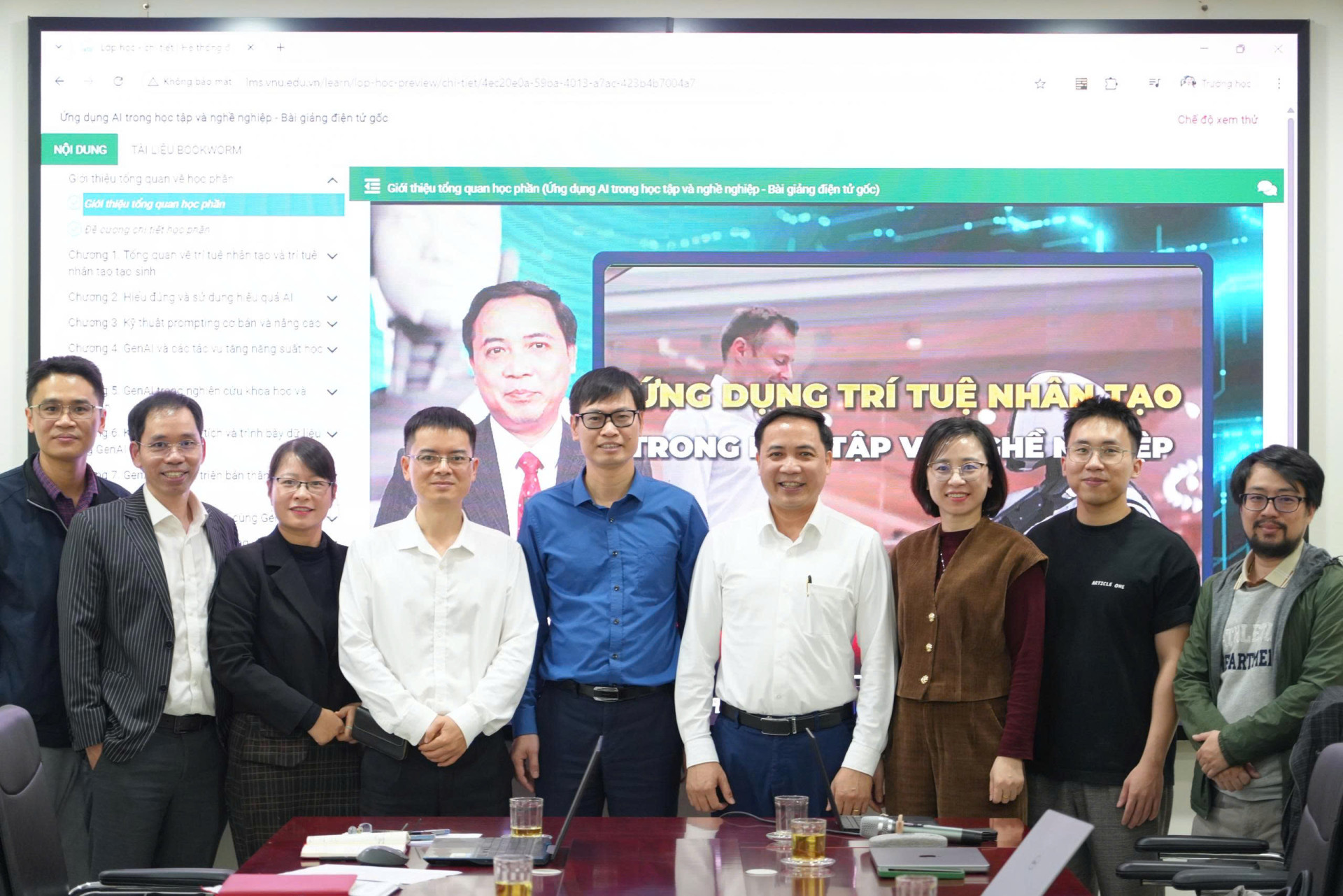
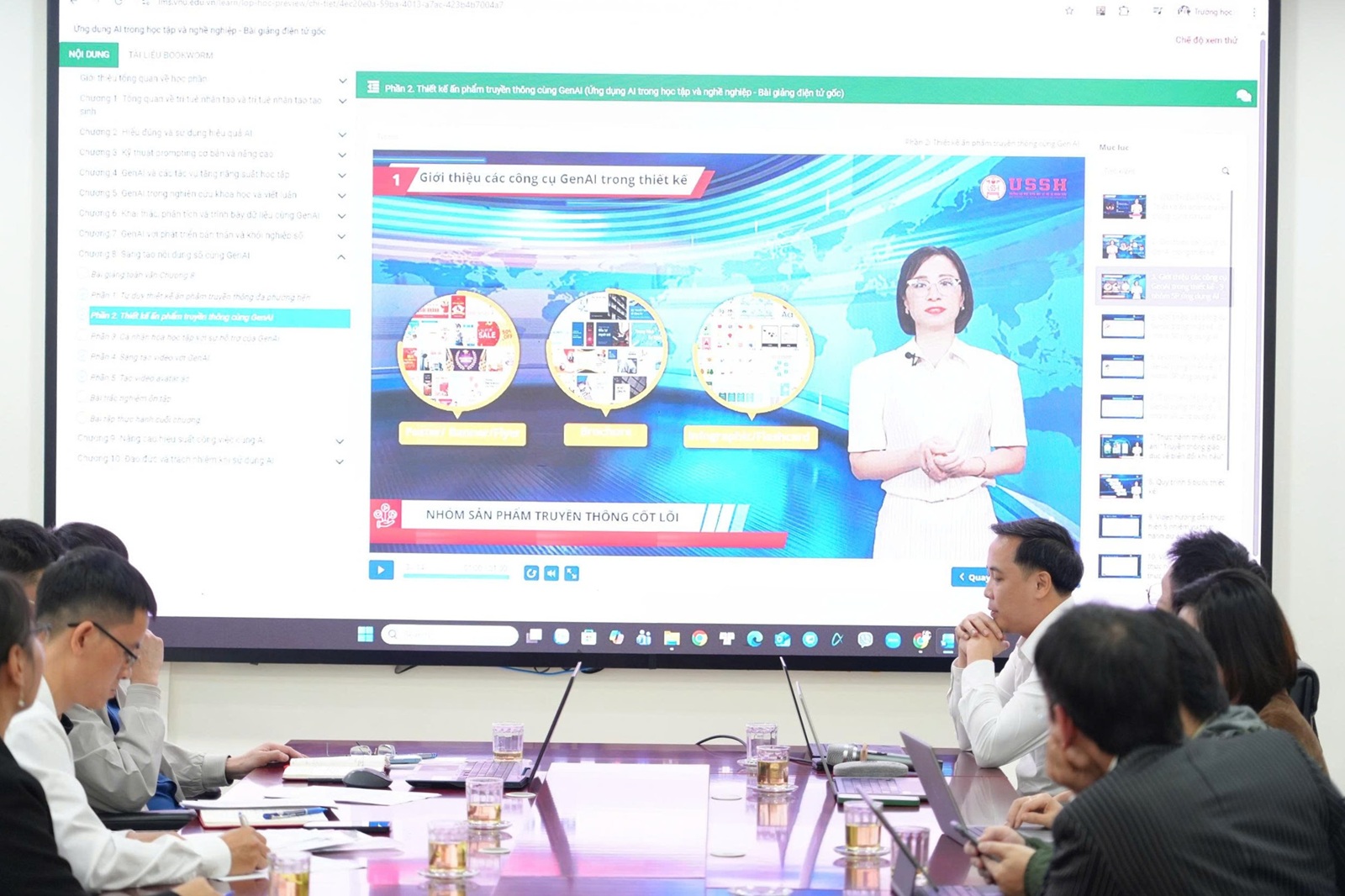
Associate Professor Dr. Dang Hong Son chaired the acceptance review session for the MOOC electronic lecture "Applications of Artificial Intelligence in Learning and Career".
The course is designed using a problem-solving approach, starting with real-world scenarios from learning and work. Learners will not only "understand what AI is" but also know when, why, and how to use AI to solve specific problems: from personalized learning and academic writing to data analysis, building career profiles, and developing startup ideas.
The entire content is organized using a microlearning model, divided into short, focused, accessible, and easy-to-practice modules. Learners can study flexibly at their own pace, accumulating small but highly applicable skills suitable for the digital learning environment and lifelong learning.
Assoc. Prof. Dr. Do Van Hung, Head of the Faculty of Information and Communication Technology, and Head of the drafting team (wearing a white shirt), reports on the results of developing the MOOC lecture "Applications of Artificial Intelligence in Learning and Career".
In terms of content, MOOCs systematically cover everything from basic platforms to advanced applications:
- An overview of AI, AI generation, and LLMs, including their operating principles, capabilities, limitations, and socio-professional impacts;
- Identifying AI risks, biases, and illusions, and developing critical thinking skills when using AI tools;
- Master basic and advanced prompting techniques, popular frameworks and patterns to optimize workflows with GenAI;
- Applications of AI in increasing learning productivity (summarizing, note-taking, planning, presentations), scientific research and essay writing, data analysis and visualization;
- Creating multimedia digital content (posters, videos, podcasts, ebooks, educational games) and improving work efficiency with AI;
- Leveraging AI for personal development, career guidance, and digital entrepreneurship.
The course is designed with an active learning approach, placing the learner at the center. Learners are encouraged to explore, experiment, critically analyze, and adapt their use of AI in their personal contexts, viewing AI as a tool to support thinking, not a replacement for human capabilities.
A recurring theme throughout the MOOC is human-centered AI, linked to ethics and responsibility. The course helps learners identify issues of academic integrity, privacy, bias, and legal risks, while practicing the transparent, responsible, and socially compliant use of AI.
Specifically, the MOOC course is designed for students in the Social Sciences and Humanities, where AI is not just a technical tool but a means of supporting thinking, interpretation, and knowledge creation. The course helps students in social sciences and humanities leverage AI in reading comprehension and text analysis, argumentation, academic writing, qualitative research, academic communication, and data storytelling, while maintaining the central role of humans in interpreting meaning, values, and socio-cultural context. AI is approached as a “learning partner” supporting the expansion of critical thinking, creativity, and humanistic skills, rather than replacing the learners' analytical, judgmental, and academic responsibility. With its modern approach, up-to-date content, and humanistic orientation, the MOOC "Applications of Artificial Intelligence in Learning and Career" aims to cultivate a generation of independent, creative, and responsible learners, ready to adapt and thrive sustainably in the age of artificial intelligence.
With its modern approach, up-to-date content, and humanistic orientation, the MOOC lecture "Applications of Artificial Intelligence in Learning and Career" aims to cultivate a generation of independent, creative, and responsible learners, ready to adapt and thrive sustainably in the age of artificial intelligence.
Related articles:
VNU-USSH participates in developing the "Digital Literacy for the People" course: Pioneering in enhancing digital skills for students.