This is one of the key issues highlighted at the Hanoi Autumn Humanities Forum 2026, organized by the University of Social Sciences and Humanities, Vietnam National University, Hanoi (VNU). Held for the first time from October 21st to 28th, the Forum includes 21 workshops, scientific seminars, and roundtable discussions, and is expected to attract approximately 1,300 scholars, including 250 international speakers.
In his opening remarks, Professor Hoang Anh Tuan, Rector of the University of Social Sciences and Humanities, emphasized the need to shift humanities knowledge from explaining social phenomena to participating in creating solutions to the country's development problems. The value of research lies not only in scientific publications but also in its ability to transform into policy recommendations, cooperation programs, and practical applications.
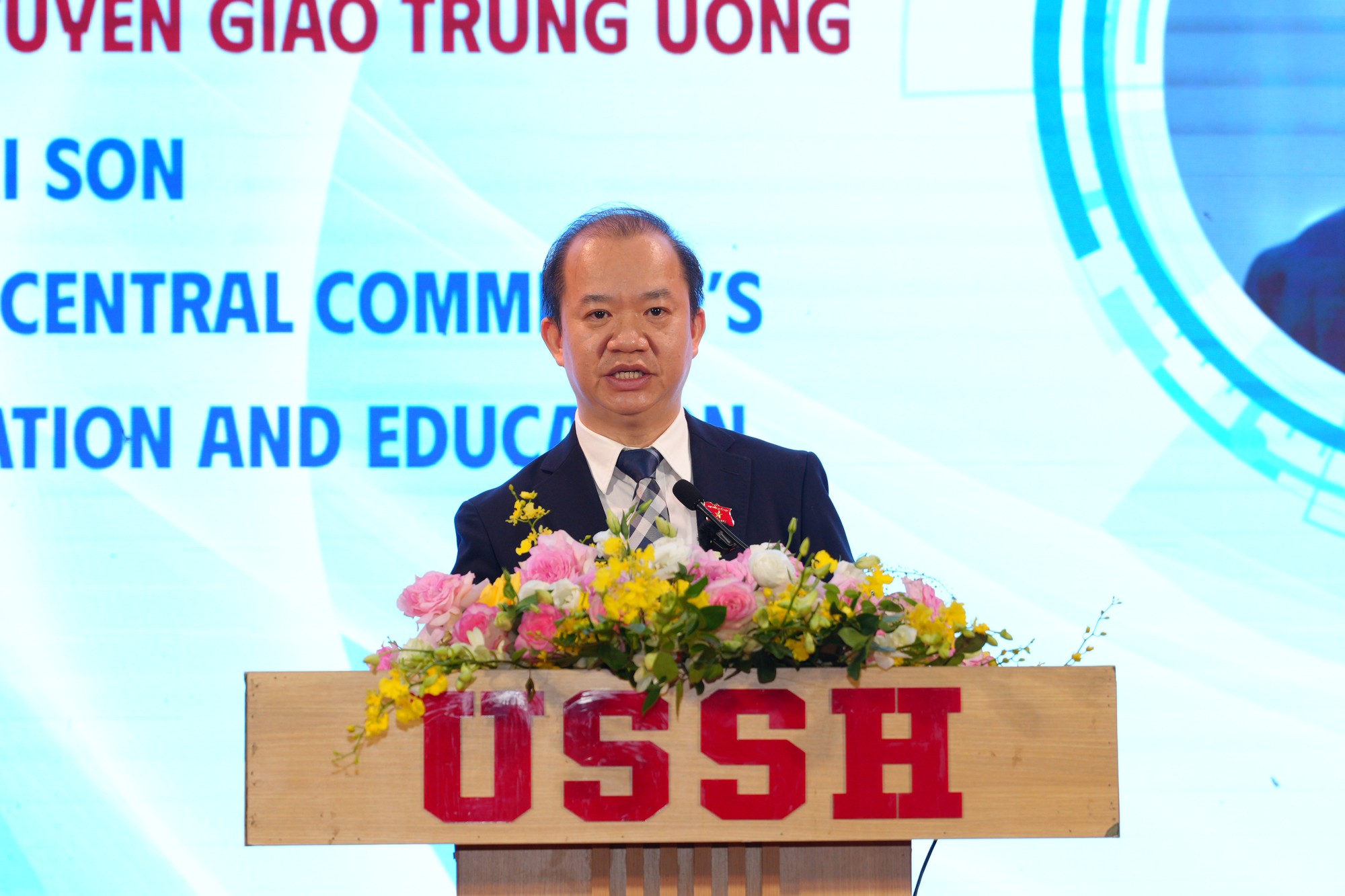
Associate Professor Bui Hoai Son emphasized the role of social sciences and humanities in social forecasting and policy planning.
Social science research must be linked to practice and policy planning.
Speaking at the Forum, Associate Professor Bui Hoai Son, Deputy Head of the Central Propaganda Department, emphasized that important resolutions of the Central Committee on science, technology, innovation, international integration, education, and culture all aim at the goal of human development, improving the quality of life and happiness of the people. This places a demand on social sciences and humanities to provide arguments to serve policy planning, proactively research, and predict social changes.
In particular, Resolution No. 25-NQ/TW on the Strategy for Ideological Work in the New Context requires innovation in research, forecasting, and understanding of the spiritual life of society. To meet this requirement, serious scientific arguments are needed, combining data exploitation with a deep understanding of people.
Referring to the rapid development of artificial intelligence (AI), Mr. Bui Hoai Son argued that technology can help a nation develop faster, but culture, ethics, and beliefs are what create the depth of development. AI can process data but cannot replace humans in choosing fairness, compassion, or responsibility towards those at risk of being left behind. "A society needs not only to be smarter, but also more humane," he emphasized.
From this perspective, Mr. Bui Hoai Son argues that social sciences and humanities must go beyond simply explaining past events, proactively predicting change, warning of risks, and contributing to finding a foundation of values for the future. Issues concerning technological ethics, digital culture, family, education, and social trust all need to be studied using an interdisciplinary approach.
For the University of Social Sciences and Humanities, Mr. Bui Hoai Son set out three expectations. First, research must be closer to the major issues of the country and the essential needs of the people, clarifying how each research result can support policy decisions and improve lives.
Furthermore, the university needs to develop interdisciplinary research groups, combining basic research with field surveys, data mining, and policy analysis; while strengthening connections between the classroom, advisory bodies, and social life. He emphasized: "A project should not stop when it is accepted; it needs to continue with clear recommendations, feasible solutions, and substantive changes."
The Deputy Head of the Central Propaganda Department also expressed his desire to continue cooperating with the School in theoretical research, summarizing practical experiences, forecasting ideological trends, advising and evaluating policies; and encouraged the formation of expert groups to work alongside advisory bodies.
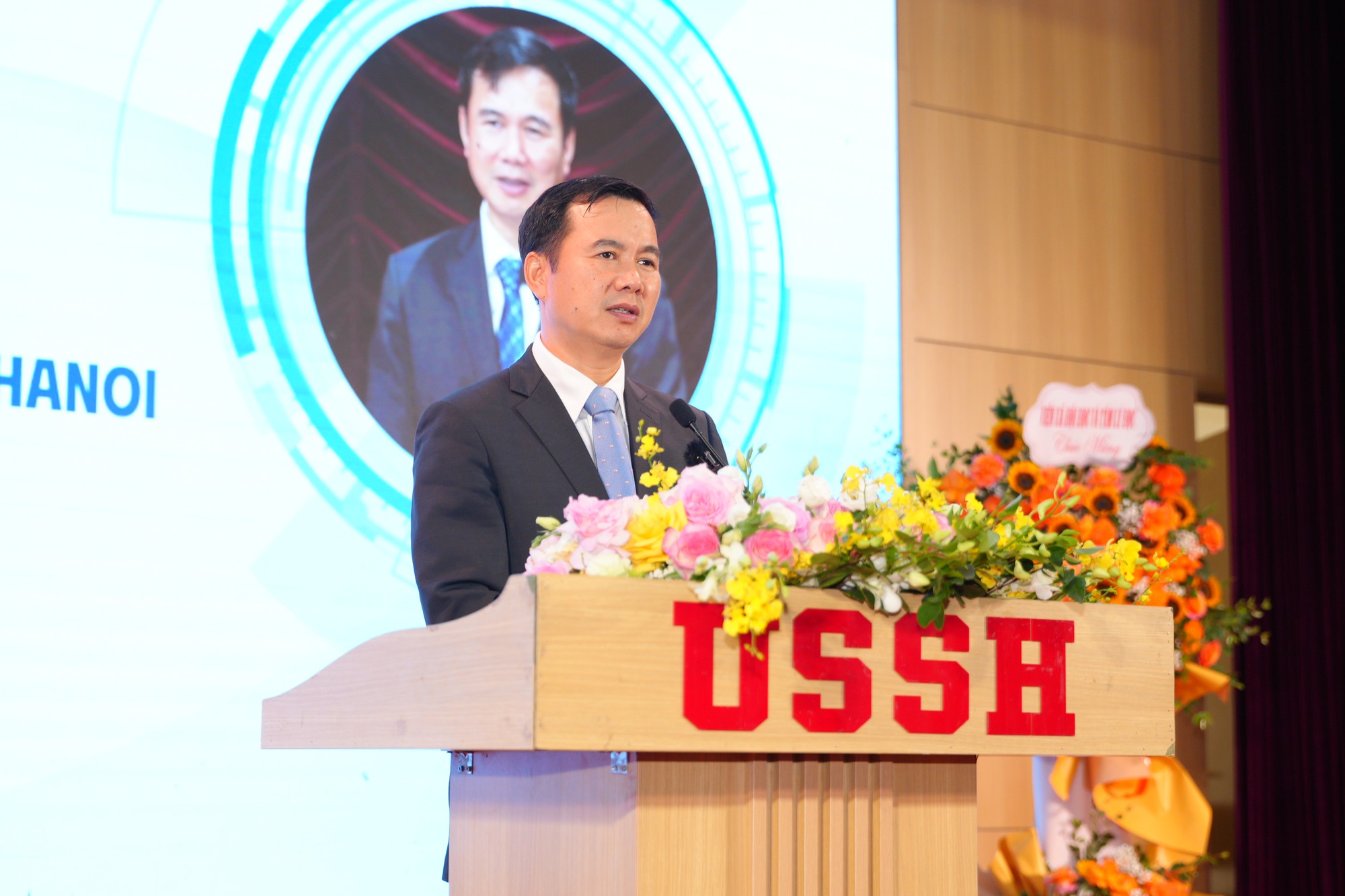
Associate Professor Bui The Duy emphasized the need to put research results into practice - Photo: chinhphu.vn/TT
Integrating research findings into specific development models.
Further emphasizing the need to link research with practice, Associate Professor Bui The Duy, Director of Vietnam National University, Hanoi, stated that it is necessary to transform the results of social science and humanities research into models that can be applied and directly contribute to the development of the community.
He hopes that scientists will continue to collaborate with the University of Social Sciences and Humanities, the University of Education, and other research and training institutions in building, testing, and scaling up development models based on social sciences and humanities. In particular, emphasis should be placed on experimental activities to verify effectiveness, adjust, and refine solutions before widespread application.
Besides applying science and technology, Mr. Bui The Duy emphasized the role of social organization, resource mobilization, and human capacity building in the development process. Drawing on the experience of South Korea's New Village Movement (Saemaul Undong), he mentioned community strength, self-reliance, and people's participation as crucial factors in the effectiveness of development models. Based on these experiences, the Director of Vietnam National University, Hanoi, suggested the potential of cooperative models linked to innovation, the application of science and technology, and suitability to the practical development conditions.
The Director of Vietnam National University, Hanoi, expects the Forum to promote academic exchange, formulate scientifically-based policy recommendations, develop application models, and expand cooperation between universities, research institutes, management agencies, and businesses. Through this, social sciences and humanities will make a more practical contribution to solving national problems and developing Vietnamese people and society.
Author:According to the Government Electronic Newspaper
Newer news
Older news

