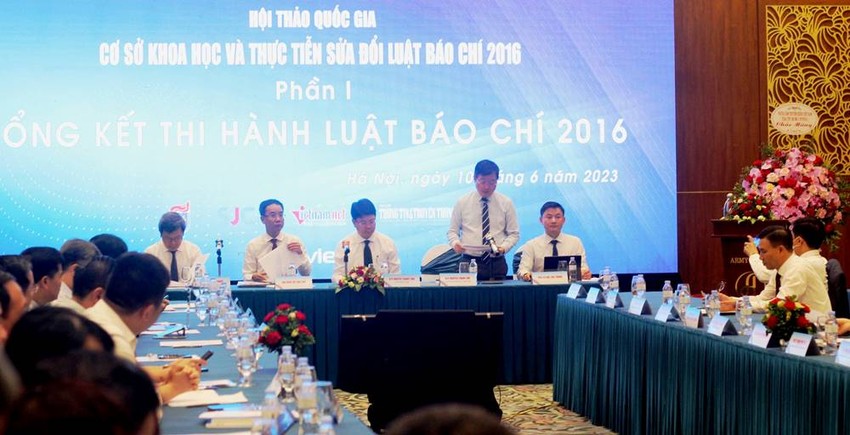
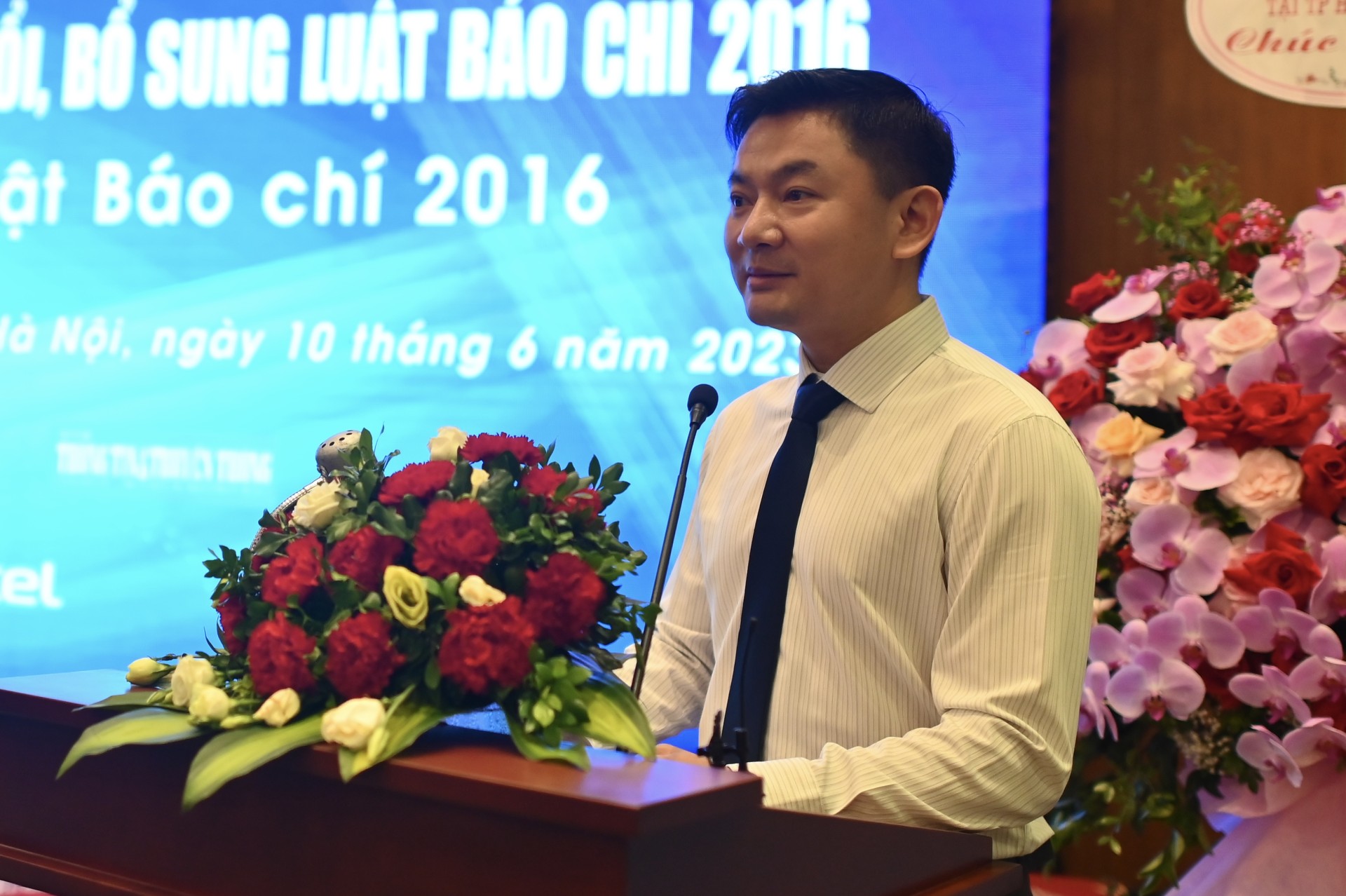
Ho Chi Minh City Law NewspaperWe had a discussion with Associate Professor Bui Chi Trung, Deputy Director of the Institute of Journalism and Communication Training, Faculty of Social Sciences and Humanities, Vietnam National University, Hanoi, and a permanent member of the workshop's organizing committee, to better understand the necessity of amending the Press Law and some issues that need to be addressed in this amendment.
Creating a framework for the development of journalism in the digital age.
Reporter:Sir, at the time of its enactment, the 2016 Press Law was considered to have created the necessary conditions for the development of journalism. How do you assess this statement?
Assoc. Prof. Dr. Bui Chi Trung:It can be affirmed that, from the 1989 Press Law to the amendments and supplements in 1999, the guidelines in 2002, and the continued refinement in the 2016 Press Law, there has been a gradual positive transformation in the regulation of press activities. Besides provisions that create favorable conditions for press development, the law also regulates and covers the content and areas of press expression within the framework of Vietnamese law and the Constitution.
However, after seven years of operation, and facing significant political and social changes under the impact of globalization, industrialization, and international integration with many new forms of journalism and media, the issue of supplementing and amending the 2016 Press Law has become urgent and needs to be considered and adjusted soon.
Assoc. Prof. Dr. Bui Chi Trung, Deputy Director of the Institute of Journalism and Communication Training, Faculty of Social Sciences and Humanities, Vietnam National University, Hanoi
Reporter:According to him, what are the reasons behind this urgency?
Assoc. Prof. Dr. Bui Chi Trung:In my opinion, the primary reason stems from the increasingly high and urgent demands of society regarding the field of journalism in the direction and management of the press. In particular, the rapid development of science and technology and modern media has led to higher demands in the field of journalism, necessitating the improvement of legal regulations to ensure timely and appropriate management, creating a framework for the development of journalism in the digital age. It is also possible that some individuals and organizations have sought to exploit loopholes to circumvent the law for personal gain.
Reporter:The reality is that the 2016 Press Law has not kept pace with the current trends of many forms of mass media activities that are similar to journalism. What are your thoughts on this?
Assoc. Prof. Dr. Bui Chi Trung:That's right. The 2016 Press Law currently only stipulates four basic types of media (print newspapers, radio, television, and online newspapers), but in reality, there are many other forms of mass media activities that are similar to or related to journalism, and have a profound impact on journalistic activities (such as social networks, websites, domestic and cross-border applications providing information and videos...).
Furthermore, with the trend of technological convergence, multimedia communication, multi-platform transmission (transmission over telecommunication network infrastructures such as cable, mobile, and satellite television (DTH)), and especially the proliferation of internet-based streaming methods via domestic and international websites and applications in Vietnam (OTT), these new platforms have an advantage over traditional methods in that they allow interaction with readers, listeners, and viewers at the time of live broadcast.
Reporter:In the "borderless" environment of the Internet, new trends are posing many challenges for media management.
Assoc. Prof. Dr. Bui Chi Trung:Yes, in fact, there are cases where news agencies proactively develop applications (apps), distribute content themselves on the Internet, or open additional channels for distributing journalistic content on domestic and cross-border social media platforms (opening channels on YouTube, TikTok, creating fan pages on Facebook, Lotus, Zalo, etc.).
During operation, errors, disputes, or violations may occur on cross-border platforms that do not comply with Vietnamese law. The continuous development of technology makes it difficult for any single legal framework to fully encompass everything over a long period.
Regulations on the new economic model for journalism need to be added soon.
Reporter:The economics of journalism is also an issue that many media organizations must pay attention to and face. In your opinion, how should this issue be addressed when amending the Press Law?
Assoc. Prof. Dr. Bui Chi Trung:In my opinion, in regulations related to the economics of journalism, it is first necessary to redefine more clearly the characteristics and functions of certain media organizations in relation to their governing bodies. Clause 1, Article 21 of the 2016 Press Law stipulates: "Media organizations operate as revenue-generating public service units."
Accordingly, press agencies that are units belonging to state agencies, political organizations, and socio-political organizations are public service units. Magazines of social organizations, socio-professional organizations, and research institutes (not belonging to state agencies, political organizations, or socio-political organizations) are not public service units. Thus, in essence, these are press agencies with a financial planning mechanism similar to that of a business enterprise, and therefore require separate regulations regarding the type of operation for press agencies in this group.
Reporter:In our country, some media outlets have implemented a policy of charging readers for content. What is your assessment of this solution?
Assoc. Prof. Dr. Bui Chi Trung:The issue of content licensing is emerging as a new business solution, a rational and trend-aligned economic model for journalism, helping newsrooms diversify revenue streams, create engaging and high-quality content to sustain operations, and reinvest in high-quality products.
However, regulations on how content fees should be collected, who is allowed to collect them, and how to collect them fairly require clear legal basis and grounds. Therefore, laws and regulations in the field of journalism in the current context need to be supplemented with provisions to promote new economic models in journalism, contributing to the transformation of the structure and diversification of journalistic revenue. This will then contribute positively to the development of online journalism models that collect content fees, closely integrated with new technological infrastructures.
Reporter:Thank you, sir.
The Press Law still has many shortcomings.
At the workshop, Deputy Director of the Hanoi Department of Information and Communications, Nguyen Thi Mai Huong, stated that in reality, journalists and reporters currently working at agencies and organizations not only need their press cards but also letters of introduction from their media organizations. However, the use of these letters of introduction when working has not yet been included in the regulations of the Press Law.
Furthermore, according to Ms. Huong, there are some shortcomings in the operation of licensed general news websites and social networks. Specifically, general news websites are not limited in the number of news sources, as long as they obtain an agreement for citing those sources.
Meanwhile, most businesses providing aggregated online information services, for their own benefit, focus only on exploiting negative news and the dark side of society, leading to a distorted online information landscape that does not accurately reflect the social situation of the country. |
The press reported on the event:
Newspaper of the Communist Party of Vietnam: Clarifying the scientific and practical basis for amending and supplementing the 2016 Press Law.
Tuoi Tre Thu Do Newspaper: Creating a legal framework to enable the remarkable development of journalism.
Vietnamnet newspaper:Many insightful opinions were contributed to amending the 2016 Press Law.
Labor Newspaper:Nearly 80 experts, journalists, and lawyers contributed their opinions on amending the 2016 Press Law.
Tuoi Tre Thu Do Newspaper:A special mechanism is needed for essential journalistic products.
Ho Chi Minh City Law Newspaper:The 2016 Press Law contains 27 provisions, some of which are inadequate.
Hanoi Labor Newspaper:Amend and supplement the 2016 Press Law to suit current practices, which is necessary.
Ho Chi Minh City Law Newspaper: Amend the Press Law: New regulations on the 'economics of journalism' are needed.
Construction Newspaper:Workshop on the scientific and practical basis for amending the 2016 Press Law.