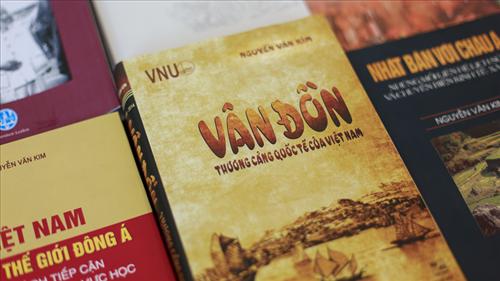
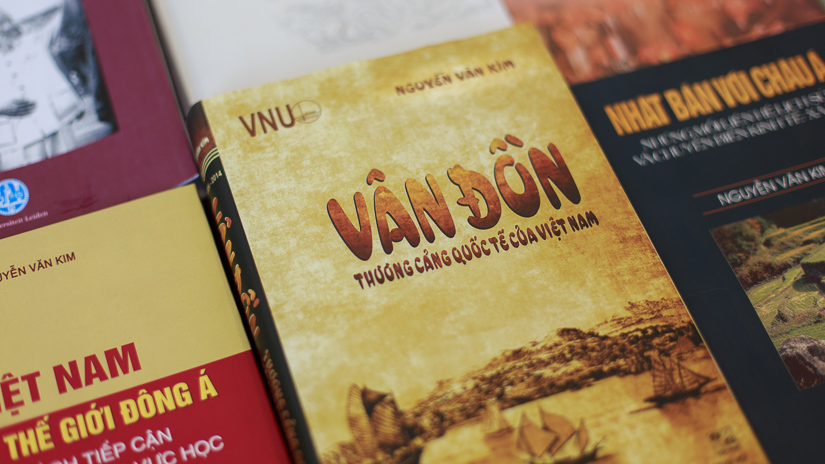
The monograph "Van Don - Vietnam's International Trading Port" by Assoc. Prof. Dr. Nguyen Van Kim. (Photo: Thanh Long)
Over the years, maritime and island issues have become a national concern. The University of Social Sciences and Humanities and its member units under the Vietnam National University, Hanoi have implemented a number of programs, projects, and research topics, including key topics on the sea, the process of establishing and defending maritime sovereignty, maritime trade, and the operation of ports and trading centers in Asia and Vietnam...
In conjunction with these vibrant scientific activities, the Faculty of History, the Department of World History, and the Asian Trade Research Group of the University of Social Sciences and Humanities have organized numerous scientific conferences and collaborative research projects with domestic and international scientists. As a result, several research works have been published and have become widely used as teaching and reference materials in the academic community. These include:East Asia - Southeast Asia: Historical and Current Issues;Southeast Asia: Tradition and Integration;Some topics in World History(2 volumes);Vietnam in the European trade systemAh,Four centuries of Vietnam-Netherlands relations; Vietnam in the East Asian world - An interdisciplinary and regional studies approach; The Vietnamese people and the sea, etc....
As Head of the Department of World History and Head of the Asian Trade Research Group, for two decades, Associate Professor Dr. Nguyen Van Kim has diligently surveyed and collaborated with Vietnamese and Japanese scientists, as well as several experts from the Netherlands, Germany, and internationally, to conduct archaeological explorations and excavations, searching for documents both domestically and in foreign archives to write and complete his monograph:Van Don - Vietnam's international trading port.The published work affirms the author's and the Group's long-term and correct research direction. Under the guidance and direction of Assoc. Prof. Dr. Nguyen Van Kim, several postgraduate students, doctoral candidates, and undergraduate students have also developed theses and dissertations focusing on diplomatic relations, the history of Asian maritime trade, and East-West economic exchange.
With its concise and well-structured five chapters, this monograph focuses on clarifying the formation, development, and continuous growth of Van Don over seven centuries, spanning the Ly, Tran, Early Le, Mac, and Later Le dynasties. The book also contributes to illuminating the potential, traditions of maritime exploitation, maritime-oriented thinking, and policies of the Vietnamese monarchical dynasties in protecting sovereignty in the northeastern sea and islands, in the context of constantly responding to regional powers. In this monograph, the author focuses on analyzing the economic and foreign relations position of the Van Don trading port, and the political, economic, and cultural role of the northeastern sea and islands in the East Asian regional trade and diplomatic routes and systems.
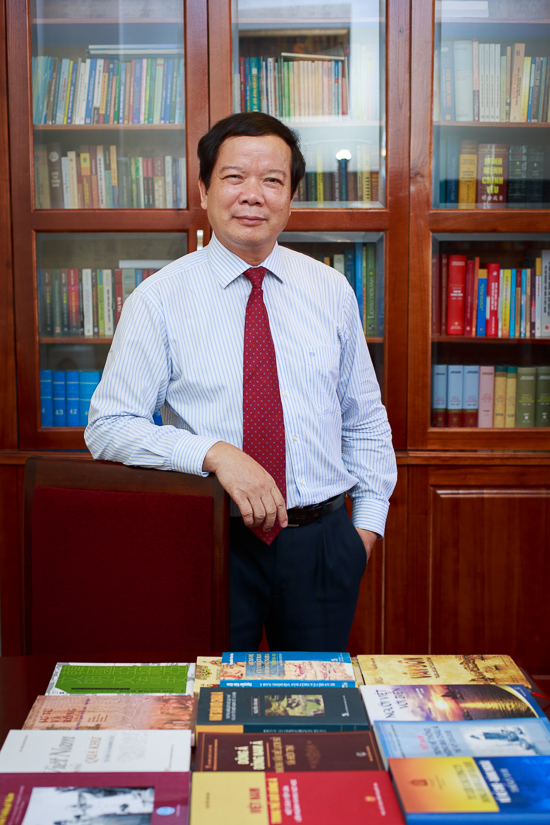
Assoc. Prof. Dr. Nguyen Van Kim. (Photo: Thanh Long)
The research results, analyses, and monographs have confirmed the important economic and political role of Van Don and several other international gateways and exchange centers in the development of the Dai Viet nation. During its development, Van Don was not merely a collection of isolated ports and wharves, but actually developed into a system with operational areas and spheres of influence, including central areas that acted as nuclei, coordinating the activities of the trading port. Clarifying and successfully demonstrating the early, long-term, and continuous formation and development, as well as the systemic nature of the Van Don trading port, are new and outstanding contributions of this monograph.
Applying systems research theory, combined with regional studies and interdisciplinary research methods and perspectives, the author argues that, despite being built in a relatively remote island region far from the capital Thang Long, Van Don quickly became a destination and a hub for domestic and international goods. From a systems perspective, the author is correct in suggesting that Van Don's true strength is integrated from four elements: Firstly,Convenient location; Monday,A safe stopover point on the East Asian trade route.; Tuesday,A hub for goods from Dai Viet and the surrounding region.; Wednesday,Van Don is a region of islands and sea rich in resources.Historically, Van Don was not only a seaport but also a region rich in natural resources, with high commercial value and favored by international merchants. Along with regional and international influences and conditions, clarifying the natural resources and inherent strengths of Van Don is a very noteworthy contribution of this research.
Considering and analyzing the diverse economic and diplomatic activities of Van Don, viewing the port's operations holistically, and placing the Northeast island port region within a chronological framework, in close relation to the Asian trade system in both traditional and contemporary aspects, Associate Professor Dr. Nguyen Van Kim consistently directs his research towards a comprehensive approach, gaining an overall understanding of the traditional exploitation of the sea, the maritime mindset, and the marine economic activities of numerous communities living in Vietnam. An interdisciplinary research perspective, combining fundamental research methods from historical sciences with archaeology, sociology, anthropology, etc., has been effectively utilized in this study. As a result, the work not only clearly presents domestic and international trade activities but also clarifies the strategic and forward-looking position of the Northeast gateway region in protecting the security, sovereignty, and economic interests of our country.
Historically, the Northeast region has always been one of the key areas for foreign economic development, while also being most frequently and strongly affected by political trends, cultural movements, and military challenges from external forces. This book focuses on analyzing the role of governments at all levels in understanding the position and resources of the sea, establishing maritime relations, and protecting maritime security and sovereignty. From this analysis, a deeper and more comprehensive understanding of foreign policy thinking and the resilience of our nation in the face of political challenges from regional powers is achieved.
As a meticulous, in-depth, and rigorous research work with many outstanding scientific contributions, this monographVan Don – Vietnam's international trading port.This project not only helps us better understand the formation and development of a trading port, foreign economic thinking, and the tradition of exploiting and developing the marine economy of our nation throughout history, but also contributes to affirming the potential, position, scientific basis, and confidence in the prospects for the development of the current marine and island economy. The project becomes even more significant as Vietnam has been and is pursuing a policy of strengthening and expanding international cooperation, promoting exchanges with East Asian countries, and simultaneously developing the Northeast marine and island region into a key economic zone and special economic zone, with Quang Ninh chosen as the driving force in implementing this.Vietnam's maritime strategy.
I would like to respectfully introduce this monograph to researchers and a wide readership.
Author:Professor Vu Duong Ninh
Newer news
Older news

