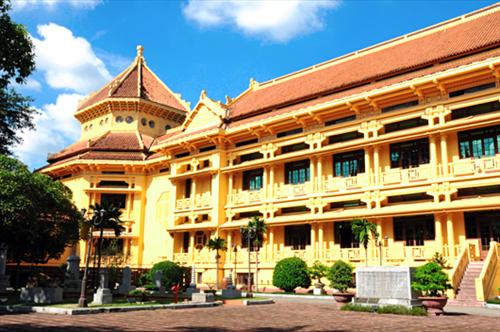
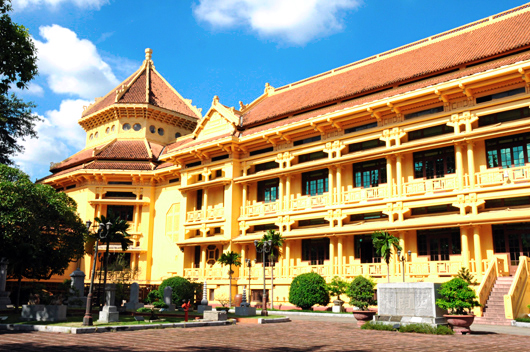
The former Institute of Far Eastern Studies, now the Vietnam National Museum of History.
first research institutein Indochina
In 1898, the Governor-General of Indochina, Paul Doumer, signed a decree establishing a research institution on the Orient called the "Permanent Archaeological Mission in Indochina." In 1900, this institution was renamed the "French School of Far Eastern Studies," abbreviated as EFEO. In 1901, French President Émile Loubet signed a decree officially confirming the establishment of the Institute, whose main function was to conduct scientific research on history, archaeology, linguistics, ethnology, geophysics, and anthropology in the Indochina peninsula and other countries in the Far East.
On September 8, 1945, just six days after the Declaration of Independence establishing the Democratic Republic of Vietnam, the President of the Provisional Government issued Decree No. 13 on the merger of the French School of Far Eastern Studies (EFEO) into the Ministry of National Education. On November 23, 1945, President Ho Chi Minh signed Decree No. 65 establishing the "French School of Far Eastern Studies" to replace the "French School of Far Eastern Studies," tasked with preserving and safeguarding the research achievements of the EFEO throughout Vietnam. These decrees demonstrate the Provisional Government's special attention to the Vietnamese social sciences and humanities, while affirming the scientific value that the French School of Far Eastern Studies had contributed to the study of history, culture, and heritage preservation in Vietnam for nearly half a century prior.
It can be said that throughout its journey across the 20th century, the French School of Far Eastern Studies (EFEO) experienced many ups and downs, mirroring the vicissitudes of Vietnamese history. However, despite the considerable influence of the colonial government (from its founding until the August Revolution of 1945), the EFEO remained steadfast in its scientific goals, achieving brilliant successes in scientific research, publication, and preservation.
During the brief period alongside the Democratic Republic of Vietnam (September 1945-December 1946), the Vietnamese government's flexible policies allowed the EFEO to exercise administrative autonomy and manage its offices independently. For the next 10 years (1947-1957), the EFEO faced numerous difficulties due to the inability of France and the Indochinese colonial administration to provide consistent funding, as well as a shortage of French researchers in Vietnam. After the Geneva Accords in 1954, the EFEO moved its headquarters to Saigon. In 1960, the EFEO officially closed, ending over six decades of operation in Vietnam. In 1993, the EFEO re-established its representative office in Hanoi. Currently, in addition to its main headquarters in Paris (France), the EFEO has 18 centers in 12 countries, including two representative offices in Vietnam, in both Hanoi and Ho Chi Minh City.
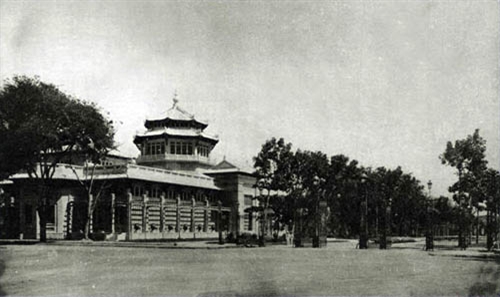
The French School of Far Eastern Studies - a French research center on Indochina in South Vietnam in 1926.
Making a significant contribution to the formation of Vietnamese social sciences and humanities.
The EFEO has made significant contributions to the formation and development of the social sciences and humanities in Vietnam. Many of the EFEO's research works on history, linguistics, literature, ethnology, religion, and archaeology have been published in Vietnam and around the world. Thousands of historical and cultural works are well managed and preserved by the EFEO, including sites that have become World Heritage sites such as the My Son Sanctuary in Quang Nam. The EFEO is the most solid bridge among many bridges of knowledge connecting Vietnamese academia with the world, especially with France.
The contributions of EFEO to the social sciences and humanities of Vietnam are demonstrated in the following key areas:Contributing to the opening of several modern social sciences and humanities disciplines in Vietnam such as Archaeology, Ethnology, Museology, and Textual Studies…with groundbreaking discoveries that have scientific value to this day;Promoting the modernization of traditional social sciences and humanities disciplines while simultaneously developing new academic fields;Contributing to the development of a team of international Vietnam studies scholars, while also contributing to the training of a generation of modern Vietnamese social scientists and humanities scholars in the 20th century;Organized numerous large-scale research programs and projects on the Neolithic Age (Hoa Binh), the Metal Age (Dong Son, Sa Huynh), ancient kingdoms (Funan, Champa), etc., and published...Bulletin de L'Ecole Francaise d'Etrême-Orient-BEFEO)and many valuable works such as "Administrative Geography of Kinh Bac" (1996), "Vietnamese Taboo Characters Through the Dynasties" (1997), "Literature and Poetry of Dong Kinh Nghia Thuc" (1997), "L'Univers des Truyen Nom" (1998), "Textual Issues of Nguyen Trai's Quan Trung Tu Menh" (1999), "Place Names and Archival Documents on Villages and Communes in Northern Vietnam" (1999)... Besides thatEFEO makes practical contributions to the collection and preservation of antiquities, the construction of modern museums, and heritage management in Vietnam.
In recent years, the EFEO has made effective contributions to introducing new research trends, perspectives, and scientific schools of thought, thereby promoting the development of Vietnam's social sciences and humanities. In this context, the University of Social Sciences and Humanities – as a leading center for social science and humanities research in Vietnam – has collaborated closely with the EFEO in many academic activities such as: organizing research programs on villages in the Red River Delta, organizing workshops in the Red River Delta region, and organizing workshops on the theory and methods of modern historical research... These collaborative activities aim to build and develop Vietnam's social sciences and humanities in a direction that is innovative, modern, and internationally integrated.
Author:ussh
Newer news
Older news

