
The closing session was chaired by Prof. Phan Huy Le (President of the Vietnam Historical Science Association), Prof. Yves Goudineau (Director of EFEO Paris), Prof. Léon Vandermeersch (former director of EFEO), and Assoc. Prof. Dr. Pham Quang Minh (Vice Rector of the University of Social Sciences and Humanities).
At the closing session, the concluding remarks once again reaffirmed the role of EFEO in the development of social sciences and humanities in Vietnam, while also highly appreciating the success of the conference as one of the manifestations of effective cooperation between EFEO and the University of Social Sciences and Humanities (VNU Hanoi) in particular, and between Vietnamese and French scientists in general.
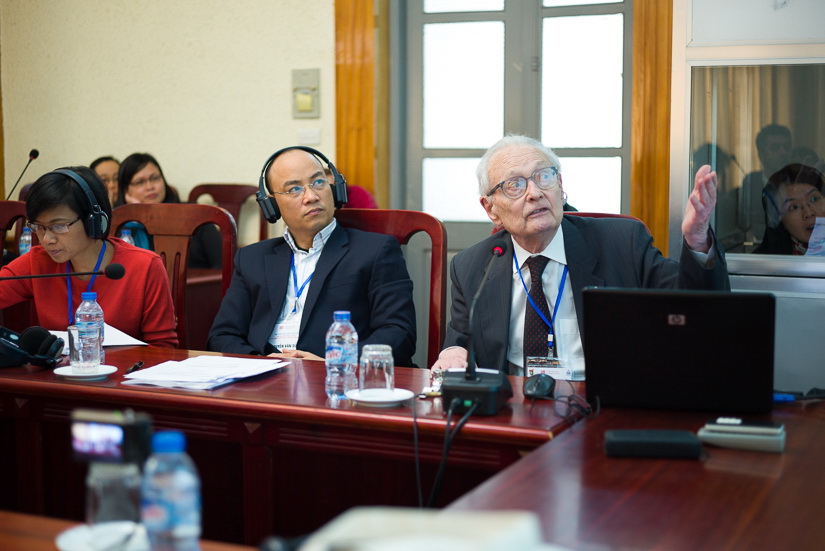
Professor León Vandermeersch (former director of EFEO) (far right)/Photo: Thành Long
Professor Léon Vandermeersch (former director of EFEO) expressed his feelings:For me, this workshop was a particularly significant event. EFEO would not have been able to achieve anything without collaborative research with Vietnamese scientists. This workshop highlighted an important aspect: the contributions of researchers from both France and Vietnam to EFEO.The veteran scientist specializing in Vietnamese studies also emphasized the close personal relationships between French and Vietnamese scientists, in addition to the cooperation between research institutions of the two countries. This close friendship is an important bridge in academic exchange between the two sides. He also expressed his pleasure at continuing to participate in collaborative scientific activities between EFEO and the University of Social Sciences and Humanities.
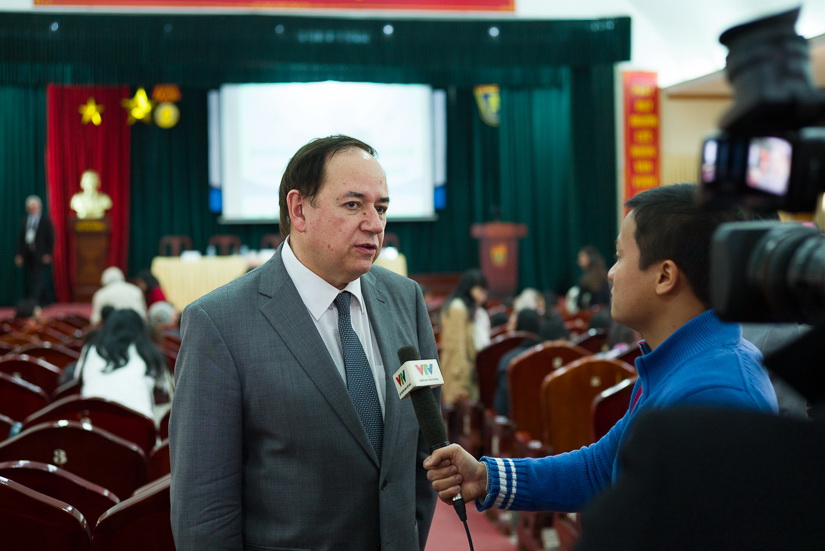
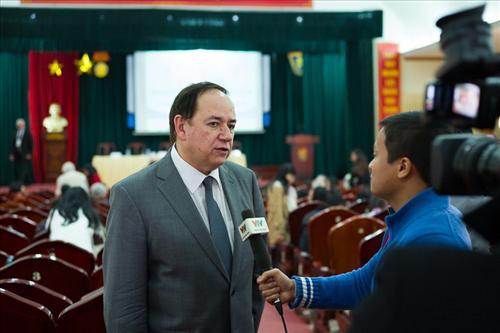
Professor Yves Goudineau (Director of EFEO Paris) answers questions from the press on the sidelines of the conference/Photo: Thanh Long
Professor Yves Goudineau emphasized the significant importance of this conference, considering it an opportunity to summarize the activities and achievements of EFEO in Vietnam, while also opening up promising new opportunities for cooperation between French and Vietnamese scientists.
In his lengthy speech at the conference, Professor Phan Huy Le devoted most of his time to discussing his personal feelings and experiences with the EFEO in Hanoi and Paris. In 1954, Professor Phan Huy Le was a lecturer in the History Department of Hanoi University, returning to Hanoi from the resistance zone after the capital's liberation. Given the lack of libraries in Hanoi's universities at the time, his first visit to the EFEO library on Ly Thuong Kiet Street left a profound impression on him. The impression stemmed from the spaciousness of the library grounds, the rich collection of books, and the friendly service of the staff. Later, as he delved deeper into the study of ancient history, Professor Phan Huy Le primarily encountered Sino-Vietnamese documents, a significant portion of which was collected and handed over to Vietnam by the EFEO in 1957. This collection included 8,368 books and over 20,000 inscriptions.In this respect, I, the Vietnamese historical community, and the entire Vietnamese people must express our deepest gratitude to the EFEO for its efforts in collecting and preserving for Vietnam a valuable part of Vietnam's Sino-Vietnamese heritage. Without this assistance from the EFEO, Vietnam's Sino-Vietnamese heritage would have suffered immeasurable losses, including precious books and inscriptions that would have been lost forever." - Professor Le said.
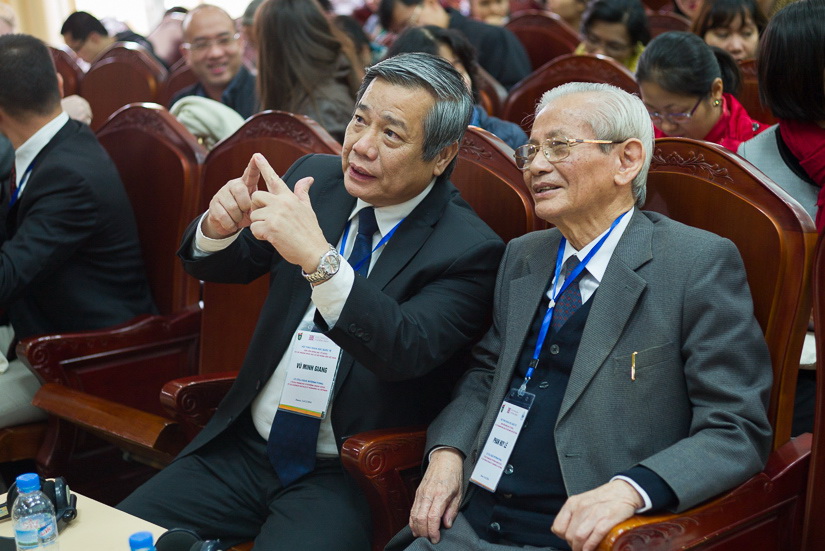
Professor Phan Huy Le (right) and Professor Vu Minh Giang (Faculty of History) at the conference/Photo: Thanh Long
In addition, EFEO has also made significant contributions to the preservation of Vietnam's tangible cultural heritage through the restoration and documentation of historical sites nationwide, especially the collection of artifacts and the construction of Vietnam's first three museums: the Vietnam National History Museum, the Da Nang Cham Sculpture Museum, and the Ho Chi Minh City History Museum.
From 1900 to 1957, during its time in Vietnam, the EFEO, through its research activities, produced works and research that contributed to the modernization of Vietnam's social sciences and humanities. The EFEO played a crucial, even decisive, role in creating the transition from traditional to modern scholarship, with a very new system of viewpoints and methodologies, not only in history but also in many later emerging sciences such as ethnology, linguistics, museology, and textual studies. From then on, historical research was conducted on a completely new scientific foundation, in close relationship with the aforementioned sciences, with approaches that were sometimes specialized, multidisciplinary, and sometimes interdisciplinary. This was a huge step forward and prepared the ground for the birth and development of the social sciences and humanities in independent Vietnam after 1945.
Since 1993, the EFEO Center has been re-established in Vietnam. Bilateral relations have been re-established within the new framework of the two countries. New research results in collaboration between EFEO and Vietnamese scholars continue to be published, both in terms of publications and staff training. In particular, the systematic publications of documents by EFEO in recent years have been very valuable. Notable among these are the "Complete Collection of Han Nom Inscriptions," "Dong Thai Du Dia Chi" (in French and Vietnamese), "Annam Techniques," and bibliographies of archived and published inscriptions in Sapa…
"Over a century has passed, and the EFEO, through its activities, its renowned scientists, and its concrete scientific works, has made a significant contribution to the study of Vietnamese history and culture."—Professor Phan Huy Le once again affirmed the important role of EFEO in the development of social sciences and humanities in Vietnam in his speech."
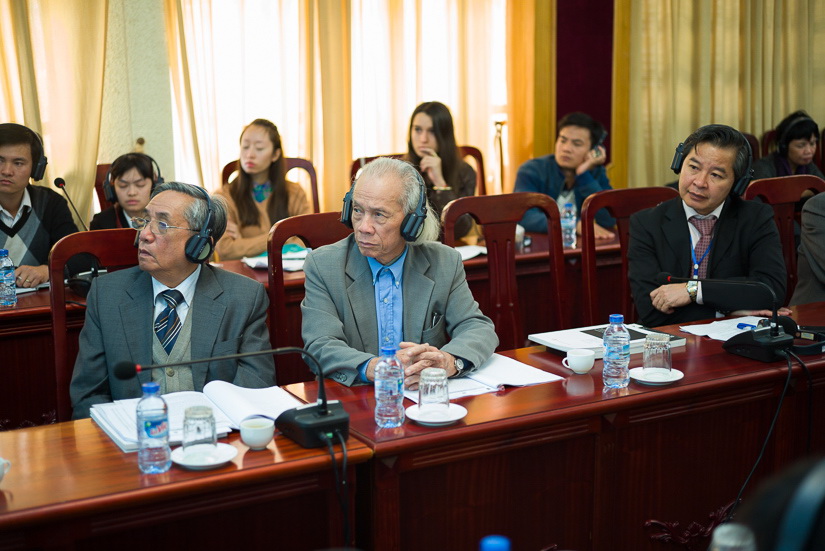
Professor Vu Duong Ninh, Associate Professor Le Mau Han, and Associate Professor Pham Quang Minh (from left to right) at the conference/Photo: Thanh Long
Representing the leadership of the University of Social Sciences and Humanities, Associate Professor Pham Quang Minh reviewed the scientific activities that the University has carried out in cooperation with French partners during the 2013-2014 Franco-Vietnamese Friendship Year. This is the fourth conference this year that the University of Social Sciences and Humanities has organized and participated in with French scientists. Associate Professor Minh affirmed that the success of the conference will be an important step to further promote cooperation between the two sides in the future.
Author:Thanh Ha
Newer news
Older news

