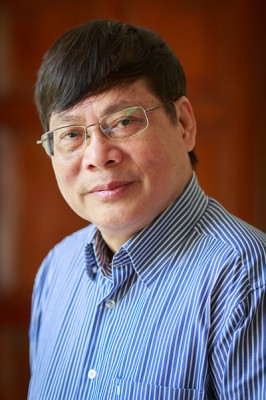
With the university entrance exam approaching, Mr. Tran Hinh (lecturer in the Faculty of Literature) shares his thoughts on current methods of teaching and learning Literature. He also offers some suggestions to help candidates perform well on the Literature exam.
- After many years of teaching and grading university entrance exams in Literature, what have you observed as the most serious mistakes students make in their current approach to studying Literature?To fully answer this question, I think it's difficult, because I'm just a "small" individual, while there are many other teachers who may have different opinions. However, if you allow me to answer frankly from a personal perspective, I assert that the most serious flaw in the way literature has been taught for so long is that students are turned into "molds," learning from "model essays." Literature in particular, and art in general, as the writer Nam Cao said, "does not need skilled craftsmen who follow a few pre-existing models. Literature only accepts those who know how to think deeply, uncover sources that no one has yet uncovered, and create something that has not yet existed." Even though Nam Cao's perspective emphasizes fictional literature, the writing of creative individuals, rather than student-style writing, I still believe that the reason why current literature education is so disastrous is because textbooks, teachers, and teaching methods tend to turn students into "machines." When writers are machines, emotions disappear, individuality vanishes, and literature becomes a "disaster." We cannot blame the students.
- So, when grading university entrance exams, what kinds of errors in Literature papers cause teachers to worry the most, sir?A common mistake students make is trying to copy model essays. Grading thousands of papers in an exam reveals that they all look very similar. However, relying solely on model essays is impossible to fully memorize. When students can't memorize model essays, they become disoriented and lose confidence in themselves. This leads to a series of essays with common flaws such as: lack of structure, unclear arguments, dry and convoluted sentences, naivety, lack of persuasiveness, and slogan-like writing. Honestly, in my nearly 40 years of grading university entrance exams, since the introduction of model essays, I've encountered many essays like these. Of course, in an examination board, you occasionally come across some truly excellent essays. These are genuinely good essays, not those written based on model essays. That's when students are themselves. They think and feel for themselves and write authentic, genuine sentences. I wish that one day we could bring the teaching and learning of Literature back to that way.
- The annual university entrance exam in Literature often includes questions requiring students to express their feelings about a poem, a character, or an issue in a prose work. With this type of question, what should candidates pay attention to in order to achieve a high score?It's true that recently, university entrance exams often feature questions asking for your personal feelings about a poem, a passage of prose, or a particular issue in one or more prose works. Specifically, university entrance exams in Literature from 2008 to the present have included numerous questions of this type: "What are your feelings about two poems from the poems 'This Village of Vi Da' and 'Trang Giang'?"; "What are your feelings about two poems from 'Tuong Tu' and 'Viet Bac'?"; "What are your feelings about two prose passages from the essays 'The Ferryman on the Da River' and 'Who Named the River?'"... In general, with this "unusual" exam question type, students should note that it's just a common essay question, not something unusual. Of course, when the question links two works or two issues together, it should be considered a comparative exam question. Students must be able to find the similarities and differences between the two poems/passages. The exam questions ask about "perception," meaning the examiners want to emphasize the students' emotional response. Therefore, with this type of exam, students can use analytical, commentary, argumentative, or interpretive methods, depending on the specific content requirements, as long as they can express the beauty, the similarities and differences in content and artistry between the poems and literary passages being compared. Students shouldn't worry too much about the word "perception" in this type of exam. However, I think that setting exam questions like this for high school students isn't really "standard." Because in the high school curriculum, there is no literary genre called "perception." It only includes analysis, explanation, argumentative, or commentary. Setting it this way will be difficult for students.
 - For many years now, the university entrance exam in Literature has included a question asking candidates to express their thoughts on a social issue. How do you evaluate this question format? Based on your experience grading university entrance exams over the years, what are your observations on how students approach this type of question, and what advice can you offer to help candidates perform their best on this type of exam?
This type of exam has actually been in use for several years now. If I'm not mistaken, I remember it starting in the 2009 exam. More precisely, it's a social commentary essay. When I took the university entrance exam [in the 1970s-1971], this type of question was very common. Now that it's being used again, many people think it's some kind of groundbreaking "innovation." Personally, I accept this approach, but I don't absolutize it. It's true that this open-ended approach can test students' social awareness and reveal their everyday thoughts. However, in reality, when grading exams of this type, I don't see that positive aspect. Most students' essays still fall into the category of "model essays," chanting slogans, repeating what teachers, textbooks, and the media have fed them, without expressing their own genuine thoughts. Even in exam questions about "honesty, hypocrisy, and deceit," I still see "dishonesty, deceit, and hypocrisy" in students' work. Therefore, in my opinion, to write a good essay of this type, students only need to sincerely present their thoughts and understanding and try to structure their writing according to the following four steps: 1. Introduction, emphasizing the key word (for example, honesty, deceit, hypocrisy, trust, indifference...); 2. Explaining the concept of the key word (what is honesty, trust, deceit...); 3. Discussing the key word in more detail; relating the key word to personal experience...
- You've graded many high-scoring literature exams before, so what's your impression of what constitutes a good essay?In short, a good essay is one that doesn't follow a template, is well-written, comprehensive, has literary quality, and is unlike any other essay of the same type. If you don't mind the length, I'm willing to provide an essay from a student taking the entrance exam for Group D at Hanoi National University in 2006; you'll then fully understand my perspective on what constitutes a good essay.
- In your opinion, what is the most important aspect of teaching and learning Literature?The goal is to teach students to appreciate the beauty and excellence of literary works. But even more important is to teach them independent thinking, the ability to read and understand specific texts, and how to express themselves fluently, accurately, passionately, and creatively in Vietnamese. I remember, though I'm not sure if it's entirely accurate, that the writer Nguyen Khai, during his lifetime, gave some excellent advice to young writers: "When reading, try to remember. When writing, try to forget." I oppose rote memorization in the subject of Literature.
- What adjustments should be made to the annual university entrance exam in Literature to better align with the above objectives, sir?We should revert to the previous exam format. Just one question per exam is sufficient. And the content shouldn't be limited to the curriculum. We should encourage concise exam questions that still effectively assess students' literary knowledge. Three criteria should be considered: understanding the issue and text in the question; fluent and clear expression in Vietnamese; and creativity in the answer, avoiding repetition from textbooks.
Thank you, teacher, for your sharing..
Essay by a student taking the entrance exam for Group D - Vietnam National University, Hanoi in 2006
Question:Express your thoughts on the tragedy of the character Vu Nhu To in the play Vu Nhu To (excerpt studied) by Nguyen Huy Tuong (exam question for Block D, 2006, 3 points).
AssignmentI will always remember the time I went to China with my parents. The feeling of standing on the land of this vast and unique neighboring country was incredibly exciting. China has countless scenic spots, places to visit, and historical sites... But perhaps the Great Wall of China is what left the deepest impressions and emotions on me. For some reason, when I stopped here and set foot on this magnificent structure, the emotions I felt when I first read Nguyen Huy Tuong's play, Vu Nhu To, flooded my mind. A mixture of pride and regret in the comparison between the Nine-Tiered Pagoda and the Great Wall of China. Isn't it a rather incongruous comparison, where one is a recognized world wonder and the other is merely a "wonder" in an architect's dream; one is tangible, enduring through the ages, while the other is just a pile of ashes in the pages of a book? It's an incongruous comparison, yet there are some fascinating similarities. The burning of the Nine-Tiered Pagoda—as Nguyen Huy Tuong put it—was that a joy or a loss? The writer doesn't know, and neither do we, because Nguyen Huy Tuong wrote the play because he shared "the same ailment as Dan Thiem." We, the readers and viewers, are merely seeking answers to the layers of tragedy the writer has depicted. The tragedy of Vu Nhu To perhaps stems from his own talent—his talent for construction, his ability to use bricks like a commander "leading troops," capable of building towering structures without a single brick being placed incorrectly; his talent for appointing the right person but at the wrong time. In aesthetic theory, tragedy is explained by the opposition between ideal and reality, the contradiction between human aspirations and the insurmountable limitations of reality. The tragedy of the character Vu Nhu To is precisely that! If only Vu Nhu To hadn't been born during the time of the tyrannical Le Tuong Duoc, a time of national turmoil and widespread suffering among the people, perhaps things would have been different, perhaps the Nine-Tiered Tower would still exist? But that's just a hypothesis, one that Vu Nhu To, if he were alive today, might still regret. We, those seeking answers, can only affirm that creation has its own logic, and Nguyen Huy Tuong also had his own. He was fortunate (or unfortunate) to meet Dan Thiem, a talented and beautiful court lady who had fallen out of favor, and who dared to burn Vu Nhu To's talent, even knowing the immense danger involved. How should we share in Vu Nhu To's tragedy—should we thank him or resent him? Nguyen Huy Tuong himself seems to have no answer. Initially, Vu Nhu To resolutely refused to build the Nine-Tiered Tower because he knew Le Tuong Duoc was a "tyrant and a cruel ruler." However, it was Dan Thiem who advised him to take this opportunity to build a Nine-Tiered Tower, "a masterpiece of exquisite craftsmanship." Vu Nhu To followed her advice, and as in the play, at the end, while the Nine-Tiered Tower was still unfinished, rebels led by Trinh Duy San rose up, killed the king, Dan Thiem, and Vu Nhu To, and burned the tower down. Why did this happen? Answering this question will help us to some extent explain the tragedy of Vu Nhu To, although it is not easy, because Nguyen Huy Tuong himself once admitted his confusion: "Alas, was Vu Nhu To right or were those who killed Nhu To right? I don't know - holding the pen is merely the same ailment as Dan Thiem." The tragedy of Vu Nhu To stems from a class tragedy: the king's debauchery and the people's suffering. Vu Nhu To did not belong to the ruling class, but for the sake of the Nine-Tiered Tower and for the sake of Beauty, he had to use power. The people suffered greatly, countless people lost fathers and sons because of the "artistic project" of the Nine-Tiered Pagoda. Therefore, in everyone's eyes, the hatred was mainly directed at Vu Nhu To. Some also argue that the people were "misguided" in directing their hatred in the wrong place. As for Vu Nhu To, who was so obsessed with beauty, perhaps he did not foresee the full extent of this tragedy. His tragedy is the tragedy of the conflict between beauty and reality, the tragedy of an artist who cannot reconcile the "heavenly realm" with the "place of suffering." Vu Nhu To focused all his efforts on the Nine-Tiered Pagoda without paying any attention to how much the "common people" and soldiers suffered. Even out of concern for the Nine-Tiered Pagoda and for its beauty, he ordered the execution of those who tried to escape. On one side is class conflict, on the other is artistic conflict; ultimately, which conflict will be resolved? The tragedy of Vu Nhu To ultimately lies in the fact that resolving one conflict doesn't resolve the other. Perhaps that's why even the writer Nguyen Huy Tuong couldn't find an answer? At the end of the play, the king is killed, the Grand Scholar Nguyen Vu commits suicide, the class conflict is pushed to its climax, and the class issue is, in a way, resolved. But the conflict of the artist Vu Nhu To, even as he faces execution, seems to remain unchanged: "Oh, Dan Thiem! Oh, the Nine-Tiered Tower!" At the end of the play, Vu Nhu To's agonizing, desperate cries still resonate in the hearts of readers and viewers. Indeed, Vu Nhu To was superior in his talent and his complete dedication to art. When Dan Thiem sincerely advised Vu Nhu To to flee, otherwise he would lose his life, he resolutely refused, remaining devoted to the Nine-Tiered Tower: "My soul is here, where else would I go?" Thus, Vu Nhu To's superiority was also his inferiority. The artist failed to recognize the times, unable to distinguish right from wrong within his own artistic world. Was that exquisite beauty worth the blood and bones of the people? Vu Nhu To only focused on pure beauty, even if it was a beauty that would last forever. Meanwhile, the people only judged beauty in relation to its usefulness in life. Two sides of the same coin, yet an irreconcilable contradiction. Beauty is eternal, but alas, the people could not understand it. They insisted on killing Vu Nhu To – the man who harmed so many families – and on destroying the Nine-Tiered Pagoda – the extravagant and costly structure that Vu Nhu To was painstakingly building. The tragedy doesn't end; it temporarily stops at an irreconcilable contradiction, and if it remains unrecognized, it will be a tragedy for generations to come. Beauty must go hand in hand with human life; beauty cannot be separated from usefulness. I am deeply troubled to wonder, will Vu Nhu To understand this in the afterlife? Can we understand that, even when captured and bound, Vu Nhu To still harbored the dream of building the Nine-Tiered Tower? Can we understand that even Thi Nhim, Vu Nhu To's wife, still considered him cruel and turned her back on her husband? Can we...? Can we...? But perhaps there's no need to ask so many more questions. After all, the tower has crumbled, and the tragedy of Vu Nhu To has already unfolded. We, readers who cherish the writer Nguyen Huy Tuong, should remember Vu Nhu To with the words of Dan Thiem: "Oh, Mr. Ca! Let us bid you farewell forever." After reading Vu Nhu To, I felt a sigh amidst a whirlwind of emotions. A sigh like a thin wisp of air, a gentle breeze and it would fly away. Tragedy upon tragedy, the tragedy between building and not building, living and not living, beauty and suffering, art and life... It's a pity for Vu Nhu To, for Dan Thiem, for Nguyen Huy Tuong, and for all of us: the Nine-Tiered Pagoda could not be built, Nguyen Huy Tuong could not find the answer, and we did not get to admire the artistic masterpiece, "a painting of exquisite craftsmanship," by this talented artist. I imagine Vu Nhu To one day standing on the Nine-Tiered Pagoda, where warm winds will return, and, high above, a kite is soaring in the wind...