
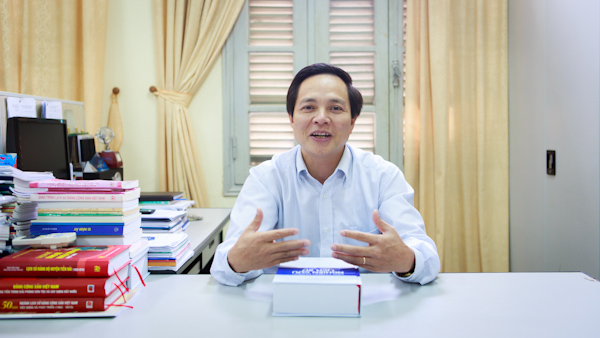
Dr. Nguyen Quang Lieu (lecturer at the Faculty of History - University of Social Sciences and Humanities) commented on the 2012 university entrance exam in History: “This year's university entrance exam in History was highly comprehensive, covering the basic knowledge of Vietnamese history from 1919-2000 and world history from 1945-2000. The questions were clear and did not trick students.”
Regarding question 1, according to Dr. Nguyen Quang Lieu, this is a simple question that tests basic knowledge, so students should easily answer it. For question 2, candidates need to be able to distinguish between five main periods: - The period of the movement to establish the Communist Party of Vietnam (1919-1930). - The period of the struggle for power (1930-1945). - The period of resistance against French colonialism (1945-1954). - The period of simultaneously carrying out two strategic revolutionary tasks for the goal of liberating the South and unifying the country (1954-1975). - The period 1975-2000: the transition to socialism and the successful implementation of the Doi Moi (Renovation) process. This is a very good question and clearly distinguishes candidates. This is also the first time the exam requires students to have an overview of Vietnamese history and the skill to distinguish between historical periods. According to experienced instructors, this is also a very weak area of knowledge and skills for current history students, so achieving a good score on this question will not be easy. Few candidates will be able to answer this question correctly; most tend to get bogged down in recounting events and dates, resulting in an incorrect answer and wasted time. This question requires comprehensive knowledge; those who answer it well demonstrate a deep understanding of Vietnamese history and good test-taking skills.

Regarding the second part of question 2, students must carefully read the question and understand that the strongest fortified complex mentioned in the exam is the Dien Bien Phu stronghold, which the French colonialists once considered an impregnable fortress. Therefore, the period the exam requires summarizing is the period after the 1953-1954 Winter-Spring campaign until the Dien Bien Phu campaign. If the question is understood, this question is not difficult, but candidates can easily get bogged down in lengthy and unnecessary information. Question 3, according to Dr. Nguyen Quang Lieu, is relatively clear, suggesting the end of March 1975 as the time when the Central Highlands campaign was completely victorious and opened a new phase, developing from a strategic offensive in the Central Highlands to a general strategic offensive throughout the South. After the victory of the Central Highlands and Hue-Da Nang campaigns, the Central Committee of the Party assessed that the strategic opportunity had arrived, and we had the conditions to quickly fulfill our determination to liberate the South. From there, the Central Committee of the Party decided that "the fastest concentration of forces, weapons, technology, and materials is necessary to liberate the South before the 1975 rainy season." For question 4a, candidates must first identify the period of the Cold War, and then present Japan's foreign policy during that time, specifically the periods 1947-1952, 1952-1973, and 1973-1989. Regarding question 4b, this is the clearest and easiest question for candidates to understand. Candidates only need to grasp India's nation-building efforts from the establishment of the Indian state in 1950 to 2000. Candidates should present India's major achievements in three main areas: economy, science and technology, and foreign policy – this part is already clearly presented in the 12th-grade History textbook. Based on the above analysis, Dr. Nguyen Quang Lieu stated: Overall, the exam questions were not difficult, and the content was very clear. The exam also emphasized important events of each historical period. Questions 1 and 4b were the easiest to answer; questions 2, 3, and 4a each had a point that required further reasoning from the candidates to answer correctly. In particular, the first part of question 2 was a key question designed to differentiate between good and excellent students. Regarding the predicted score distribution, Dr. Nguyen Quang Lieu said: “In my opinion, scores from 4.5 to 5.5 will be the majority, scores from 0-2 will be very rare, but there will certainly be some very high scores in History, such as 9 or 9.5.”
Author:thanhha
Newer news
Older news

