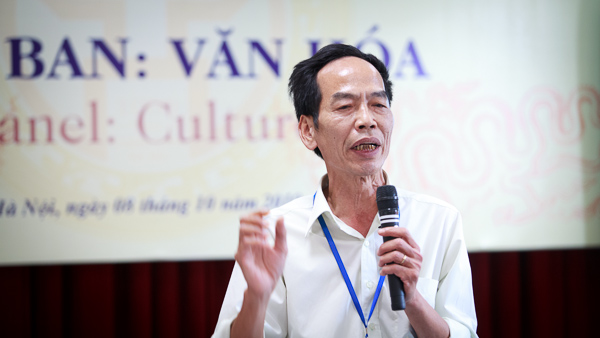
In 1981, for various reasons, the students of our 26th cohort in the History Department enrolled late. Fortunately, on our very first day as students, we had the opportunity to hear Professor Tran Quoc Vuong teach us about archaeology using an interdisciplinary approach. It can be said that the extraordinary appeal of those first lectures by the dedicated and talented professors and scientists of the History Department kept many of us in the department and inspired us to follow in their footsteps in history, teaching history, and so on.During that first year of university, we also studied with Professor Nguyen Hai Ke. He taught us about the Lam Son Uprising. What still impresses me to this day is his unconventional teaching style and way of thinking about the causes and motivations of the uprising, and the miraculous transformation of the uprising from a local movement into a national liberation movement. He taught little, just one lesson, but I remember it forever! Yet, more than 30 years have passed, and we, his classmates, now have graying hair and are in our fifties, knowing the will of Heaven. According to the academic system of that time, we no longer had the opportunity to study with him. The history of our nation, as well as world history, has turned a new page. However, we still know him as a renowned youth union activist at the University of Hanoi. For many years, he played a key role in organizing and leading the youth union activities of the History Department, then the youth union movement of the University of Hanoi, and the Hanoi Youth Union. While simultaneously teaching, conducting research, and publishing his first research papers, Professor Nguyen Hai Ke held the positions of Secretary of the Youth Union of the Faculty of History, Deputy Secretary and then Secretary of the Youth Union of Hanoi University, Member of the Party Committee of Hanoi University, and Member of the Executive Committee of the Hanoi City Youth Union. Amidst the countless difficulties facing the country at that time, overcoming immense challenges: "Floods in the North, floods in the South, bloodshed on the border – Hands against the sky, hands against the water, straining muscles," the movement for learning, research, and socio-political activities of the youth of Hanoi University always remained a leading force among universities nationwide. In the midst of these difficulties and challenges, many generations of educators, scientists, and administrators – who were once staff and students of Hanoi University – have matured and become individuals who have made significant contributions to the country and society. That remains a source of pride for the University of Hanoi, contributing to one of the exemplary values of a fundamental university, renowned for its scientific research achievements. And it was precisely in that difficult and challenging environment, in the face of great endeavors, that people had to suppress and sacrifice personal thoughts and interests to focus on the common goal, accepting the organization and maintaining discipline. A close friend of ours, a fellow student from the same hometown as Professor Nguyen Hai Ke, still cherishes the memory of being severely criticized by Professor Nguyen Hai Ke for his lack of planning and organization in student union activities! I also know that my friend was not the only one who received such criticism from the Professor. In 1987, after temporarily leaving the university lecture halls and vibrant student union activities, and after many sacrifices and contributions, Professor Nguyen Hai Ke was sent by the University of Hanoi to study in the Soviet Union. During his nine years of study and research at the Soviet Academy of Sciences, Professor Nguyen Hai Ke successfully defended his doctoral and postdoctoral dissertations. In 1996, Professor and scientist Nguyen Hai Ke returned to his alma mater, his teachers, colleagues, and students. He taught classical history while also contributing to the development of a new training specialization within the Faculty of History: Vietnamese Cultural History. In this new scientific field, he found a source of energy and motivation for development. In this relatively new area of expertise, Professor Nguyen Hai Ke clearly demonstrated his capabilities, passion, and contributions as a specialist in Cultural Studies.

Throughout the long history of Vietnamese culture, educator and researcher Nguyen Hai Ke has consistently made new discoveries, deeply reflecting his personal imprint. In his university lectures, research papers, and media coverage, he has always been deeply concerned with the fundamental values of national culture, with cultural transformations and exchanges, with the principle of "Mother," and with the diverse nuances between different cultural layers, regions, and spaces within a Vietnamese culture rich in humanistic values and unity. Works such as: "An Ancient Vietnamese Village in the Northern Delta," "Hai Phong - A Forgotten Land During the Early Le Dynasty," "Approaching Vietnamese Identity from a Guide by Ho Chi Minh," "Southern Vietnamese Characteristics in 19th-Century Vietnamese Culture," and his co-authored and edited works on the countryside of Hai Phong, Thanh Hoa, Thai Binh, Nam Dinh, and Thang Long - Hanoi… have left a strong mark and established his reputation as one of the leading experts in Vietnamese cultural history. During his years as Head of the History Department and concurrently Head of the Cultural History Division, and Vice President of the Hanoi Historical Society, scientist Nguyen Hai Ke made many important contributions to the development of the History Department and the History field, especially in maintaining the tradition of a Heroic Labor Unit during the period of reform. As an administrator and a teacher, Professor Nguyen Hai Ke left a deep impression and affection on his students and colleagues with his simple, warm, sincere, approachable, and deeply loving lifestyle. Many of his undergraduate, graduate, and doctoral students, whom he cared for like the most beloved people, have now grown up and many have become researchers, teachers, and administrators holding responsibilities in society. Upon learning of Professor Nguyen Hai Ke's serious illness, many students from universities, research institutes, and even from rural areas, as well as friends and colleagues, gathered at Military Hospital 108 to visit him, care for him, and worry about his health. The affection, respect, and sorrow of his colleagues and fellow students for Professor Nguyen Hai Ke in recent days have been profound! Perhaps, along with the titles he received, the affection and sorrow of his students and colleagues are the most precious honor he received before his passing. With 60 years of life and 36 years of professional experience, Professor Nguyen Hai Ke dedicated himself to research in the fields of history and national cultural history. His deep knowledge of Chinese studies and his foundation in history served as a foundation and support for his creative thinking in the study of Vietnamese culture and cultural history. In the minds of his friends and colleagues, Professor Nguyen Hai Ke was always a man of immense intellectual resources, always loving and valuing people, respecting the character of his students, and wholeheartedly dedicated to caring for their growth, sharing in their difficulties and hardships within the Faculty of History. From now on, the lecture halls will be silent, devoid of his eloquent, passionate, and unconventional lectures. The campus will be empty of him, a simple man with a tall, thin build, who loved smoking, was addicted to cigarettes, and whose discourse was always captivating. Spring is in full bloom, and he has gone, leaving an irreplaceable void in the hearts and minds of his family, generations of students, and colleagues!