Studying Sino-Vietnamese studies will help you become a bridge between the ancient and the modern.Tran Thanh Nga, born in 2001 in Hanoi, is a final-year student majoring in Sino-Vietnamese Studies, Faculty of Literature, University of Social Sciences and Humanities - Vietnam National University, Hanoi. She recently won the USSH Youth Awards 2023 in the field of Academic Achievement and Scientific Research.
2023 Youth Humanities Award in the field of Learning and Scientific Research
When Thanh Nga introduced herself as a student majoring in Sino-Vietnamese studies, most people were surprised because relatively few knew about this field, and they asked many "funny yet frustrating" questions. In response to these questions, she usually answered simply: "Sino-Vietnamese studies is a field of study that researches the history and culture of Vietnam and other culturally similar countries based on documents written in Chinese and Nom script."
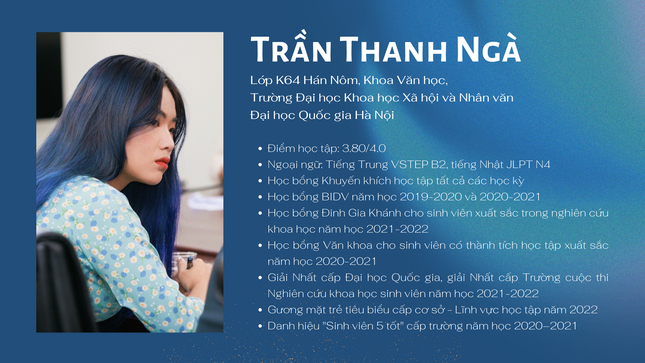
Some notable achievements of Tran Thanh Nga
Sharing her reasons for choosing Sino-Vietnamese studies, Thanh Nga said that when selecting her major, she read an interview with Dr. Dinh Thanh Hieu, Head of the Sino-Vietnamese Studies Department, Faculty of Literature, University of Social Sciences and Humanities - Vietnam National University, Hanoi. In it, Dr. Hieu commented that Sino-Vietnamese studies plays a role as a "bridge between traditional and modern cultural values," providing students with both knowledge and ethical values.
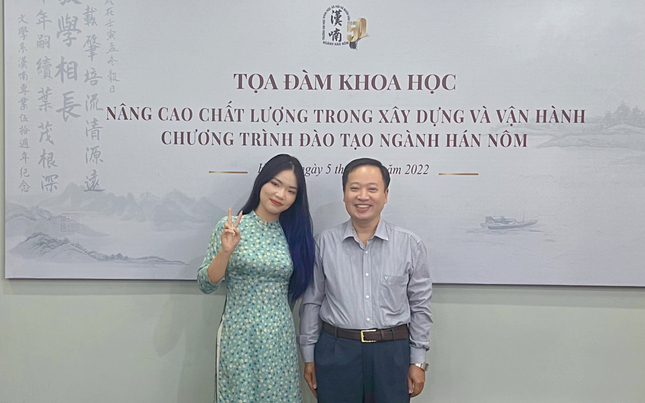
Thanh Nga and Dr. Dinh Thanh Hieu
Impressed by that statement, and recognizing that the teaching objectives of the major aligned with her personal interests, Thanh Nga decided to choose the field of Sino-Vietnamese Studies. This is a field of study that connects the ancient and the modern, so it requires certain standards from students.
First, it involves memorizing Chinese characters, transcribing them, and translating some ancient texts. Higher demands may include understanding the ideas and political viewpoints of philosophers from various schools of thought.
When she first started studying, Thanh Nga was truly overwhelmed by the number of Chinese characters she needed to memorize, the amount of knowledge she had to learn, and the length of each teaching material. For a freshman like her, who didn't have a solid foundation in Sino-Vietnamese studies, memorizing and learning traditional Chinese characters was incredibly difficult. However, this was the foundation for learning more advanced knowledge, which made her feel she needed to study even harder.
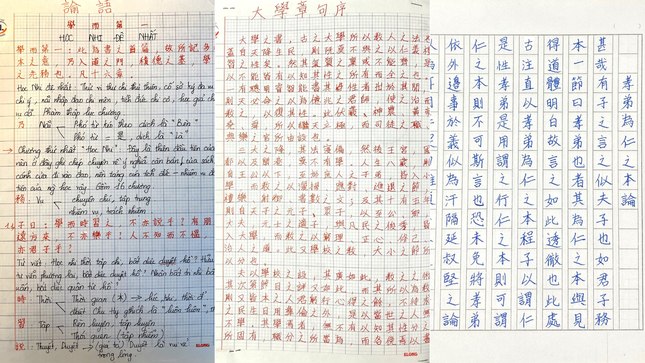
Her initial Chinese and Vietnamese characters were not standard, beautiful, and contained many errors. Faced with this difficulty, Thanh Nga was determined to practice writing, rewriting them many times until she memorized the characters and how to write them. Gradually, as she memorized more characters, her handwriting became more confident, graceful, clear, and neat.
These are Thanh Nga's handwriting practice samples (from left to right) from her first to third year of university.
“The specialized subjects were carefully selected by the professors to instill in us many beautiful humanistic values of our ancestors. The knowledge gained from this field has helped me change a lot in my thinking and way of life. For me, this is the most valuable thing that the Han Nom Studies major has given me,” she shared.
Thanh Nga likens her field of study to a key that unlocks the treasure trove of ancestral cultural traditions. According to her, in today's era of integration and development, preserving and promoting national identity is extremely important. Sino-Vietnamese script (Hán Nôm) is one of the solid foundations upon which Vietnamese people can build a culture rich in national identity.
She believes that, in order to excel in the field of Sino-Vietnamese studies, students need to possess two qualities: a passion for learning about tradition and a talent for literature.
Passionate about scientific research, with a dream of helping underprivileged children.In 2022, Thanh Nga was one of two students from the University of Social Sciences and Humanities whose student research project received an award from the Vietnam National University, Hanoi. Her research topic, "The Pre-Learning Etiquette in Ancient Elementary Education: A Study of the 'Ming Lun' Chapter in the Book of Elementary Education by Zi Zhu Zi," won first prize at the Vietnam National University, Hanoi, and was subsequently developed and published in the commemorative book of the "2022 Han Nom Studies Conference."
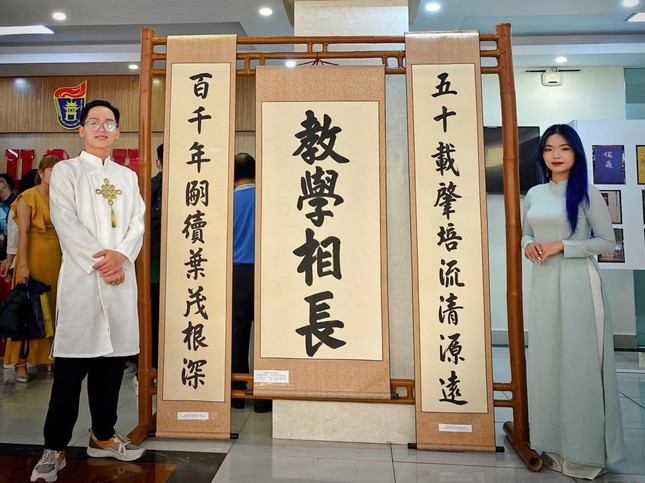
At the 50th anniversary celebration of the Han Nom Studies program, November 2022
Currently, Thanh Nga is interested in and conducting several research projects on Confucian classics in Vietnam. Although this is a direction that many researchers have been pursuing, she believes that scientists must always find new perspectives to diversify their approach to the subject.
Thanh Nga hopes that her subsequent research papers will continue to be read and receive feedback and critical comments from the public. From this, a young person like her will gain more profound experience on her scientific research journey.
"Scientific research is not a smooth road paved with roses, but I will continue to pursue it after graduation. Because, through the research process, I can understand more principles and gain more knowledge. I hope that I can go as far as possible on this path," Thanh Nga confided.
Classical Chinese and Vietnamese script studies often involve extensive work with documents and books, leading some to believe it's rather boring. Others think that students majoring in Classical Chinese and Vietnamese script simply sit still and participate in few extracurricular activities.
But that's not the truth. During her studies, Thanh Nga always fully participated in programs and events organized by the Youth Union and Student Association. She also received the "Excellent Student" award at the school level. Thanks to her involvement in the Youth Union and Student Association, she gradually developed a passion for volunteering, especially in protecting and helping children.
Thanh Nga during some of her student activities.
During her extracurricular activities, she became acquainted with many students who shared her interest in learning about Asian cultures. They shared a wealth of interesting knowledge with diverse perspectives, which was invaluable to her in her research and development.
Thanh Nga is expected to graduate from university this July. She is looking for opportunities to teach in remote areas, helping children in disadvantaged regions access knowledge. This has been her dream since she first entered university. After that, she plans to pursue a master's degree in Sino-Vietnamese studies to continue her path to becoming a researcher.
-------------------------------------
Let's learn about the Han Nom Studies program, part of the Faculty of Literature, University of Social Sciences and Humanities, Vietnam National University, Hanoi. here
Information about the training program
Name of the training program:
+ Vietnamese: Sino-Vietnamese
+ English: Sino-Nom
Degree awarded: Bachelor's
Training duration: 4 years
Name of the diploma:
+ Vietnamese: Bachelor's degree in Sino-Vietnamese Studies
+ English: The Degree of Bachelor in Sino-Vietnamese
Career opportunities
Specialist in collecting and preserving Sino-Vietnamese texts.
- Research specialist in ancient texts, historical relics, and folklore.
- Teaching Sino-Vietnamese script and Chinese language in schools.
- Chinese translation and interpretation services for government agencies and businesses.
- Editors at newspapers and specialized magazines, Chinese language tour guides, etc.
Opportunities for further learning and professional development after graduation.
After graduating from university, depending on their abilities and needs, students can continue their studies at higher levels (Master's and Doctoral degrees in Sino-Vietnamese Studies) at training institutions within and outside Hanoi National University.