
That was the title of the seminar jointly organized by the Student Dormitory Center of Vietnam National University, Hanoi and the Center for Psychological Support and Counseling of the University of Social Sciences and Humanities at the Me Tri Dormitory Cultural Center on the evening of July 2, 2008.
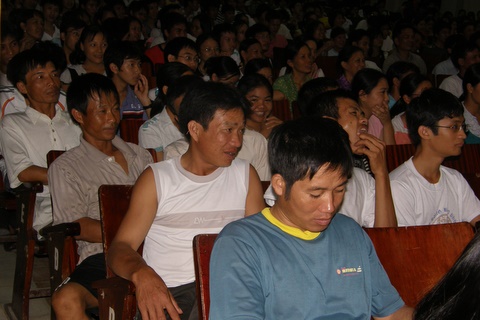
That was the title of the seminar jointly organized by the Student Dormitory Center of Vietnam National University, Hanoi and the Center for Psychological Support and Counseling of the University of Social Sciences and Humanities at the Me Tri Dormitory Cultural Center on the evening of July 2, 2008.
The seminar featured direct discussions, consultations, and dialogues with many leading experts in psychology, nutrition, and mental health in Vietnam. The goal of the seminar was to help candidates relieve psychological stress, learn how to recognize, prevent, and alleviate stress caused by academic and exam pressure, help them manage their study and rest time effectively, and share experiences on exam preparation, nutrition, and medical care to help them achieve the best possible results in the exam.

That was the first message the show's guests wanted to convey to the contestants. According to Dr. Dinh Dang Hoe (Institute of Mental Health, Bach Mai Hospital), "Stress" or also known as "psychological traumaStress refers to events and phenomena that occur in everyday life, strongly impacting people's psychology and causing negative reactions such as anxiety, loss of composure, sadness, and depression. This is a very normal psychological phenomenon that can occur anytime, anywhere, and each person experiences stress in different circumstances. Because stress is unavoidable in life, the question is how to cope with it. Dr. Dinh Dang Hoe gave the simplest example of stress: the cry of a newborn baby upon first contact with the environment outside the mother's womb – an instinctive reaction to the first stress of a person's life.
Regarding a candidate's question:How to live with stress?"Dr. Dinh Dang Hoe offered this advice:Don't dwell on the past or worry about the future; focus on what you need in the present. Then you'll know what to do to solve your problems."
Agreeing with Dr. Dinh Dang Hoe's viewpoint, Associate Professor Dr. Nguyen Huu Thu (Head of the Psychology Department) further stated that stress at a "moderate" level can even have positive effects on people. For exam candidates, a little anxiety and psychological pressure will make them more diligent and hardworking in their studies. At a higher level, when experiencing anxiety in sudden situations, people often exhibit biological symptoms such as trembling limbs, dizziness, palpitations, stuttering, etc., and psychological symptoms such as sadness and lack of energy to work.If so, then you need to learn how to regain your balance using simple but effective relaxation techniques."—Associate Professor Dr. Nguyen Huu Thu shared.
According to MSc. Tran Thanh Nam (lecturer in the Psychology Department), when people lose their composure in the face of a sudden incident, they become overwhelmed, tremble, and lose self-control. In such situations, applying a few quick and simple relaxation techniques can be highly effective, such as: closing your eyes and slowly counting from 1 to 10, gently massaging the area around your eyes to relax the muscles, create a feeling of comfort and ease, and reduce stress immediately.

From our observations, most of the candidates and parents attending the seminar were curious but rather shy and unfamiliar with the process. However, when guided through the relaxation exercises by Mr. Tran Thanh Nam, almost everyone participated enthusiastically. The entire hall fell silent; everyone closed their eyes, breathed rhythmically, and relaxed their bodies to the gentle, steady guidance of Mr. Tran Thanh Nam:...Sit up straight, close your eyes, breathe rhythmically... and gently sway your head... Do you feel a cool stream of water flowing down your neck and onto your shoulders?... Now, relax your shoulder muscles, like this..."And so, relax, unwind, imagine... 30 minutes later, the exercise ended. Everyone seemed to awaken. Although the large, noisy hall wasn't the ideal environment for this psychological-biological practical exercise, the results were very positive. When asked, a girl named Linh from Phu Tho shyly replied:I felt quite comfortable, thank you to the teachers and seniors."
As the seminar progressed past its halfway point, many candidates submitted questions on paper or boldly asked for advice directly from the experts in the auditorium. This shows that pre-exam stress is quite common among candidates, but clearly they didn't have many opportunities to relieve stress and receive helpful advice on this issue.
One question that many candidates are interested in is:There's always the feeling of not having finished studying before the exam, and this causes anxiety and stress. So, should we utilize every moment to study day and night, right up until the exam?"?" Associate Professor Dr. Nguyen Huu Thu advised: "Learning is a long process, and you must prepare for the university entrance exam well in advance, even during your studies at each grade level. Only then will you have confidence in yourself and approach the exam proactively. If you are still anxious with only a few dozen hours left before the exam, it will only harm you. According to Associate Professor Dr. Nguyen Huu Thu, burying yourself in books until the very last hour is the wrong approach. Instead, candidates should relax and enjoy extracurricular activities to relieve stress, create a refreshed spirit, and maintain mental clarity before the exam."Constant worrying will kill your health and your spirit."—Associate Professor Dr. Nguyen Huu Thu warned candidates about the dangers of endless and unplanned exam preparation."
[img class="caption" src="images/stories/2008/7/07/p7022006.jpg" border="0" alt="Assoc. Prof. Dr. Nguyen Huu Thu: Burying yourself in books until the very last hour is a mistake" title="Assoc. Prof. Dr. Nguyen Huu Thu: Burying yourself in books until the very last hour is a mistake" width="187" height="280" align="right" ]A common health problem among students during exam periods is dizziness, lightheadedness, and even fainting within minutes. In response, Dr. Dinh Dang Hoe explains that if this only occurs during exam preparation and not beforehand, it could be considered a sign of stress. Dr. Hoe believes this is due to students studying excessively without sufficient rest, leading to fatigue. Specifically, studying too much and sleeping too little—not getting the minimum 6-7 hours of sleep per day—is quite common during exam preparation. Students can only overcome this by adjusting their study schedule to maintain a normal circadian rhythm.
Another rather interesting question that captured the audience's attention was:How can you tell if you're overconfident or overconfident before an exam?Associate Professor Dr. Nguyen Huu Thu stated: Confidence is especially important for a person's success in all circumstances. Confidence stimulates creativity, bringing passion and inspiration to one's work. Confidence helps candidates abandon conventional methods that rely solely on textbook knowledge to find new and innovative solutions to a problem, and to appreciate and understand the unique and profound ideas when analyzing a poem. Only confidence can lead to exciting and miraculous moments of "exceeding expectations." However, confidence is only based on actual ability, which is the knowledge and experience gained through a serious, long-term, and effective study plan with significant investment of time and effort. Confident people always know who they are, where they stand, what they have, and what they need to do in specific situations. In contrast, those who are overconfident before an exam always think everything will be easy without much effort. They are always hasty and impatient, neglecting the most basic knowledge and never having a concrete, long-term plan for their goals. That cannot lead to success.
That's the advice Dr. Dinh Dang Hoe gave to the candidates. Based on his 31 years of experience in the field, Dr. Hoe said that every year he encounters cases of candidates vomiting and having stomachaches during university entrance exams. He believes this responsibility primarily rests with the parents. Regarding eating habits, MC Bich Ngoc recounted a regrettable true story from last year's exam: to celebrate her son's successful first attempt, the father and son allowed themselves a few beers during lunch. As a result, they both overslept and missed the exam, having to abandon their dream of going to university due to this avoidable oversight.
According to Dr. Hoè, for many candidates and parents, nutrition during exam season is limited to eating sticky rice with black beans, green beans, or red beans for good luck, avoiding sticky rice with peanuts for fear of getting off-topic, and not eating noodles or pho for fear of being too long and tedious...If simply eating sticky rice with beans could get you into university, then that would be incredibly cheap."—Dr. Hoè humorously criticized this misconception. Another common misunderstanding is that as exam days approach, parents go to great lengths to find delicious, unique, nutritious, and even expensive foods to nourish their children. Some parents even compete with each other, trying to find what other families are feeding their children, hoping their own children won't fall behind during these important days. But in reality, the results are not as good as expected; in many cases, children don't get used to it and even suffer from digestive problems."
So, what kind of diet is appropriate during exam days? According to Dr. Hoè, the simpler the diet during exam days, the better, based on the criteria of: sufficient nutrition, hygiene, and especially...Use what you're familiar with, and don't use what you're unfamiliar with."In addition, parents should allow their children to maintain normal eating habits during these days, especially light and moderate meals, avoiding overeating or forcing themselves to eat, which will help the digestive system function smoothly. This is crucial for ensuring good health during the exam period."
Author:thanhha
Newer news
Older news

