
On March 14, 2009, during a live admissions counseling program of Hanoi National University on VTV2, Associate Professor Dr. Vu Quang Hien (Faculty of History - University of Social Sciences and Humanities) provided detailed advice to students on how to study and test-taking skills for the History subject. The University of Social Sciences and Humanities website would like to summarize the content of this response.
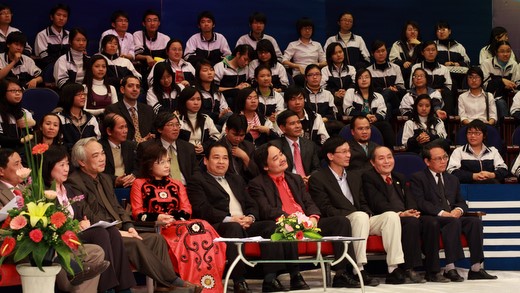
On March 14, 2009, during a live admissions counseling program of Hanoi National University on VTV2, Associate Professor Dr. Vu Quang Hien (Faculty of History - University of Social Sciences and Humanities) provided detailed advice to students on how to study and test-taking skills for the History subject. The University of Social Sciences and Humanities website would like to summarize the content of this response.
Some people believe that History is a subject that can be passed any exam simply by memorizing the textbook. This notion is completely wrong. If that were the case, students could simply buy textbooks and memorize them at home, without needing to go to school. "Rote learning" is a phenomenon that needs to be combated throughout the entire teaching and learning process, as well as in testing and evaluating learning. Current forms of testing and evaluating students' learning abilities are designed to assess their understanding and application of knowledge, that is, their ability to select, analyze, synthesize, compare, and evaluate historical events and processes.
During the review process for high school history, students should pay attention to the following points:
Understanding, exploring, and creating are the hallmarks of learning history. When reviewing history, you should always ask yourself and answer three basic types of questions:
Students need to rephrase or write down their answers on paper, not just imagine them in their heads. They are not allowed to use any materials while writing. After writing, they should compare their answers with the provided materials to correct any errors. If there are many mistakes, they need to review the material and rewrite it.
It is noteworthy that students are not required to present every historical issue mechanically, word for word, exactly as in the textbook. They can change the wording and structure, as long as the content is accurate. Furthermore, they can present knowledge not found in the textbook.
 |
1. Analyze the questions in the exam.
You must read and understand every word of the question precisely. In an exam, a well-structured question will not contain any "superfluous" words. Read the question carefully to determine the time, place, historical content, and the question's requirements (presentation, comparison, explanation, analysis, evaluation, etc.).
2. Allocate your time wisely.Based on the score for each question, allocating approximately 15 minutes per point is appropriate.
3. Create an outline.
Treat each question like a short essay. Create an outline, identify the main points, and determine their order. Then, write the introduction. Don't spend too much time thinking about it. Once you've determined the content, you'll know how to write the introduction, and it should be direct and concise. After writing the entire content, you'll know how to conclude. Don't think about the conclusion beforehand, and keep it brief.
In terms of form, not everyone can write beautifully or construct eloquent sentences, but try to write clearly, using correct sentences and spelling, avoiding clichés, verbosity, and abbreviations. Always remember: Correct, complete, and clear – that's good; simple language – that's good.
1. Off-topic, excessive or insufficient basic knowledge.This is a fairly common error. For example, when answering the question: Present the activities of Nguyen Ai Quoc abroad in the 1920s of the 20th century, there were the following mistakes: (1) Presenting Nguyen Ai Quoc's activities in seeking a way to save the country from 1911 to 1920 (off-topic, incorrect basic knowledge, because the time period was not correctly identified); (2) only presenting Nguyen Ai Quoc's activities in France and the Soviet Union from 1920 to 1924 (missing basic knowledge, lacking events in the years 1924-1929); (3) Presenting unnecessary events from 1917 to 1919 (redundant).
Sometimes the exam question asks for an "explanation" or "analysis," but the answer only requires a "presentation."
To overcome this problem, it is necessary to carefully read the exam question, clearly identify the requirements, and prepare a preliminary outline before writing the essay.
2. Confusing events between different periods and stages of history.Some candidates wrote: “One of the conditions for the outbreak of the Vietnamese revolutionary movement in 1930 was the leadership of the Party, the Government, and President Ho Chi Minh” (At that time, there was no Government, and Ho Chi Minh was not yet President). Or: “The Dien Bien Phu campaign brought the August Revolution to success.” “The August Revolution of 1945 was successful thanks to the correct leadership of the Vietnam Labor Party” (the Party only acquired this name in 1951).
The main reason is a lack of alertness, or losing composure, failing to think things through before writing. Sometimes it's also due to subjective habits, leading to unconscious mistakes.
3. By default, the latter must be more complete than the former.One candidate wrote: The October 1930 Political Thesis was "developed and perfected" compared to the Brief Political Program and Brief Strategy adopted by the Party Founding Conference (it should have been written as "with limitations"). The reason for this error is a misunderstanding of the lesson.
4. In addition, candidates often make mistakes in expression, spelling, and grammar in their essays.The main reason is the lack of practice during the learning process.
In the 2008-2009 school year, the high school history textbooks were completely replaced, serving as the basis for teaching and assessment. The new textbooks do not stop at the year 1991, but extend to the year 2000, with corresponding historical content.
The content, structure of chapters and lessons, events, and review questions after each section and lesson in the new book also differ from the old book.
Independent candidates should read the new textbooks to update their knowledge. If anything is unclear, they should consult their teachers for further assistance.
Ultimately, exams are just a scale to test our knowledge. Focus on studying, not on exams. The purpose of learning is to acquire knowledge. The greatest benefit for a learner is having a wealth of knowledge. A thirst for learning leads to success.
Author:thanhha
Newer news
Older news

