On the afternoon of September 23, 2008, a delegation led by Deputy Prime Minister and Minister of Education and Training Nguyen Thien Nhan visited and worked at the University of Social Sciences and Humanities (Vietnam National University, Hanoi).
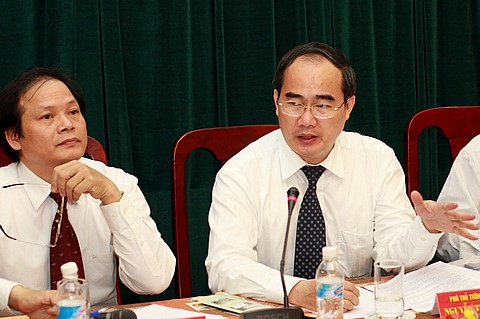
On the afternoon of September 23, 2008, a delegation led by Deputy Prime Minister and Minister of Education and Training Nguyen Thien Nhan visited and worked at the University of Social Sciences and Humanities (Vietnam National University, Hanoi).
[img class="caption" src="images/stories/2008/9/24/img_0658.jpg" border="0" alt="Deputy Prime Minister attends a class on Methodology of History" title="Deputy Prime Minister attends a class on Methodology of History" width="240" height="160" align="right" ]The delegation included Mr. Tran Quoc Toan - Deputy Head of the Government Office, Mr. Banh Tien Long - Permanent Deputy Minister of Education and Training, Mr. Le Dinh Tien - Deputy Minister of Science and Technology, along with representatives from the leadership of departments of the Ministry of Education and Training, the Ministry of Planning and Investment, the Ministry of Construction, the Ministry of Science and Technology, and the Government Office. Accompanying the delegation were Prof. Dr. Mai Trong Nhuan - Director of Vietnam National University, Hanoi, and representatives from the leadership of various departments and divisions of Vietnam National University, Hanoi.
The PTT delegation attended a class on Historical Methodology, visited the History Department – a heroic unit during the đổi mới (renovation) period, visited the Anthropology Museum, and the Broadcasting and Television Professional Center – Faculty of Journalism. Following this, the PTT delegation held an official working session with the school's leadership.
[img class="caption" src="images/stories/2008/9/24/img_0762.jpg" border="0" alt="PTT visits the Museum of Anthropology" title="PTT visits the Museum of Anthropology" width="180" height="269" align="left" ]At the meeting, Professor Nguyen Van Khanh, Rector and Party Secretary of the University, gave an overview of the tasks performed during the 2007-2008 academic year and the direction and tasks for the upcoming academic year. Besides the achievements, Professor Nguyen Van Khanh also frankly pointed out the major difficulties the university is currently facing, such as: a shortage of highly qualified leading experts; the current percentage of lecturers with doctoral degrees is only 33%, still low compared to the target of 60% in 2010; and difficulties in infrastructure and finances...
During discussions with the university's leadership, the delegation showed interest in and asked many questions related to specific issues in the social sciences and humanities: the biggest difficulties faced by students in social sciences and humanities during their studies and work; the employment rate of social sciences and humanities graduates; the issue of linking training and scientific research between faculties, departments, and centers of the university; the issue of orienting basic research in social sciences and humanities in general, as well as identifying research directions that are strengths and specialties of the university in the future; identifying key disciplines to focus on high-quality training; what are the necessary shifts in the university's training strategy to serve societal needs; and the measures the university will take to continue maintaining its outstanding achievements and traditions dating back to the time of Hanoi University...
Concluding the working session, Vice Prime Minister Nguyen Thien Nhan affirmed the school's significant contributions to the development of Vietnam's education system, particularly in the field of social sciences and humanities. Thirty-three years after reunification, this remains in the minds of Vietnamese people the cradle of social sciences and humanities, and the school's achievements and recognition are entirely deserved. In the overall development of the education sector, the Vice Prime Minister especially commended the school's efforts in adjusting its training direction and opening up new fields of study that meet the practical needs of society. To continue its strong development, the Vice Prime Minister also noted that the school should focus on implementing several key areas:
The firstIt is necessary to conduct specific and accurate research on the employment situation of the school's graduates. The opinions of alumni after a long period of exposure to real-world work will provide useful suggestions for the school to adjust its training to better suit the realities of society.
 MondayI agree with the Rector's opinion on promoting the teaching and learning of Sino-Vietnamese studies for students, especially those in the social sciences and humanities.
TuesdayRegarding the research and teaching of Vietnamese Studies, the University should clearly define its own development direction, aiming to become a leading international center for Vietnamese Studies. To achieve this, we must have a standardized roadmap for our staff, research directions, and proactive international integration. The University should also expand its engagement with Vietnamese Studies researchers in surrounding countries and regions, thereby broadening academic exchanges and enhancing its influence on this field globally.
WednesdayThis involves reviewing textbooks used in schools, paying attention to modernizing the curriculum to keep it up-to-date with global standards. Schools should also consider developing their own sets of textbooks, bearing the school's brand.
ThursdayTo become a strong research center in the social sciences and humanities, the university needs to define its main research directions and priorities, and in those directions, the university must be a reputable spokesperson.
Author:i333
Newer news
Older news

