
Time: Friday morning, May 22, 2026
Location: University of Social Sciences and Humanities, 336 Nguyen Trai Street, Thanh Xuan District, Hanoi
In recent years, the rapid development of artificial intelligence (AI), particularly large language models (LLMs) such as ChatGPT, Gemini, and Claude, as well as tools supporting research, data analysis, translation, and content creation, is creating profound changes in university research, teaching, and administration globally. AI is not only impacting the natural sciences and technology but is also fundamentally changing the social sciences and humanities – fields traditionally considered the center of critical thinking, social analysis, human studies, culture, and spiritual life.
In this context, many universities and research institutions around the world have begun integrating AI into academic activities such as: supporting document search and synthesis, qualitative and quantitative data analysis, research proposal development, learning material design, supporting international scientific paper writing, digital lecture development, as well as innovating teaching methods and student assessment. AI is gradually becoming a "new knowledge infrastructure" for higher education and scientific research.
For the social sciences and humanities, AI presents both significant opportunities and new challenges. On the one hand, AI enhances research efficiency, expands the capacity for processing big data, accelerates access to international knowledge, supports scientific publications, and promotes innovation in teaching. On the other hand, AI also raises important issues related to academic ethics, the authenticity of knowledge, fact-checking skills, copyright, plagiarism, data security, and the role of critical thinking in the digital academic environment.
In the context of Vietnam's higher education system promoting digital transformation, innovation, and international integration, faculty members in the social sciences and humanities need to be equipped with fundamental knowledge, application skills, and practical AI capabilities that are effective, responsible, and appropriate to the specific characteristics of these disciplines. However, in reality, access to and use of AI among faculty members is still uneven; many faculty members do not have access to new AI tools, are unfamiliar with methods for applying AI in research and teaching, or are still struggling to integrate AI into their daily academic work.
Arising from this practical need, the University of Social Sciences and Humanities, Vietnam National University, Hanoi (with the Journal of Social Sciences and Humanities as the professional coordinating body) is organizing a training program titled “Social Sciences and Humanities in the AI Era: Tools, Methods, and Practical Applications” to create a forum for academic exchange, update on new trends, and enhance the AI application capabilities of faculty members. The program aims to introduce tools and methods for application in research and teaching in social sciences and humanities, while also sharing practical experiences, real-world case studies, and skills in using AI effectively, creatively, and with academic responsibility in professional work.
Through this program, the University hopes to contribute to promoting digital transformation in training and scientific research activities; enhancing academic competitiveness, international publication capacity, and adaptability of the faculty in the social sciences and humanities in the context of current technological transformation and the digital society.
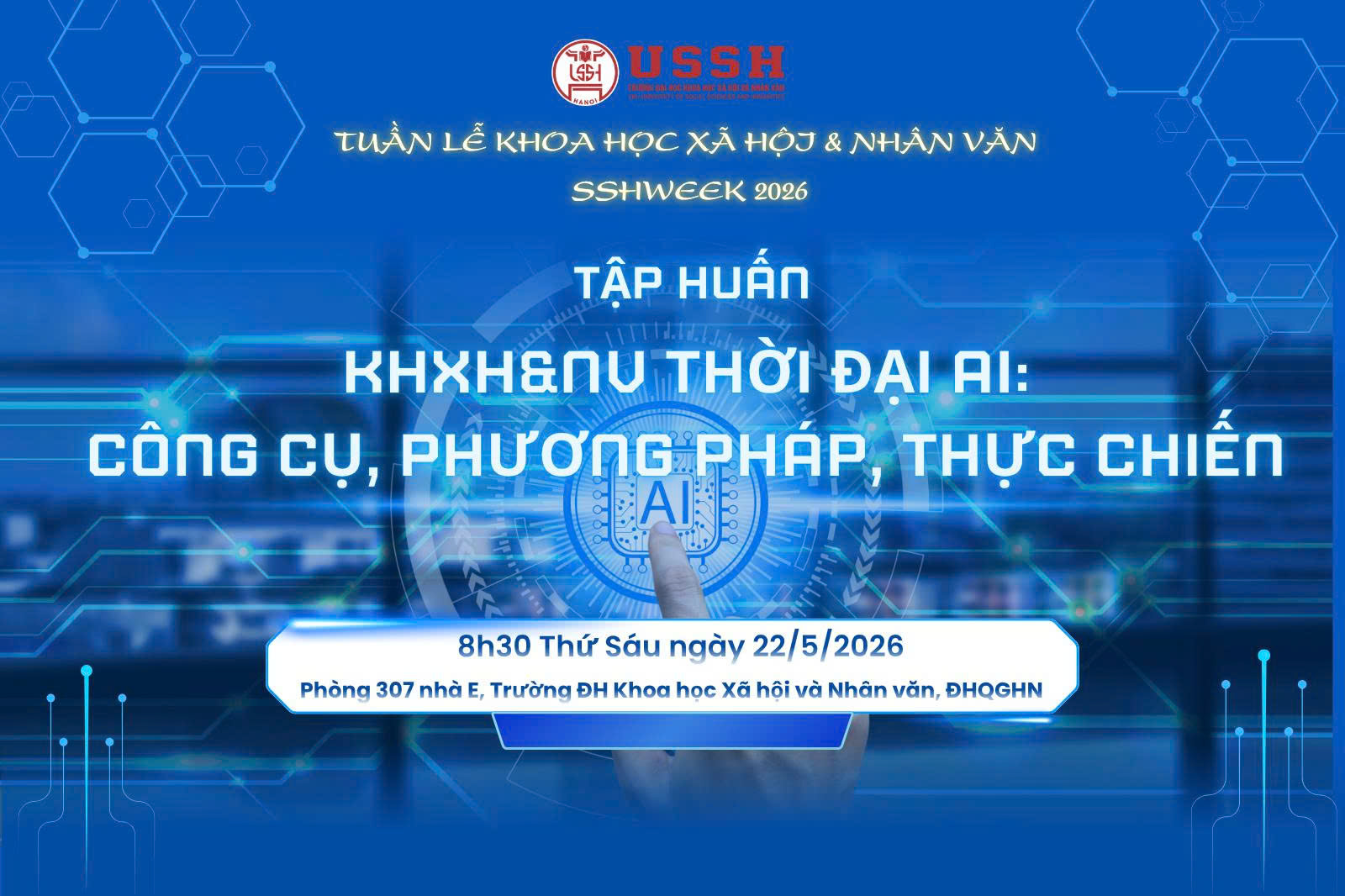
The training program "Social Sciences and Humanities in the AI Era: Tools, Methods, and Practical Application" is designed to combine knowledge updates, methodological guidance, and practical application of AI in research and international scientific publications in the field of social sciences and humanities. The specific content is as follows:
Content 1: AI and the transformations of social sciences and humanities
- An overview of artificial intelligence (AI) and emerging technology trends.
- The impact of AI on scientific research and academic publishing, opportunities and challenges for the social sciences and humanities.
- Academic ethics, intellectual authenticity, and issues related to the use of AI in research.
Content 2: Applying AI to research design
- Applying AI to generate ideas and identify research problems, develop research objectives, questions, and hypotheses.
- Applying AI in building theoretical frameworks and designing research.
- Practice using AI tools in research design.
Content 3: Applying AI to document review
- Applying AI in the synthesis, classification, and analysis of research documents.
- A guide to using AI to assist in writing document reviews.
- Practice creating document reviews using AI tools.
Content 4: Applying AI to data analysis
- Overview of AI applications in quantitative and qualitative research
- AI applications support data processing, data analysis, and data visualization.
- Practical application of AI in data processing and analysis.
Content 5: Applying AI to writing article drafts
- AI applications assist in structuring and refining scientific paper drafts, supporting editing, checking logical reasoning, and standardizing citations.
- AI assists in translation and improves the quality of manuscripts.
Content 7: Discussion and exchange of experiences
The discussion and experience-sharing session was organized to create an open academic forum for lecturers, researchers, and experts to share practical experiences in applying AI to research, teaching, and international scientific publications in the field of social sciences and humanities.
We cordially invite all delegates, scientists, lecturers, administrators, researchers, trainees, and students who are interested to attend!
Related information:
Scientific Workshop: Heritage Economics: From Theory to Policy and Sustainable Development Practice
Scientific seminar “From ecocriticism to ecocinema in Vietnam: Interdisciplinary approaches”
Scientific presentation "Approaching Vietnamese Studies from the Perspective of Buddhist Philosophy"
Author:Organizing Committee
Newer news
Older news

