
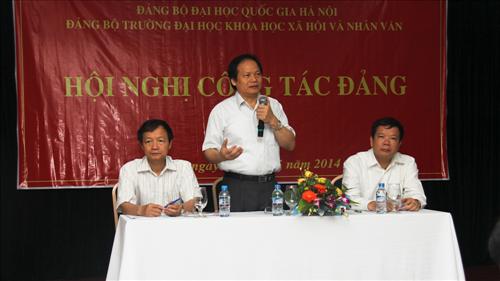
Attending the conference were Prof. Dr. Nguyen Huu Duc, Deputy Secretary of the Party Committee and Vice Director of VNU Hanoi; Prof. Dr. Nguyen Van Khanh, Secretary of the Party Committee and Rector of the University of Social Sciences and Humanities; along with representatives from the Party Committees of the branches, heads of units, and directors of centers.
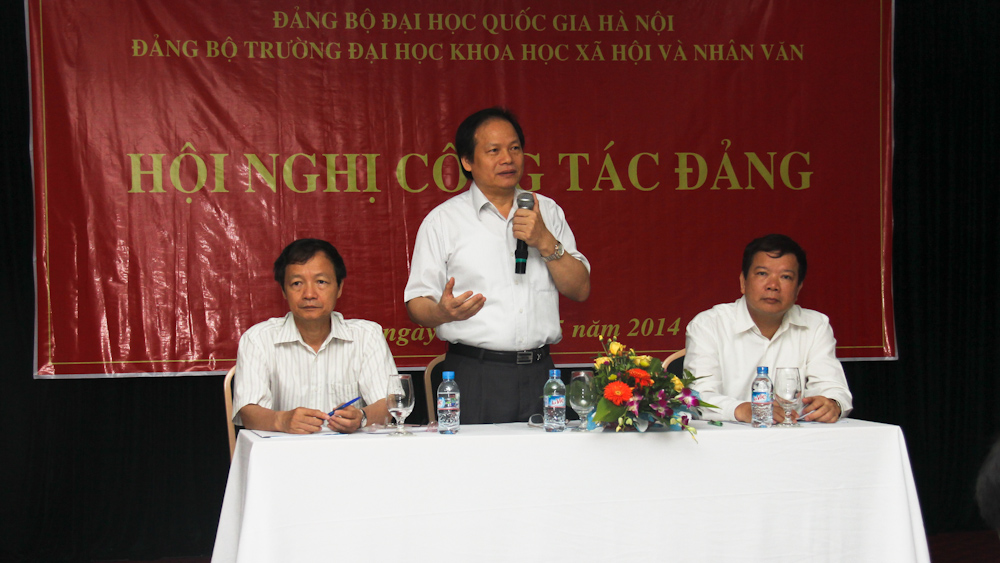
Professor Dr. Nguyen Van Khanh, Secretary of the Party Committee and Rector of the University of Social Sciences and Humanities, delivered a speech at the conference.
Following the report on Party work for the first five months of the year and the dissemination of Party work guidelines by the University Party Committee, presented by Professor Dr. Vu Duc Nghieu (Vice Rector), the delegates listened attentively and contributed many opinions to the draft action plan of the University Party Committee to implement Resolution No. 8 of the 11th Central Committee on fundamental and comprehensive educational reform, presented by Associate Professor Dr. Nguyen Van Kim (Vice Rector).
In implementing Resolution No. 8 of the 11th Plenum of the Central Committee of the Communist Party of Vietnam on "Fundamental and comprehensive reform of education and training to meet the requirements of industrialization and modernization in the context of a socialist-oriented market economy and international integration," the Party Committee of the University of Social Sciences and Humanities, Vietnam National University, Hanoi, has extensively studied and disseminated the content and spirit of the Resolution to all cadres, Party members, staff, and students of the University. Based on the action plans of the Party branches, the University Party Committee has developed a specific action plan and program.
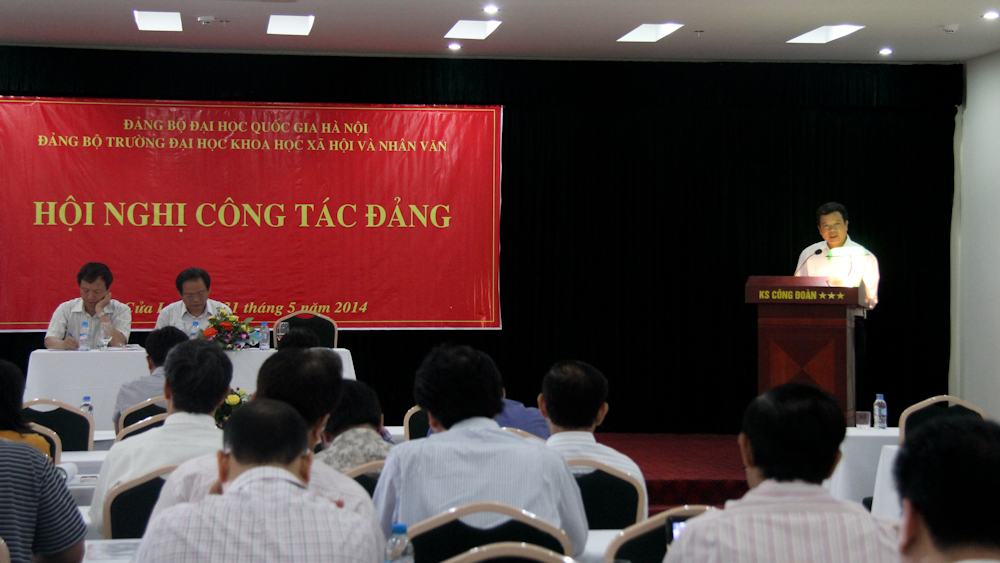
Associate Professor Dr. Nguyen Van Kim is presenting the draft action plan.
The objectives of the action program are:
- To train highly skilled human resources, nurture and attract talent; to comprehensively develop the abilities and qualities of learners.
- To promote the improvement of the quality of research, innovation, and policy consulting activities, practically serving the cause of national construction and defense.
- Innovate university management and governance methods towards modernization, promote deep regional and international integration, and create momentum towards building the University into a research university.
A summary of the direction and solutions for implementing the reform is as follows:
1. Regarding awareness, ideology, and guidance
- It is necessary to ensure that all cadres, Party members, and students clearly understand the purpose, requirements, and objectives of the action program, thereby unifying their understanding and actions to comprehensively reform all aspects of the school's work, creating a new phase of development for the school in the coming period.
- Transform awareness of innovation into values, beliefs, and movements promoting excellence in work, teaching, research, and learning among all faculty and students of the University.
2. Regarding training and quality assurance: Complete and continue to extensively implement the credit-based training model across all levels and training systems, specifically in the following areas:
- Based on the goals of educational and training reform, continue to clearly define and publicly disclose the objectives and learning outcomes for each educational level, subject, program, major, and specialization, considering them as a commitment to ensuring the quality of the entire system, and as a basis for monitoring and evaluating the quality of education and training.
- Successfully implemented the University's sectoral and specialized planning project for the period 2014-2020.
- Building and developing a learning materials system during the period 2014-2020.
- Innovate teaching and learning methods towards a modern approach, promoting the active participation, initiative, creativity, and ability to apply knowledge and skills of learners.
- Innovate the forms and methods of examinations, tests, and evaluation of educational and training results, ensuring honesty and objectivity.
- Conduct national and international assessments of training quality to serve as a basis for developing policies and solutions to improve the quality of training at the university. Consider societal acceptance of students and scientific products as an important criterion for evaluating the quality of training and research.
3. Scientific research activities
- Strengthening and improving the quality and effectiveness of scientific research and technology transfer, closely linking training and research, and connecting the university with state agencies, organizations, and businesses in society.
- Forming strong research groups and centers/institutes of excellence.
- Develop mechanisms to support and promote domestic and international publications, especially publications in prestigious international scientific journals.
- Develop a plan to transform the school into a research university.
4. Foreign affairs and regional and international integration
- Strengthen linkages and cooperation, and secure funding for training and research activities between the University and domestic and international agencies and organizations, making good use of social resources for the innovation and development of the University.
- Develop an international cooperation strategy focused on quality, expanding relationships with important and reputable partners to enhance the effectiveness of external relations and strengthen and expand the University's influence in the region and the world. Promote cooperative relationships and training partnerships, and actively propose participation in collaborative scientific research activities with domestic, regional, and international partners.
5. University administration, finance, and facilities.
- Promote autonomy and accountability to innovate management mechanisms, ensuring democracy, openness, and transparency.
- Implement a mechanism for learners and partners to participate in evaluating the training activities of the organization.
- Standardize the quality assurance conditions of training and research processes, focusing on output quality, and promoting the application of information technology in management.
- Manage and utilize facilities effectively for training and research.
6. Personnel organization
- Review the organizational structure, adjust or establish new unit models suitable for organizing and implementing tasks as required by the reform.
- Develop and implement plans for training, fostering, and attracting a team of highly qualified teachers, scientists, and leadership and management staff to meet the university's innovation requirements.
- Establish regulations for personnel management and conduct performance evaluations based on position requirements and work efficiency, encouraging and fostering a proactive, creative, responsible, and inclusive work environment.
Constructive feedback
The draft received many contributions and shared opinions from comrades at the conference. Professor Nguyen Huu Duc said: "Vietnam National University, Hanoi highly commends the Party Committee of the University of Social Sciences and Humanities; you have been very proactive in developing this important action program." However, for this draft to be implemented more effectively, the Party Committee of the University needs to identify the fundamental elements in the orientation of fundamental and comprehensive reform; otherwise, it will fall into the old path, the old way of thinking, and will not be able to develop rapidly. Comrade Nguyen Huu Duc shared some suggestions for the Party Committee of the University:
- We should focus on identifying new keywords, because without those keywords, we won't have a solid foundation or a comprehensive understanding.
- In terms of development orientation, development should be directed towards both broad scope and specific points. Comrade Nguyen Huu Duc shared: In reality, most research projects and scientific topics of Vietnam National University, Hanoi in general, and of the University of Social Sciences and Humanities in particular, still mainly focus on broad scope, while specific points, bright spots, and major areas still have many shortcomings and have not been fully exploited.
- We should focus on highly qualified staff, leading experts, and those at the forefront of their respective fields. We should prioritize and act quickly in rewarding and supporting this group of staff. These are the key engineers who will build the brand and reputation, propelling the university's position to greater heights and ensuring its sustainability.
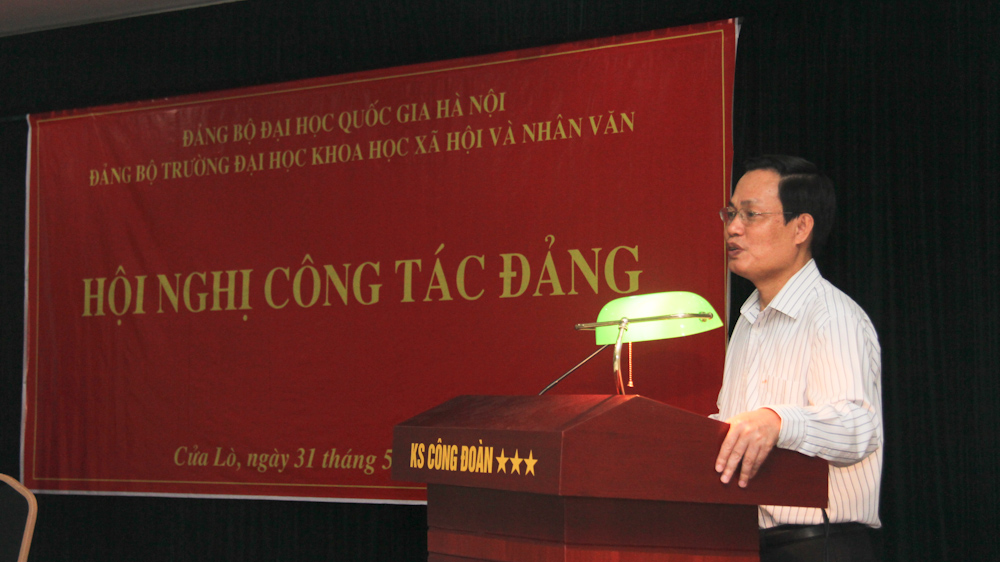
Professor Nguyen Huu Duc, Deputy Secretary of the Party Committee and Vice Director of Vietnam National University, Hanoi, delivered a speech at the conference.
Besides the comments and suggestions from the Vice Director of VNU, the draft also received many opinions from other participants at the conference. According to Associate Professor Dr. Doan Duc Phuong, Head of the Faculty of Literature, this draft action program should further emphasize political and ideological education, as ideological education currently has a significant impact on the socio-political development of the country, especially at this time. We must regularly educate lecturers, trainees, and students to understand their responsibility for the development of the University and the unit, and their individual responsibility for the development of society and the country.
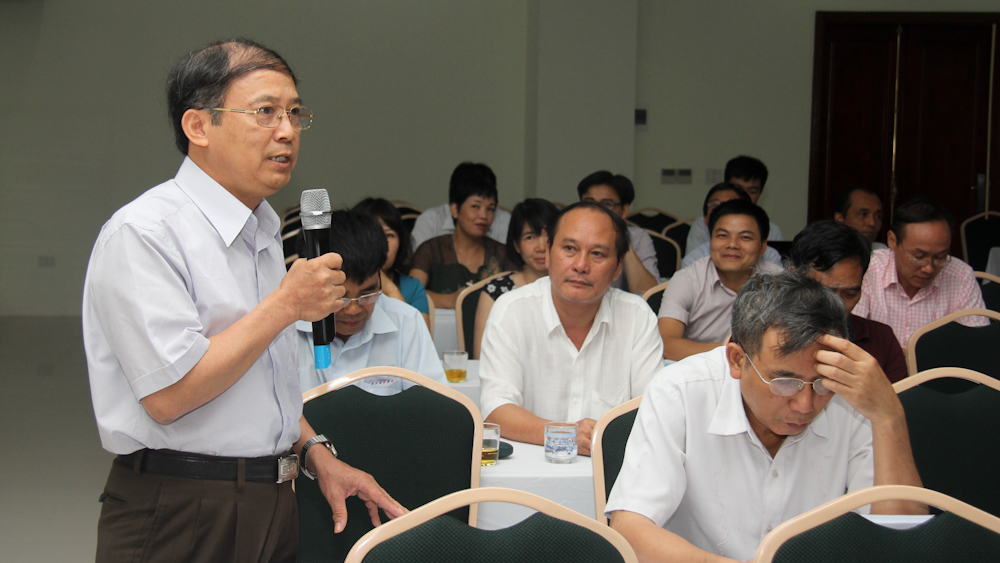
Associate Professor Dr. Doan Duc Phuong, Head of the Faculty of Literature, contributed his opinions on the draft action plan.
Agreeing with Comrade Doan Duc Phuong's opinion, Ms. Ngo Thi Kieu Oanh (Deputy Head of the Personnel and Organization Department) also shared: Among the objectives, we must prioritize political and ideological work. Because only with a thorough understanding of political and ideological work can other activities be carried out effectively.
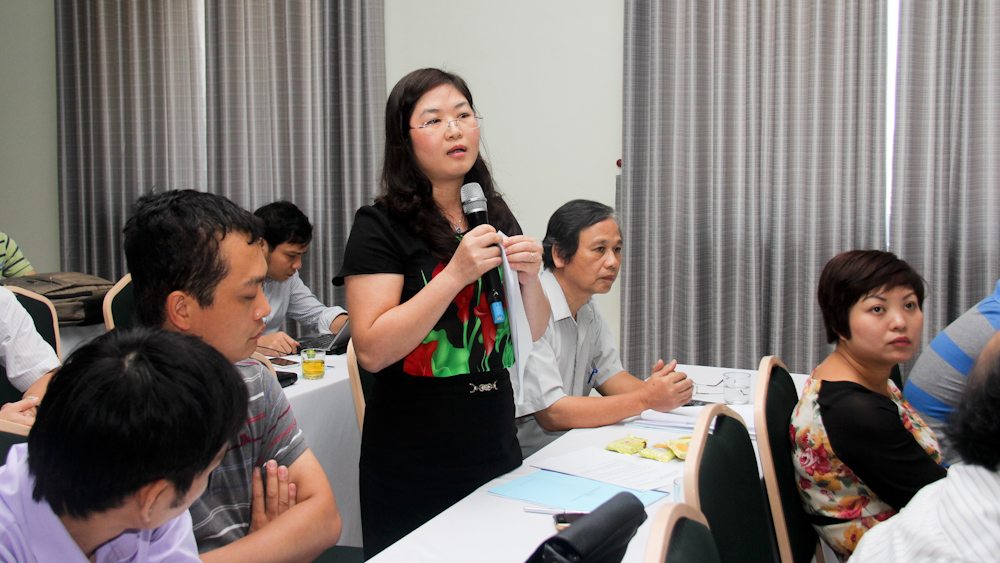
Ms. Ngo Thi Kieu Oanh contributed her opinions at the conference.
Comrade Ngo Kieu Oanh further shared: This draft action program requires us to have a strong qualitative and comprehensive transformation in all areas of the school's activities. Therefore, the content of this action program should, on the one hand, closely adhere to the spirit of the resolution, and on the other hand, we also need to closely follow the school's work areas.
On behalf of the conference chairman, Professor Dr. Nguyen Van Khanh, Secretary of the Party Committee and Rector of the University, concluded the conference: Based on the action program of the University's Party Committee, the Party branches will concretize and develop their own action programs, directing their units to implement them in the coming period, initially in the upcoming academic year and then over a longer period, 5 or 10 years.
In order to develop such a specific action plan, Party branches must answer the following questions:
- What are the goals of educational and training reform in general, or specifically the training and research activities of your unit?
- What should be innovated? What new content should be focused on?
- How should we innovate? And how can we innovate? Focus on solutions for implementing innovation.
Based on the roadmap we have outlined, after each school year we will evaluate what we have achieved and what we have not. Based on that, we will develop plans for the following school years. We should focus on building specific action programs, avoiding vague statements.
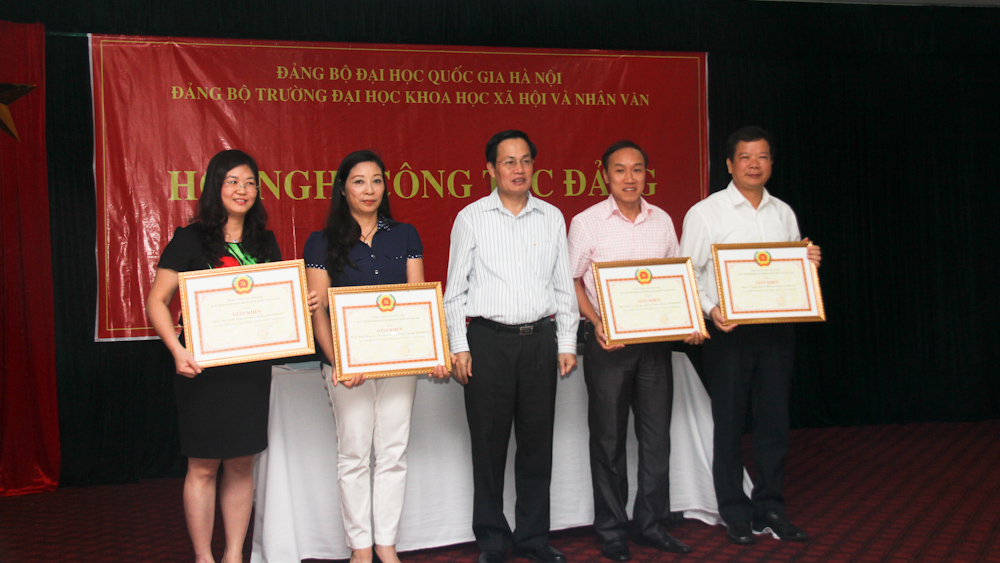
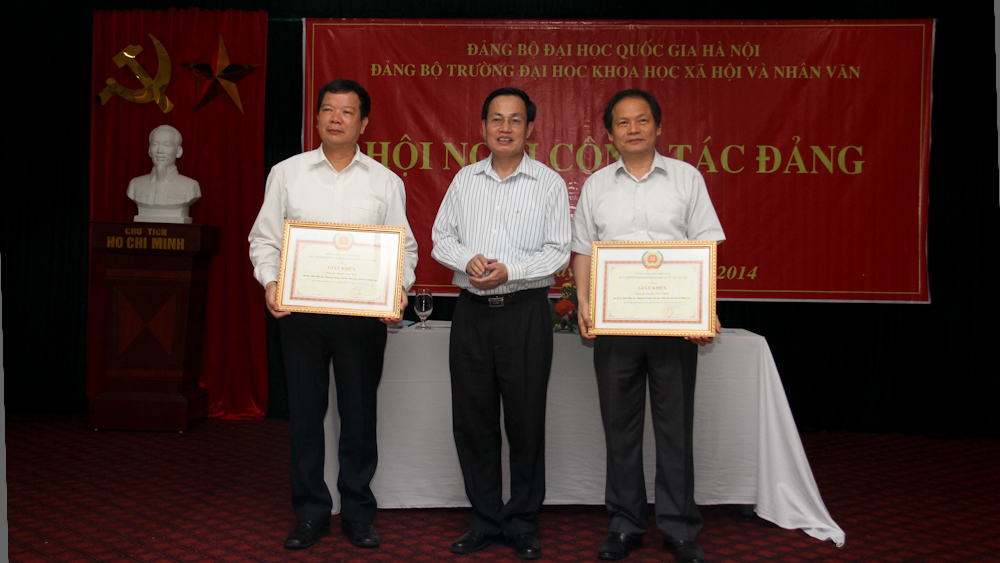
The conference also included the presentation of certificates of commendation from the Party Committee of Vietnam National University, Hanoi to collectives and individuals belonging to the Party Committee of the University of Social Sciences and Humanities.
Author:Dinh Hau
Newer news
Older news

